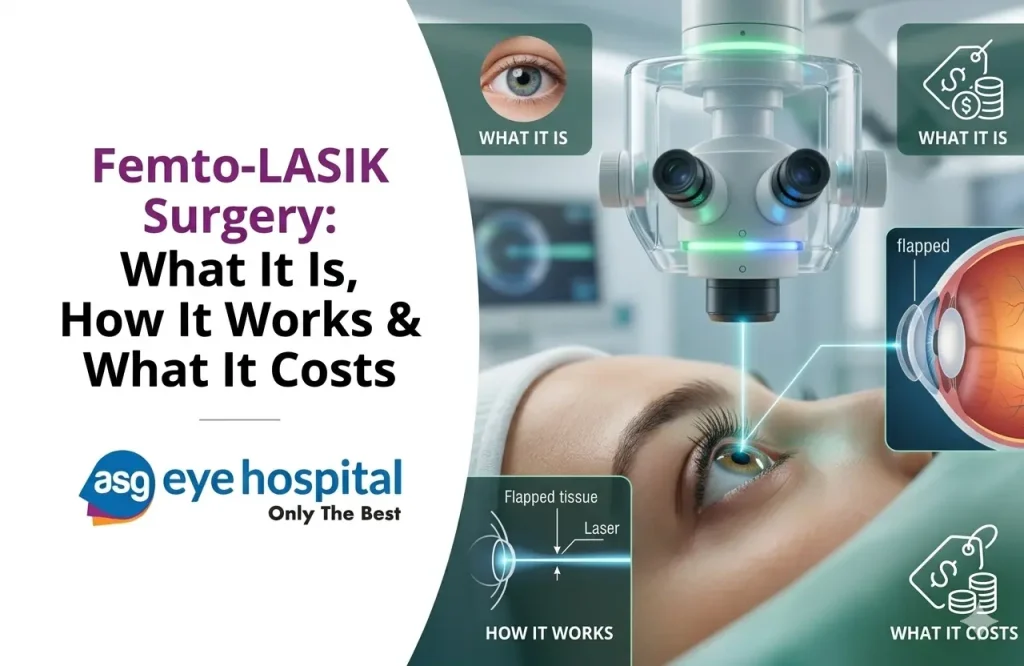
Refractive errors such as myopia, hyperopia, and astigmatism are among the most common causes of visual impairment. The development of laser technology has brought about major advancements in surgical correction techniques, which now include femto lasik surgery as a highly accurate and effective method. The article presents a clinically accurate overview of what femto Lasik is through its procedure description, safety assessment, and listing of advantages and cost factors.
What Is Femto LASIK?
The procedure requires people to understand what femto LASIK surgery involves before proceeding with it. Femto LASIK is an advanced form of laser-assisted refractive surgery that uses a femtosecond laser to create a corneal flap instead of a mechanical microkeratome blade used in conventional LASIK.
The bladeless technology improves surgical accuracy while decreasing operational variation and enhancing complete surgical results. The femtosecond laser operates at ultra-fast speeds, creating microscopic pulses that allow controlled and accurate corneal flap formation. The innovation establishes femto LASIK surgery as the preferred choice for contemporary eye care professionals.
How the Femto LASIK Procedure Works
The femto LASIK procedure requires outpatient treatment, which lasts for 15 to 20 minutes when both eyes undergo the procedure. The process includes these medical procedures and assessments:
Preoperative Assessment
The comprehensive eye examination includes corneal topography and pachymetry, and tests to determine refractive errors. The tests determine Who is eligible for femto Lasik because they need to verify their fitness for the procedure.
Corneal Flap Creation
A femtosecond laser creates a corneal flap that has uniform thickness throughout its structure. The procedure achieves high accuracy through its blade-free method of operation.
Laser Reshaping of Cornea
An excimer laser reshapes the underlying corneal tissue to correct refractive errors. The laser ablation procedure uses customized parameters derived from specific eye measurements.
Flap Repositioning
The corneal flap is repositioned without sutures. The natural process of adhesion enables quick recovery. The femto LASIK PROCEDURE delivers high patient satisfaction because it causes minimal discomfort while enabling most patients to regain their eyesight within 24 to 48 hours.
Femto LASIK vs LASIK
The comparison between femto LASIK and LASIK shows how technological advancements in medical treatment have developed refractive eye surgery. Traditional LASIK uses a mechanical blade for flap creation, while femto LASIK uses a femtosecond laser to create flaps. The precise measurement results of femto LASIK reach a higher level because it allows users to measure flap thickness and flap width with exact precision. The safety profile of femto LASIK shows a decreased likelihood of developing flap-related complications.
The two surgical techniques both successfully correct vision; however, femto LASIK provides results that are more reliable than the other two methods. The comparison between femto-LASIK and LASIK shows that femto-LASIK provides hospitals with a better surgical method to achieve accurate surgical results for their patients. The comparison between femto LASIK and LASIK shows that femto-LASIK provides hospitals with a better surgical method to achieve accurate surgical results for their patients.
Femto-LASIK Benefits
The clinical advantages of femto LASIK are well-established and include the following:
- Bladeless Technique: The procedure uses the bladeless technique, which removes the need for mechanical cutting, thus decreasing all surgical risks.
- Enhanced Precision: The accurate measurement of flap thicknesses. The surgical results will depend on this specific measurement.
- Reduced Complications: The treatment results in fewer instances of flap-related complications.
- Faster Recovery: Patients reach their functional vision state within a 1 to 2 day period.
- Improved Comfort: The procedure results in minimal discomfort during both the surgical process and the recovery period.
- These femto Lasik Benefots make the procedure suitable for patients seeking reliable and predictable refractive correction.
Who Is Eligible for Femto LASIK?
The process for assessing who can undergo femto LASIK requires an extensive evaluation of their ophthalmic condition. Ideal candidates typically include:
- Individuals aged 18 years or older
- Stable refractive error for at least one year
- Adequate corneal thickness
- Absence of active eye infections or diseases
- No history of severe dry eye syndrome
Patients who have keratoconus, uncontrolled diabetes, or autoimmune disorders cannot undergo the procedure. The assessment process will determine who can undergo femto LASIK while protecting their safety.
Is Femto LASIK Safe?
The majority of patients express their primary concern about whether femto LASIK is safe. Clinical evidence shows that femto LASIK maintains its safety and effectiveness when skilled ophthalmic surgeons execute the procedure.
The following factors contribute to improved safety:
- Computer-controlled laser precision
- Reduced dependence on manual instruments
- Lower risk of intraoperative complications
Dry eyes and glare, along with halos and under/over-correction, constitute potential risks, although complications remain uncommon. Most of these temporary conditions can be effectively treated. The question is, is femto LASIK safe? It requires scientists to perform personalized assessments that need to follow specific medical guidelines.
Recovery and Postoperative Care
Recovery following femto LASIK surgery is typically rapid. Patients are advised to follow strict postoperative guidelines:
- Use the prescribed antibiotic and lubricating eye drops
- Avoid rubbing the eyes
- Limit exposure to dust and screen strain
- Attend scheduled follow-up visits
Visual stabilization usually occurs within a few days, although minor fluctuations may persist temporarily.
Femto LASIK Cost
The femto LASIK cost depends on multiple clinical and institutional factors, which include the following elements:
- The Technology used
- The Surgeon expertise
- The Preoperative diagnostic tests
- The Postoperative care and follow-up
The femto LASIK COST in India typically ranges from ₹80,000 to ₹1,50,000 for treatment of both eyes. The total cost will increase when advanced customization and premium diagnostic systems are used. Patients must choose between quality and safety or spend less money, according to their advice.
Conclusion
Femto LASIK surgery introduces a major breakthrough to refractive eye care because it delivers better accuracy and safety with enhanced visual results than traditional methods. People need to learn about femto LASIK and its procedure, with related information about its cost and eligibility requirements, to make better decisions.
People who have refractive errors need to receive a complete eye examination, which will help determine their eligibility for femto LASIK treatment. People need to see an ophthalmologist without delay because this helps them receive better treatment plans with improved outcomes.
ASG Eye Hospital provides its advanced diagnostic and surgical services through its various locations, which include ASG Eye Hospital in Parel, Dadar, Jaipur, Jodhpur, Ahmedabad and Udaipur. Healthcare professionals can perform accurate diagnostic work because they have access to specialized ophthalmic knowledge, which enables them to deliver evidence-based treatments for refractive disorder patients.
The achievement of long-term visual clarity and eye health needs both early treatment and professional assessment.
Frequently Asked Questions
1. How long does a Femto LASIK operation last for both eyes?
Both eyes take an average of 15-20 minutes to perform, of which only a few minutes are spent applying the laser.
2. Does the Femto LASIK operation hurt or feel painful to the person having it done?
Typically, civilians will experience no pain during a femto LASIK operation because of the use of eye drops that cause numbing effects in their eyes, where the only sensations they might feel during surgery will be some light pressure.
3. When is a person’s vision going to improve following Femto LASIK surgery?
Generally, you can expect a person’s vision to return to pre-surgical levels somewhere between 24 hours (or less) and 48 hours (or more) after the procedure. Beyond that time frame, a person’s visual acuity will gradually begin to stabilize over the course of several weeks, as well as the ability for the individual to adapt fully to their new visual state.
4. What are the determining factors behind the costs associated with Femto LASIK surgery?
Factors such as technology used, surgeon’s experience, tests performed prior to surgery (diagnostic testing), and post-operative care will affect the total cost of femto LASIK surgery.
5. Will everyone who has vision problems qualify for Femto LASIK?
No. The patient’s medical care provider will ascertain if the patient qualifies for femto LASIK through a clinical assessment.