People between 40 and older experience common clinical problems with their near vision because of age-related vision changes. People develop presbyopia when their natural lens loses its ability to bend, which causes them to lose their ability to see nearby things.
Contact lenses as standard correction methods, but modern refractive surgical techniques now allow them to select PresbyLASIK as a surgical solution. Doctors need to understand what is PresbyLASIK because it helps them choose which patients will benefit from the treatment.
Understanding Presbyopia and Its Impact
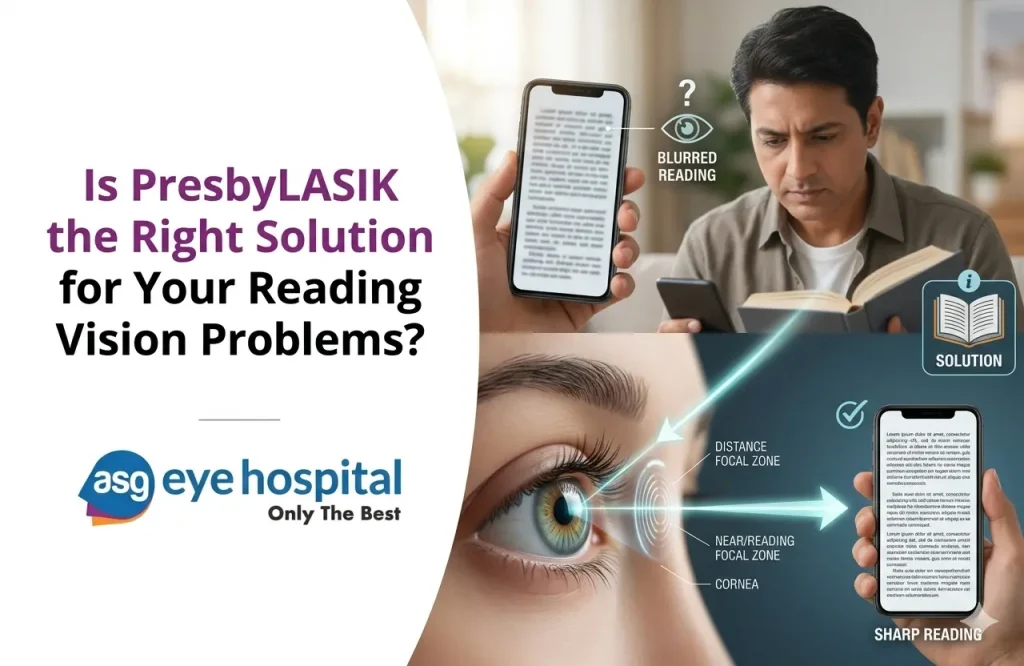
The condition of presbyopia exists as a natural physiological state which operates outside of medical disease boundaries. The condition develops because of age-related changes that affect both the crystalline lens and ciliary muscle functionality. Patients usually experience three main symptoms which include difficulties reading small text, eye strain, and the requirement to maintain distance from reading materials.
The standard treatment options consist of
- Reading glasses
- Bifocal or progressive lenses
- Multifocal contact lenses
The solutions available in this section fail to resolve the fundamental problems related to refractive errors. The surgical procedure PresbyLASIK treatment delivers a lasting solution through its ability to alter corneal optical properties.
What is PresbyLASIK?
What is PresbyLASIK refers to an advanced laser-based refractive procedure designed to correct presbyopia by reshaping the cornea. Unlike conventional LASIK, which corrects a single refractive error (myopia, hyperopia, or astigmatism), PresbyLASIK surgery creates a multifocal corneal surface.
This technique allows the eye to focus on both near and distant objects by:
- Creating multiple focal zones on the cornea
- Enhancing depth of focus
- Reducing dependency on reading glasses
Different approaches to PresbyLASIK treatment include central presbyLASIK (near vision correction at the corneal center) and peripheral presbyLASIK (near correction in the peripheral cornea), depending on patient suitability.
PresbyLASIK Benefits
The growing use of PresbyLASIK treatment results from its various clinical benefits. The primary advantages of PresbyLASIK treatment include:
- Reduced dependence on reading glasses
- Simultaneous correction of near and distance vision
- The procedure requires only minimal invasion and can be performed on an outpatient basis
- Most patients achieve fast visual recovery
- The system provides permanent visual stability
The main advantage of PresbyLASIK treatment benefits people who need to switch between watching distant and nearby objects throughout their work and daily routines.
Can PresbyLASIK Remove Reading Glasses?
The question whether PresbyLASIK can completely eliminate the need for reading glasses remains a common inquiry. The clinical results show that most patients experience a major decrease in their need for reading glasses after they complete the treatment.
The following points must be understood:
- Complete elimination of reading glasses is not guaranteed in all cases
- Outcomes depend on individual ocular parameters
- Mild near-vision correction may still be required in low-light conditions or prolonged reading
The surgical procedure known as PresbyLASIK will enable patients to achieve their desired results according to their expected outcomes. The upcoming surgery needs to explain both present outcomes and the future expected results.
Who is Eligible for PresbyLASIK?
The determination of who can receive PresbyLASIK treatment needs an entire eye examination process. The ideal candidates for this role must satisfy the following requirements:
- Individuals above 40 years with presbyopia
- Patients with stable refractive error
- Those with healthy corneal thickness and structure
- Individuals without significant ocular surface disease
Patients with conditions such as severe dry eye, corneal irregularities, or advanced cataracts may not be suitable candidates.
The evaluation protocols for determining PresbyLASIK eligibility requirements include these assessment methods:
- Corneal topography
- Wavefront analysis
- Tear film assessment
- Retinal examination
The selection process for patients requires appropriate methods because successful results depend on this stage.
Risks and Limitations
Although PresbyLASIK surgery is considered safe, it carries certain risks and limitations:
- Temporary visual disturbances such as glare or halos
- Reduced contrast sensitivity in some cases
- Need for enhancement procedures
- Adaptation period for binocular vision
Patients must be counseled regarding these factors prior to undergoing PresbyLASIK treatment.
PresbyLASIK Cost Considerations
PresbyLASIK cost varies based on several factors, including:
- Technology used (standard vs. customized laser systems)
- Surgeon expertise
- Hospital infrastructure
- Preoperative and postoperative care
In India, PresbyLASIK cost may differ across cities and healthcare facilities. While cost is an important consideration, clinical safety, surgeon experience, and technology should be prioritized over pricing alone.
Comparison with Other Treatment Options
Presbyopia management can be achieved through these alternative methods:
- Monovision LASIK
- Multifocal intraocular lenses (IOLs)
- Conductive keratoplasty
PresbyLASIK treatment provides a corneal-based solution that operates without requiring intraocular procedures. The decision about which procedure to use requires evaluation of both patient characteristics and medical evidence.
Clinical Evaluation and Preoperative Planning
Successful outcomes in PresbyLASIK surgery rely on detailed preoperative planning. This includes:
- Accurate refractive assessment
- Dominant eye determination
- Corneal mapping
- Patient expectation analysis
The process of selecting a procedure for PresbyLASIK requires understanding the treatment through the framework of individual patient visual requirements.
Conclusion
People who develop presbyopia will experience difficulty viewing objects that are nearby because of their advancing age. The surgical option of PresbyLASIK treatment enables people to achieve optimal vision because it corrects both their near and distance viewing needs. The advantages of PresbyLASIK treatment provide medical benefits to patients, but doctors must correctly choose their patients, while patients need to understand their treatment results.
Potential candidates for the procedure must complete an eye evaluation test, which will determine their eligibility for PresbyLASIK and assess whether the treatment will eliminate their need for reading glasses.
ASG Eye Hospital operates specialized assessment services at its locations, which include ASG Eye Hospital in Parel, Dadar, Jaipur, Jodhpur, Ahmedabad and Udaipur. Immediate medical assistance helps people because it enables doctors to make correct diagnoses, which leads to the development of suitable treatment plans that match their visual requirements.
Frequently Asked Questions
1. What are the main aims of PresbyLASIK?
The main aim of PresbyLASIK is to allow for better near and far vision by establishing a multifocal corneal topography, which will help the patient to be less reliant on reading glasses.
2. Will anyone with presbyopia be a candidate for PresbyLASIK?
No. PresbyLASIK will only be performed on selected patients who are deemed to be suitable based on their corneal health, stability, and other general eye health conditions.
3. What is the duration of recovery from PresbyLASIK?
Functional vision is typically restored within a few days following the PresbyLASIK procedure; however, complete visual adaptation following the procedure may take several weeks.
4. What is the cost of PresbyLASIK dependent on?
PresbyLASIK cost is dependent on the technology used, the surgeon’s experience, any diagnostic tests done on the patient before surgery, and the hospital’s level of services.
5. Will a patient no longer require reading glasses after PresbyLASIK?
Expectation is that patients who have received PresbyLASIK will no longer need to wear reading glasses; however, results will vary by patient, with some still having to wear very minimal near-vision correction in specific situations.