Refractive errors, which include myopia, hyperopia and astigmatism, affect a large portion of people and lead to major problems with their ability to see clearly throughout their daily activities. Laser vision correction procedures have become a widely accepted option for individuals seeking freedom from glasses or contact lenses. The effectiveness of these procedures varies according to several eye measurements, with corneal thickness serving as the primary assessment criterion.
Patients with thin corneas have restricted options when they want to undergo traditional laser vision correction treatments. The evaluation process requires detailed assessment and precise procedure selection to provide safe treatment with the best visual results. Patients and doctors can find the right treatment method by studying the available options of Refractive surgery for thin corneas.
Understanding Corneal Thickness and Its Role in Refractive Surgery
The cornea is the transparent, dome-shaped structure at the front of the eye that plays a critical role in focusing light onto the retina. Refractive surgery procedures reshape the cornea to correct refractive errors, which lead to better vision results.
Standard procedures for LASIK require surgeons to create a corneal flap, and they need to use an excimer laser to remove a small portion of corneal tissue. Patients with thinner corneas face higher complication risks because their corneal structure will become weaker due to excessive tissue removal, which will result in corneal ectasia.
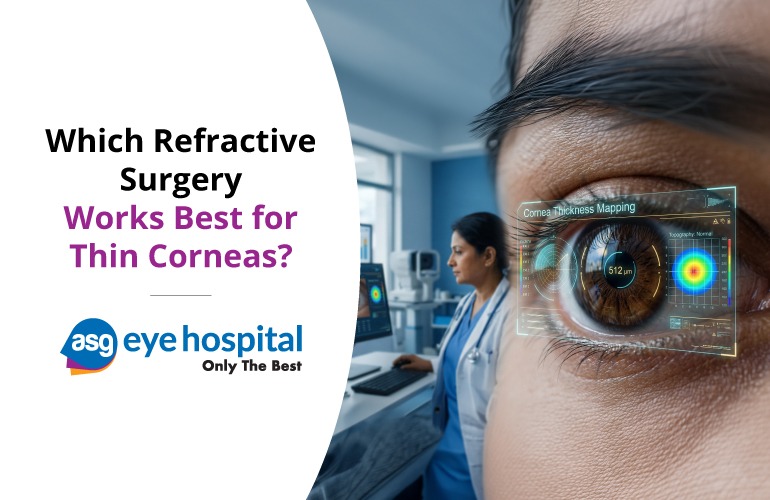
Ophthalmologists need to conduct preoperative evaluations, which require them to measure corneal thickness with pachymetry while they use corneal topography to assess corneal shape. The diagnostic tests help determine whether the patient meets the criteria for specific procedures, and they help choose the Refractive surgery for thin corneas.
One of the most frequently asked questions among patients is ‘Can you get LASIK with thin corneas?’ People with extremely thin corneas should not use conventional LASIK as their primary treatment option.
LASIK requires the creation of a corneal flap followed by laser reshaping of the underlying corneal tissue. The procedure removes part of the corneal thickness, which becomes dangerous for patients who already have thin corneas. The insufficient corneal thickness which remains after surgery will lead to problems with corneal stability.
However, eligibility depends on several factors, including:
- Total corneal thickness
- Degree of refractive error
- Corneal curvature
- Residual stromal bed thickness
If the cornea is borderline thin but other parameters are favourable, certain modified techniques or alternative procedures may be considered. In many cases, ophthalmologists recommend other forms of Refractive surgery for thin corneas that preserve more corneal tissue.
PRK as an Alternative for Thin Corneas
Photorefractive keratectomy (PRK) stands as one of the first laser eye correction methods that doctors recommend to treat patients who have corneal thickness below normal levels. PRK SMILE surgery for thin corneas proves to be a safer choice than LASIK for thin corneas because it eliminates the need to create a corneal flap. The process of PRK begins with the removal of the cornea’s outer epithelial layer and the excimer laser is used to reshape the corneal surface. The procedure preserves more corneal tissue because LASIK requires flap creation.
Key characteristics of PRK include:
- The treatment is appropriate for individuals who have corneas that are thinner than normal.
- The procedure does not require the creation of a corneal flap.
- The procedure results in a reduced chance of developing complications that are associated with flap surgery.
- The patient experiences visual improvement, which takes multiple days to reach complete recovery.
PRK serves as a valid substitute for LASIK because it has been proven effective for patients who need thin cornea treatment despite its longer visual recovery time.
SMILE Procedure and Thin Corneas
Small Incision Lenticule Extraction (SMILE) is a newer, minimally invasive laser vision correction technique that has gained attention for its tissue-preserving properties.
In SMILE surgery for thin corneas, a femtosecond laser creates a small lenticule within the cornea, which is removed through a tiny incision. The procedure requires no major corneal flap to be created, which distinguishes it from LASIK.
The procedure of SMILE surgery for thin corneas provides these advantages to patients:
- The procedure causes minimal changes to the normal functioning of corneal tissues.
- The procedure needs less tissue cutting than LASIK does.
- The procedure shows lower chances of dry eye symptoms for particular patients.
- The cornea achieves its complete structural stability at an accelerated pace.
The success of SMILE treatment depends on three main elements, which include corneal thickness, refractive error and the patient’s complete eye assessment. The procedure requires a detailed preoperative assessment because not all patients with thin corneas can undergo this treatment.
Implantable Collamer Lens (ICL) as a Non-Corneal Option
Ophthalmologists recommend Implantable Collamer Lens (ICL) implantation for patients who have corneas that are too thin to undergo laser-based treatments. The procedure places a biocompatible lens inside the eye while maintaining the original structure of the cornea.
ICL is often considered when determining the best laser eye surgery for thin corneas, particularly for individuals with high refractive errors or insufficient corneal thickness for laser reshaping.
The main characteristics of the ICL system include the following:
- The procedure does not require any corneal tissue to be removed.
- The procedure can be undone in multiple situations.
- The procedure provides effective treatment for patients with advanced myopia.
- The procedure maintains the body’s original corneal structure.
Because the cornea remains untouched, ICL serves as a highly effective alternative to LASIK for a thin cornea when laser procedures are not advisable.
Factors That Determine the Best Procedure
The selection of the best laser eye surgery for a thin cornea needs both time and expertise from an ophthalmologist who possesses sufficient professional expertise. The surgical planning process evaluates multiple components, which include the following:
- Corneal thickness and topography
- Stability of refractive error
- Presence of corneal irregularities
- Pupil size and ocular surface condition
- Age and general eye health
The selection between PRK, SMILE and ICL depends on the results of comprehensive diagnostic examinations. The study of PRK vs LASIK for thin corneas and the evaluation of SMILE surgery for thin corneas depend on each patient’s unique anatomical structure and eye correction needs.
Importance of Pre-Surgical Eye Evaluation
The process of conducting a complete eye examination before surgery becomes vital for evaluating safe treatment options that work for patients who have thin corneas. Advanced diagnostic tools help assess corneal thickness distribution, shape, and biomechanical stability.
These evaluations help ophthalmologists determine whether refractive surgery for thin corneas is feasible and which procedure offers the most favourable safety profile. The appropriate selection of patients helps to decrease surgical hazards while increasing their chances of achieving better visual results.
Patients should avoid making decisions based solely on procedure popularity. Instead, individualized assessment remains the most reliable method for selecting the appropriate alternative to LASIK for thin corneas.
Conclusion
Individuals with thin corneas still have eligibility for laser vision correction procedures. PRK, SMILE, and implantable lens technologies serve as advanced procedures that deliver safe and effective solutions for different eye conditions. The experienced ophthalmologist needs to conduct a thorough assessment to decide if the patient should undergo SMILE surgery for thin corneas or any other Refractive surgery for thin corneas.
Candidates for vision correction procedures must complete extensive diagnostic assessments to establish their eligibility and the safety of their planned surgeries.
ASG Eye Hospital maintains several locations across India to provide its specialised eye assessment services andeye surgery procedures. The ASG Eye Hospital facilities in cities like ASG Eye Hospital in Mumbai, ASG Eye Hospital in Delhi, ASG Eye Hospital in Chhattisgarh, ASG Eye Hospital in Jodhpur and ASG Eye Hospital in Lucknow provide patients with expert medical care through their professional assessment and treatment services.
The first assessment of patients needs to be done by certified eye doctors who will determine the appropriate treatment based on the patient’s corneal characteristics and their refractive needs.
Frequently Asked Questions
1. What is the definition of a thin cornea when it comes to surgery on the eye?
When evaluation is done to determine if an individual will need some type of surgery has to be done, the cornea may be considered too thin.
2. Are there any requirements to perform LASIK surgery on individuals who have thin corneas?
Whether or not LASIK can be performed on an individual depends on how thick their cornea is and how healthy their eyes are. If an individual is determined not to be a good candidate for LASIK, other types of surgeries that do not require the cornea to be as thick may be better suited.
3. Should I choose PRK instead of LASIK when I have a thin cornea?
Many individuals would choose PRK as they often feel that PRK surgeries allow for more of the cornea to be preserved as compared to LASIK surgeries.
4. Can SMILE be performed on individuals with thin corneas?
SMILE could potentially be done on an individual who has thin corneas, however they must be able to pass a complete eye exam first.
5. What are some alternatives to LASIK when you have a thin cornea?
Several types of surgery can be performed on an individual who has thin corneas and is unable to hold true to the requirements needed to perform LASIK. PRK and placement of an implant lens are some of these options depending on the patient’s overall eye health.