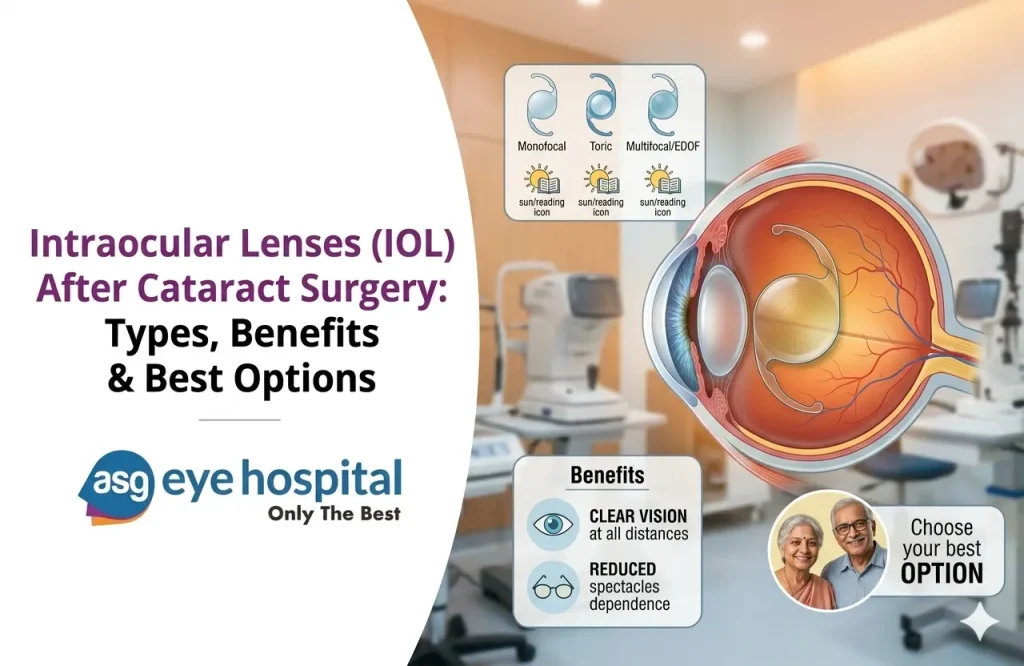
Cataract surgery not only removes the cloudy natural lens but also replaces it with an artificial lens called an Intraocular Lens (IOL). Choosing the right IOL is crucial because it directly impacts your vision quality and dependence on glasses after surgery.
At ASG Eye Hospital, advanced IOL options are available to match your lifestyle and visual needs—whether you want clear distance vision, reduced dependence on glasses, or improved screen vision.
What Are Intraocular Lenses (IOLs)?
Intraocular lenses are artificial lenses implanted inside the eye to replace the natural lens affected by cataracts. These lenses help restore clear vision and can also correct refractive errors like:
- Near-sightedness (myopia)
- Far-sightedness (hyperopia)
- Astigmatism
- Presbyopia (age-related reading difficulty)
Types of Intraocular Lenses
There are different types of IOLs, each designed for specific vision needs:
Monofocal IOL
This is the most commonly used lens.
Benefits:
- Clear vision at one distance (usually far)
- Reliable and cost-effective
Limitations:
- Reading glasses required
- No intermediate vision correction
👉 Best for: Patients comfortable using glasses for near work
Multifocal / Trifocal IOL
Designed to provide vision at multiple distances.
Benefits:
- Clear near, intermediate, and distance vision
- Reduced dependence on glasses
Limitations:
- Halos or glare at night
- Slight adaptation time
👉 Best for: People who want minimal dependence on glasses
Toric IOL
Specially designed for patients with astigmatism.
Benefits:
- Corrects astigmatism and cataract together
- Improved distance vision
Limitations:
- May still need glasses for near vision
👉 Best for: Patients with cylindrical power
Accommodating IOL
Works with eye muscles to adjust focus.
Benefits:
- Smooth transition between distances
- More natural vision
Limitations:
- Limited range compared to multifocal lenses
- Not suitable for all patients
👉 Best for: Active individuals needing flexible vision
EDOF (Extended Depth of Focus) IOL
Advanced technology lens for modern lifestyle needs.
Benefits:
- Clear distance and intermediate vision
- Less glare and halos
- Ideal for screen usage
Limitations:
- Reading glasses may still be required for small text
👉 Best for: Professionals using computers frequently
Monofocal vs Multifocal IOLs – Key Difference
| Feature | Monofocal | Multifocal |
|---|---|---|
| Vision Range | Single distance | Multiple distances |
| Glasses Dependency | High | Low |
| Cost | Lower | Higher |
| Night Vision | Better | Slight glare possible |
👉 Choose based on your lifestyle simple clarity vs glasses-free convenience.
How to Choose the Best IOL?
Selecting the right lens depends on:
- Your daily activities (reading, driving, screen time)
- Eye conditions (astigmatism, dry eye)
- Budget and insurance
- Willingness to use glasses
At ASG Eye Hospital, specialists guide you with advanced diagnostics to choose the most suitable lens.
Recovery After IOL Implantation
After cataract surgery:
- Vision improves within a few days
- Full recovery may take a few weeks
- Brain adapts to new lens (especially multifocal/EDOF)
✅ Aftercare Tips:
- Use prescribed eye drops
- Avoid rubbing eyes
- Attend follow-up visits
- Protect eyes from dust
Benefits of Intraocular Lenses
- Permanent vision correction
- Improved quality of life
- Reduced dependence on glasses
- Safe and long-lasting solution
Conclusion
Intraocular lenses provide personalized vision correction after cataract surgery. With options ranging from monofocal to advanced EDOF lenses, you can achieve clear and comfortable vision tailored to your lifestyle.
Consult experts at ASG Eye Hospital to choose the best IOL and experience life with clearer vision.
FAQs (Frequently Asked Questions)
1. What are intraocular lenses made of?
IOLs are made from biocompatible materials like acrylic or silicone, ensuring safety and durability.
2. Do intraocular lenses last forever?
Yes, most IOLs are designed to last a lifetime and do not require replacement.
3. Will I still need glasses after IOL surgery?
It depends on the lens type. Monofocal lenses require glasses, while multifocal lenses reduce dependency.
4. Are intraocular lenses safe?
Yes, IOL implantation is a safe and widely performed procedure.
5. How long does recovery take after cataract surgery?
Most patients recover within a few days, with full stabilization in a few weeks.
6. Can I choose my IOL type?
Yes, your doctor will guide you based on your eye condition and lifestyle needs.
7. Are premium lenses worth it?
Premium lenses like multifocal or EDOF offer better visual freedom but may cost more.
8. Can IOLs correct astigmatism?
Yes, toric IOLs are specially designed to correct astigmatism.
9. Do IOLs cause side effects?
Some patients may experience glare or halos initially, but it usually improves over time.
10. Which IOL is best for computer use?
EDOF lenses are ideal for intermediate vision and screen use.