Laser vision correction has transformed the way refractive errors are treated. For people with high myopia (severe nearsightedness) or astigmatism, a common question remains: Is LASIK safe and effective? At ASG Eye Hospital, advanced diagnostic tools and experienced eye specialists help determine whether LASIK is the right choice for your eyes.
What is High Myopia and Astigmatism?
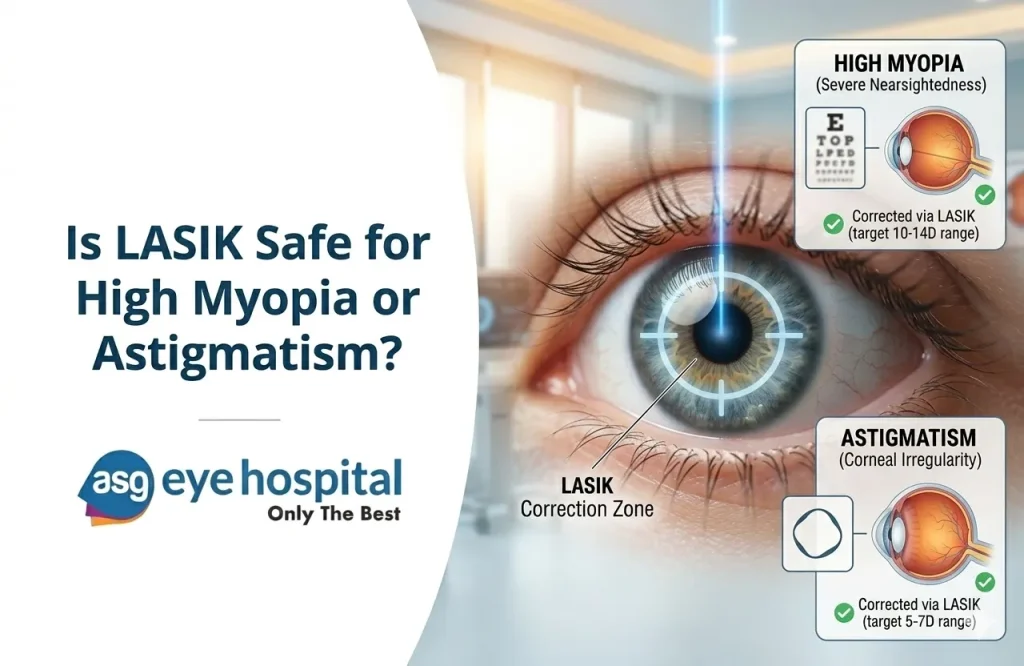
High myopia refers to a refractive error greater than -6.00 diopters, where distant objects appear blurred due to elongation of the eyeball. Astigmatism occurs when the cornea is irregularly shaped, leading to distorted or blurred vision at all distances. Patients with these conditions often rely heavily on glasses or contact lenses, making LASIK an attractive long-term solution.
How LASIK Works for High Power
LASIK surgery reshapes the cornea using a precise laser to correct refractive errors.
For higher prescriptions:
- More corneal tissue needs to be reshaped
- Detailed eye evaluation becomes critical
- Corneal thickness must be sufficient
At ASG Eye Hospital, advanced technologies like:
- Wavefront-guided LASIK
- Femtosecond laser
- Real-time eye tracking
ensure high precision and improved safety.
Is LASIK Safe for High Myopia?
Yes, LASIK can be safe and effective — but only for suitable candidates.
You may be eligible if:
- Corneal thickness is adequate
- Eye power is stable
- No underlying eye disease is present
- Proper pre-surgery evaluation is done
In such cases, LASIK can significantly reduce dependence on glasses.
When LASIK May Not Be Suitable
LASIK may not be recommended if:
- Cornea is too thin
- Myopia is extremely high
- Severe dry eyes are present
- Conditions like keratoconus exist
In such cases, alternatives like ICL (Implantable Lens) or surface procedures may be suggested.
Role of Epi-LASIK for High Myopia
For patients with thinner corneas, Epi-LASIK is a safer alternative.
Benefits:
- No deep corneal flap
- Reduced risk for thin corneas
- Effective for moderate to high myopia
Recovery may take slightly longer, but results are comparable.
Safety Considerations
Modern LASIK is safer than ever, but some factors still matter:
Corneal Thickness
Ensures structural safety of the eye
Risk of Regression
Slight chance in very high prescriptions
Dry Eyes
Temporary dryness post-surgery
Night Vision Issues
Mild glare or halos (reduced with new technology)
Benefits of LASIK for High Myopia & Astigmatism
- Reduced dependence on glasses
- Quick procedure (10–20 minutes)
- Fast recovery
- Long-lasting results
- Improved quality of life
Why Choose ASG Eye Hospital?
Choosing the right hospital is critical for successful outcomes.
At ASG Eye Hospital, you get:
- Experienced ophthalmologists
- Advanced LASIK technology
- Personalized treatment plans
- High success rate
Proper evaluation + expert care = safer and better results
Important Things to Know Before Surgery
- Not everyone is eligible for LASIK
- Detailed eye check-up is mandatory
- Results vary based on eye condition
- Alternatives may be safer in some cases
Conclusion
LASIK can be a safe and effective option for high myopia and astigmatism when performed on the right candidate. With advanced technology and expert guidance at ASG Eye Hospital, patients can achieve clear vision with confidence.
Always consult an experienced eye specialist to determine the best treatment for your eyes.
FAQs
1. Is LASIK safe for high myopia?
Yes, LASIK is safe if proper screening is done and corneal thickness is adequate.
2. Can astigmatism be corrected with LASIK?
Yes, LASIK effectively corrects most types of astigmatism.
3. What is the best alternative if LASIK is not suitable?
ICL or Epi-LASIK may be recommended depending on your eye condition.
4. Does LASIK give permanent results?
Results are long-lasting, but minor changes may occur over time.
5. How do I know if I am eligible?
A comprehensive eye examination by a specialist is required.