
There is a moment most glasses wearers recognise. The lenses fog the second you step into a warm room. The frame slides mid-workout. The scratch appears from nowhere and sits exactly where you look most. Contact lenses remove the frames but introduce their own routine, the daily insertion, the evening dryness, the low-grade unease of something resting on the eye all day. LASIK surgery for vision correction exists because both of these paths have real costs, and for many people those costs add up over the years.
Whether LASIK is the right solution depends on specific factors about your eyes, your prescription, and your lifestyle, not just on how tired you are of your glasses.
Is LASIK Better Than Glasses? The Honest Comparison
Whether LASIK is better than glasses depends on what bothers each person most. LASIK removes the need for any correction device. Once healed, there are no lenses to fog, break, lose, or clean. Vision is available the moment you open your eyes.
Glasses have the advantage of reversibility and simplicity. A prescription update means new lenses. Glasses carry no infection risk, no surgical risk, and no corneal contact. For someone who wears them comfortably with no strong motivation to change, they remain an adequate solution.
The honest answer is: LASIK is better than glasses for people whose glasses genuinely limit them, during sports, in humidity, in occupational settings where eyewear is impractical, or for high-prescription wearers dealing with optical distortion from thick lenses. It is not categorically better for everyone.
LASIK vs Contact Lenses: Where Lenses Fall Short
Contact lenses are a more discreet form of correction than glasses and eliminate the frame and distortion issues. But they come with a different set of limitations that prompt many wearers to consider LASIK:
- Daily insertion and removal is a discipline that lapses, sleeping in lenses, wearing them beyond the recommended duration, or wearing them while swimming significantly raises the risk of corneal infection
- Dry eye is the most common reason people give up contact lenses. End-of-day dryness and irritation are persistent problems for a large proportion of lens wearers, and they worsen with age and screen use
- Monthly lens cost, solutions, and cases add up. Over ten years, the cumulative cost typically exceeds the one-time cost of LASIK surgery in India
- Lens intolerance: Some people are simply unable to wear contact lenses comfortably due to corneal sensitivity, surface conditions, or dry eye
The LASIK vs contact lenses comparison often tips decisively for people who have already tried and struggled with lenses. If contact lenses are working well and the wearer is satisfied, LASIK is a preference rather than a solution to a problem.
Who Is Eligible for LASIK Surgery
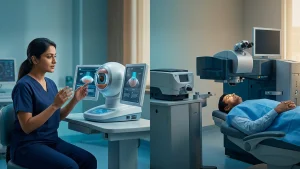
Eligibility is not simply a matter of prescription range. The pre-operative evaluation is comprehensive, and several factors determine suitability:
- Age 21 or over, with a stable prescription that has not changed significantly in at least one year
- Corneal thickness sufficient to allow safe ablation while maintaining an adequate residual stromal bed
- No keratoconus, corneal ectasia, or significant corneal irregularity on topography
- No severe dry eye, LASIK transiently worsens dryness in the post-operative period, and patients with significant pre-existing dry eye are not suitable candidates
- No active autoimmune or connective tissue conditions that affect corneal healing
- Refractive error within the treatable range (typically up to approximately −10 D of myopia, ±6 D of hyperopia, and up to 6 D of astigmatism, depending on corneal thickness)
People who are not eligible for standard LASIK may be candidates for surface ablation procedures such as PRK or SMILE, or for implantable collamer lenses (ICL) if the cornea is too thin or the prescription too high. The evaluation determines which option, if any, is appropriate.
If my prescription is very high, does that automatically disqualify me from LASIK?
Not automatically, but corneal thickness becomes the limiting factor. The higher the prescription, the more tissue must be removed, and there must be sufficient residual corneal thickness after ablation. A detailed pre-operative assessment, including pachymetry and topography, determines whether LASIK is safe at your prescription.
LASIK Eye Surgery Benefits: What Patients Actually Report
LASIK eye surgery benefits go beyond the headline of clear vision without glasses. According to the 2016 Modern LASIK Outcomes study, 99.5% of treated eyes achieve 20/40 or better, the standard required to drive without correction, and most achieve 20/20. Patient satisfaction in large outcome studies is consistently high.
The practical benefits patients report include full peripheral vision without frame edges, no fogging during exercise or in high humidity, freedom during sport without lens displacement, and reduced dependence on morning routine. For high-prescription wearers, eliminating image minification through thick lenses produces a visual quality that glasses cannot match.
Cost of LASIK Surgery in India: What Shapes the Price
The cost of LASIK surgery in India varies by laser platform, procedure type, facility, and surgeon. Bladeless all-laser LASIK using a femtosecond laser costs more than microkeratome-assisted. Wavefront-guided or topography-guided ablation adds to the base cost. SMILE carries its own pricing tier.
When comparing costs, the right comparison is like-for-like: same laser platform, same procedure type, and confirmation of what the quoted price includes, the pre-operative assessment, post-operative drops, and follow-up visits. A lower quoted price that excludes these elements is not cheaper in practice.
Final Thoughts: Is LASIK the Right Solution for You?
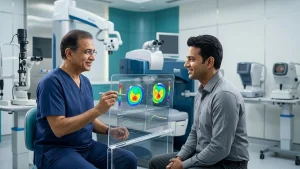
LASIK is the right solution for people who are genuinely bothered by glasses or lenses, meet the candidacy criteria, and have realistic expectations. It is not the right solution for everyone, and a good LASIK provider will say so plainly. The starting point is the evaluation, not the procedure.
ASG Eye Hospital, with centres in Mumbai, Delhi, Jodhpur, Udaipur, and more, offers comprehensive LASIK candidacy assessments, including corneal topography, pachymetry, and dry eye evaluation. Patients who are not suitable for LASIK are assessed for PRK, SMILE, or ICL alternatives at the same visit.
FAQs
1. Is LASIK better than glasses for everyone?
No. LASIK is better than glasses for people whose glasses genuinely limit them -due to sports, occupation, high prescription, or lifestyle. For people who wear glasses comfortably with no practical frustration, glasses remain a safe and adequate solution.
2. Who is eligible for LASIK surgery?
Adults 21 or over with a stable prescription for at least one year, adequate corneal thickness, no keratoconus, no severe dry eye, and no active autoimmune conditions. A comprehensive pre-operative assessment confirms eligibility for each individual.
3. What are the main LASIK eye surgery benefits?
Clear vision without glasses or lenses, full peripheral vision, freedom from fogging and frame limitations, the ability to play sports without optical dependence, and long-term cost efficiency over glasses and contact lenses combined.
4. How does LASIK vs contact lenses compare?
LASIK eliminates the daily insertion and removal routine, the dry eye burden, the infection risk, and the ongoing cost of lenses and solutions. Contact lenses remain reversible and carry no surgical risk. For lens wearers who are satisfied, LASIK is a preference. For those who struggle with lens wear, LASIK often provides a definitive solution.
5. What is the cost of LASIK surgery in India?
Cost varies by laser platform, procedure type, and facility. Bladeless femtosecond LASIK costs more than microkeratome-assisted. Always compare on like-for-like terms and confirm what is included -pre-operative assessment, drops, and follow-up visits should be part of any quoted price.