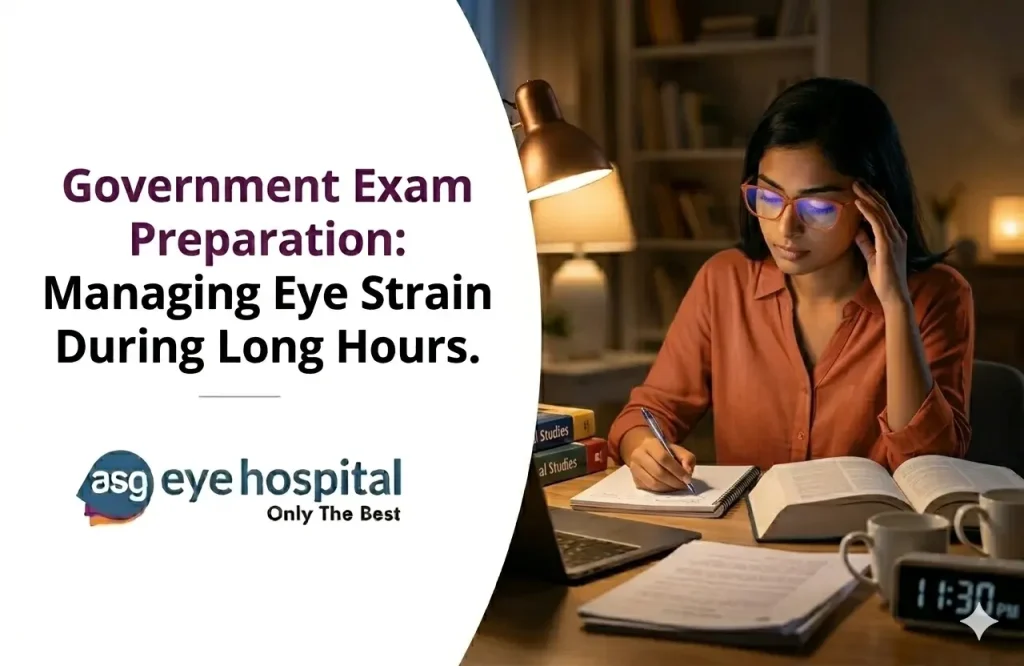
Lakhs of students appear for the competitive exams conducted by the Government of India every year like UPSC, SSC, Railway, Banking, State Level etc. The preparation requires 10 to 14 hours of study on a daily basis, much of which is done in front of books, laptops or mobile devices. What most aspirants never consider is how brutally this routine punches their eyes. According to specialists at ASG Eye Hospital, one of India’s most trusted eye care networks with over 3 crore eyes treated, digital eye fatigue during study has quietly become one of the biggest yet most ignored health risks among exam candidates.
How Can Government Exam Students Reduce Eye Strain During Long Study Hours?
Government exam students can reduce eye strain by following the 20-20-20 rule, maintaining proper room lighting, blinking frequently, adjusting screen brightness, staying hydrated, and taking short breaks every hour. Regular eye checkups also help detect hidden vision problems that affect concentration during exam preparation.
Why Government Exam Aspirants Lose Sight Before They Lose Focus
There is no such thing as a human eye that can withstand 12 hours of screen time. After a student spends an hour or six hours sitting in front of a PDF, he/she blinks less than 5-6 times a minute. This in turn will lead to dehydration of the cornea, contraction of the ciliary muscles and a screaming call for rest from the optic nerve. Doctors of various specialties at ASG Eye Hospital, which includes 700+ doctors trained at AIIMS, are seeing a significant number of young patients complaining of burning eyes, blurred vision and chronic headaches just prior to exam sessions.
This is exactly what happens during eye strain during exam preparation. The problem compounds because most students ignore early warning signs. A bit of dryness, a slight headache — they soldier on. However, the damage takes place gradually, and in some cases, it can cause permanent refractive changes or cause myopia to progress.
Common Eye Problems During Government Exam Preparation & Their Solutions
| Eye Problem | Common Cause | Quick Solution |
|---|---|---|
| Burning eyes | Reduced blinking | Blink consciously |
| Blurry vision | Long screen focus | Follow 20-20-20 rule |
| Headaches | Poor lighting | Improve room lighting |
| Dry eyes | Dehydration | Drink more water |
| Eye fatigue | Continuous study hours | Take short breaks |
| Light sensitivity | High screen brightness | Lower brightness |
Eye Care Tips for Government Exam Students That Actually Work
The positive is that safeguarding vision while studying hard doesn’t have to necessitate expensive gadgets or complicated regimens. Little and consistent actions have a huge impact.
First off, the 20-20-20 is not a rule to be played around with. Look at a 20 foot away object for 20 seconds every 20 minutes. It seems like the easy thing to do, but ophthalmologists swear by it. The ciliary muscles inside the eye need that micro-break to relax. Without it, they stay contracted for hours, mimicking the strain of actual near-vision work.
Second, the lighting is indeed crucial. Working under a low light source or under one overhead light makes the pupils work harder. ASG experts suggest having a lighted room, ambient light and a focused desk lamp that doesn’t reflect light on screens. Natural light – even in a window – greatly diminishes fatigue.
Third, screen distance and angle. The laptop computer must be at arm’s-length with the top of the screen at or below eye-level. Most students cradle phones inches from their faces during quick revisions — that habit alone accelerates digital eye fatigue during study faster than anything else.
How to Reduce Eye Strain While Preparing for Exams Without Losing Study Time
Here’s where most eye care tips for government exam students fall short — they assume students have time for elaborate eye exercises. The reality is different. A UPSC aspirant who is in between the prelims and mains, simply does not have 30 minutes to warm up the hands and do palmistry exercises.
So what works in the trenches? Blink consciously. Seriously. Set a phone reminder every hour that says “blink.” It sounds ridiculous, but forced blinking rewets the cornea and resets the tear film. Cold water splashing on closed eyes for 10 seconds between study sessions also helps — it stimulates blood flow and eases muscle tension around the eyes.
Hydration plays a role too. Dehydrated bodies produce fewer tears. Students who skip water and survive on chai and instant noodles are essentially starving their eyes of moisture. Drinking 2-3 liters daily isn’t just good for the brain — it directly supports study long hours eye care.
When to See a Specialist Before the Exam D-Day
No amount of home care replaces a professional checkup. ASG Eye Hospital recommends that every serious aspirant get a comprehensive eye exam at least once during their preparation phase. Things like undiagnosed astigmatism, latent squint, or early dry eye syndrome can slash concentration and reading speed — exactly what a student cannot afford months before the exam.
The network of 180+ hospitals across 95+ cities makes it accessible even for students in Tier 2 and Tier 3 towns where coaching centers are packed but eye clinics are not. Booking an appointment takes minutes online, and a basic refraction test costs far less than a single coaching module.
The Bottom Line: Eyes Are the Real Exam Equipment
Every government exam tests knowledge, patience, and stamina. But none of that matters if the eyes give out in the last lap. Study long hours eye care isn’t optional luxury — it’s strategic preparation. The students who crack tough exams aren’t just the ones who studied the most. They’re the ones who protected the one organ they literally cannot function without.
Treat the eyes the same way a topper treats revision — with discipline, consistency, and zero shortcuts. Because in the end, clear vision isn’t just about seeing the question paper. It’s about seeing the future clearly and it can happen only if you reduce eye strain while preparing for exams.
FAQ Section
1. Why do government exam students experience eye strain?
Long hours of reading, screen exposure, reduced blinking, and poor lighting cause eye muscles to become fatigued, leading to eye strain during exam preparation.
2. What is the best way to reduce digital eye fatigue during study?
The best methods include the 20-20-20 rule, proper lighting, screen distance correction, frequent blinking, hydration, and limiting continuous screen time.
3. Can studying for UPSC or SSC affect eyesight permanently?
Continuous eye strain may worsen myopia progression or dry eye symptoms if ignored for long periods, especially during intense preparation phases.
4. How many hours of screen time are safe for students?
There is no fixed safe limit, but students should take short breaks every 20–30 minutes and avoid nonstop screen exposure for several hours.
5. Why do eyes become dry while studying?
Students blink less frequently while concentrating on screens or books, causing tear evaporation and dryness.
6. Should government exam aspirants get regular eye checkups?
Yes. Routine eye exams help detect refractive errors, dry eye syndrome, or astigmatism that can affect focus and reading performance.