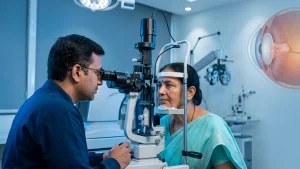
A pterygium which is a raised wing shaped growth of conjunctival tissue that may grow over the white of the eye into the cornea. It is related to exposure to ultraviolet light, wind, dust and dry environments. A small pterygium may cause no issues but a large one may cause redness, irritation, a foreign body sensation in the eye, blurred vision or changes in the corneal shape. Surgery is recommended when the growth affects vision, continues to get larger, causes persistent discomfort or creates a large cosmetic issue.
The process is just a stop along the road. Pterygium Surgery Recovery goes as the eye and graft adjust. Redness, watering and grittiness may still be present even if healing is normal. In doing Pterygium Surgery Aftercare, the likely Pterygium Healing Time and the stages of Pterygium Recovery which you will go through may reduce your uncertainty.
What Happens During Pterygium Surgery?
Ophthalmologists which remove abnormal tissue from the cornea and sclera in many procedures take a thin piece of healthy conjunctiva from another part of the same eye and put it over the affected area. The graft is held in with tissue glue, the patient’s blood or absorbable sutures. For pterygium surgery we perform the procedure as day surgery under local anesthetic but the approach is tailored to the eye in question.
Because the eye is in the process of repairing itself post surgery, Pterygium surgery recovery is a slow process. May see improvement in comfort within a few days’ time but redness may still be present which does not mean it is fully healed.
The First 24 to 48 Hours of Pterygium Surgery Recovery
After surgery the eye is to be covered with a pad or protective shield. Some centers report to have patients in for the night or for a full 24 hours’ period which is about a day, while the operating doctor may present a different schedule. That personal advice should be followed.
As it is coming out of anesthesia you may experience soreness, watering, light sensitivity, temporary blur and a scratchy sensation. It may also feel like a eyelash has got in your eye, or there’s a grain of sand present. NHS states that pain may continue up a 10 days in some, while that grittiness will stick around from 10 20 days for some people.
Early aftercare for Pterygium surgery typically includes protection of the eye, use of prescribed medications and avoidance of rub. Vision may change due to watering, ointment application, swelling or an uneven healing which may present. Also it is noted by one NHS post op guide that blur may persist up to six weeks. A sudden or progressive drop in sight is not a typical course in Pterygium Recovery and should be reported to your health care provider immediately.
Pterygium Healing Time: A Practical Timeline
No two eyes heal in the same way. Size of growth, surgical approach, use of sutures or glue, state of the eye surface, work environment and patient’s adherence to medication may all play a role in Pterygium healing time. The table which follows is a general guide to Pterygium healing time at best it is not a guarantee.
| Period | What may be noticed | Main focus |
| First 1–2 days | Soreness, watering, light sensitivity, blur and a foreign-body feeling | Rest, protect the eye and begin Pterygium Surgery Aftercare exactly as instructed |
| Days 3–7 | Discomfort often starts easing, although redness remains obvious | Continue drops, avoid rubbing and stay away from dust |
| Weeks 2–4 | Comfort usually improves, but the graft and redness may still be visible | Attend reviews and follow the prescribed drop-tapering plan |
| Weeks 4–6 | Vision and surface comfort may become steadier | Increase activity only as advised during Pterygium Recovery |
| Up to 3 months | Residual redness may gradually fade | Maintain UV, wind and dust protection |
Published in the NHS are wide range of possibilities. Redness may improve in 2 to 3 weeks, may last 6 to 12 weeks or in some cases up to three months’ time before resolution. These variations which we see is what puts forward the fact that Pterygium Surgery Recovery should be a clinical review issue and that Pterygium Healing Time is very personal to each individual.
Why the Eye May Look Worse During Pterygium Surgery Recovery
The white of the eye may appear very red, and the graft at first may be raised or swollen. During Pterygium healing time what is important is that the pain is going down and vision is stable. If there is increasing pain, redness with discharge or vision which is getting worse then you should have an urgent assessment.
Eye Drops and Pterygium Surgery Recovery Medicines During Pterygium Surgery Aftercare
Antibiotics and steroids in the form of eye drops are used to treat patients post pterygium surgery. The former is for reducing risk of infection, the latter for inflammation. Health service information reports a few weeks of treatment is routine but it is also true that the dose and tapering schedule will differ. As always with these drops they should not be stopped, extended, or restarted out of the ophthalmologist’s care.
Clean technique is key to Pterygium surgery recovery. Before using the eye drops wash your hands, do not put the bottle tip near the eye and follow the advised intervals between each dose. In case of missed doses or adverse reactions ask the hospital staff before you double up on the medication.
Lubricating drops will be prescribed if dryness persists after Pterygium recovery. Only what the ophthalmologist prescribes should be used. Also out of question are leftover antibiotics, steroids or redness relievers as they can mask symptoms or present an unneeded risk.
Everyday Pterygium Surgery Aftercare at Home
Protect of the graft from rub and pressure as well as from contaminated water and dust is key to Pterygium Surgery Recovery. At Leeds Teaching Hospitals we are told that for at least a week to avoid rub or pressure and to use a night shield if instructed. Also they say to avoid strenuous activity for two weeks and swimming for four weeks. Another NHS center says to avoid swimming for two weeks. Thus the main timetable for Pterygium Surgery Aftercare will be what your surgeon gives out.
The face may be cleansed but do not use soap, shampoo or direct water on the operated eye for the time being. If the eyelids stick together report that the NHS says to clean them with cooled boiled water after you wash your hands.
| Activity | General guidance | Reason |
| Rubbing the eye | Avoid until cleared by the surgeon | Protects the graft and healing surface |
| Driving | Resume only after professional clearance and adequate vision | Blur and light sensitivity can affect safety |
| Screen use | Use for comfortable periods and take breaks | Prolonged viewing may increase dryness or irritation |
| Exercise | Avoid heavy lifting, bending and strenuous exercise initially | Limits sweat, pressure and accidental trauma |
| Eye makeup | Wait for the period advised; one NHS guide recommends one week | Reduces contamination and rubbing |
| Swimming | Wait for clearance; NHS guidance ranges from two to four weeks | Water exposure can increase infection risk |
| Outdoor work | Use wraparound UV-protective glasses and dust protection | Reduces environmental irritation |
This approach supports healing without complete bed rest. Reading and television are generally acceptable if comfortable.
Work, Driving and Pterygium Surgery Recovery During Pterygium Recovery
The time back to work varies by what the job is. A person that works at a desk in a clean indoor environment may get back to work sooner than a farmer, construction worker, driver or someone that is exposed to dust, wind, smoke or chemicals. NHS guidance is that some may return in a few days and others may need to be away for a week or 2 depending on how the person is doing and what they do.
Driving may resume only when pain has improved. Also the patient must have good enough vision, be able to handle light and judge distance well. The ophthalmologist’s say it is important that the eye which had the operation is not still blurred.
A gradual return to routine supports Pterygium Healing Time. Symptoms that become stronger each day should be reported.
Supporting Long-Term Pterygium Surgery Recovery and Pterygium Recovery
The most useful habits are straightforward: Use proper medications, keep follow up visits, do not touch the eye, stay away from dusty or smoky environments and wear sunglasses when outdoors. The National Eye Institute and MedlinePlus also report that for pterygium which is a growth of tissue which may develop on the eye’s surface you should wear sunglasses and a brimmed hat to reduce ultraviolet exposure. Also after your surgery which may be done to remove this growth, it is important to follow these tips as environmental exposure will still play a role in the health of your eye.
Follow up exams are a key part of Pterygium Surgery Aftercare and structured Pterygium Surgery Recovery. The doctor may check graft placement, inflammation, eye pressure, surface healing and vision. Appointments are to be kept as per that which is given at discharge even when the eye feels better.
No diet or supplement can replace prescribed treatment. Patients with diabetes, dry eye or another ocular-surface condition should ask whether extra monitoring is needed.
Warning Signs During Pterygium Surgery Recovery
Some degree of discomfort is to be expected but at home do not note severe or rapid onset of symptoms. For ophthalmic attention if vision does go, pain is very bad or does not improve with what is recommended, you see discharge, redness or that light sensitivity increases instead of going down. These are signs which may indicate infection, over inflammation or some other issue that will require a professional evaluation. Pterygium has a tendency to come back after surgery. UHS reports that we see it in about 1 out of 10 cases and it usually is within the first year that we notice a recurrence though your personal risk may vary. A reappearing flesh growth, persistent irritation or steady redness should be checked out.
Realistic Expectations During Pterygium Surgery Recovery
Recovery photographs can be misleading because techniques, growth size, and eye-surface health do not match. A realistic view of Pterygium Surgery Recovery separates comfort from cosmetic settling: pain may ease first, vision may stabilize next, and redness may fade last.
Pterygium Treatment at ASG Eye Hospital
ASG Eye Hospital reports on pterygium which we treat via a variety of options that may include surgical removal and conjunctival autografting as is clinical appropriate. What we do in each case is base our decision on symptoms, growth degree, corneal impact and what we find during the eye exam.
Before surgery patients may go over the technique, anaesthesia, expected timeline, medicine regimen and personalized Pterygium Surgery Aftercare. We see this as very beneficial for outdoor workers during Pterygium Surgery Recovery.
Frequently Asked Questions
1. How long does Pterygium Surgery Recovery usually take?
Soreness usually improves in a few days to a week. Many people get back to their routine within one to two weeks but redness, temporary blur and full cosmetic recovery may take several weeks to a few months.
2. What is the normal Pterygium Healing Time for redness?
Redness will see a great improvement within 2 to 4 weeks but may persist up to 12 weeks and at times for as long as 3 months. As a trend note Pterygium Healing Time is towards improvement.
3. Is pain normal during Pterygium Recovery?
Mild to moderate soreness, grittiness and light sensitivity are common early on. Severe, worsening or persistent pain should be reported promptly.
4. What should be avoided during Pterygium Surgery Aftercare?
Rub of the skin, pressure, dust, in that time also avoid strenuous activity which is not approved by your doctor, eye make up during the restricted period and swimming before you are cleared should be had out. The primary guide for discharge instructions is the treating surgeon.
5. When can the face be washed?
The face may be cleaned as usual but do not use soap, shampoo or direct water on the operated eye as the surgeon will specify. During the Pterygium Healing period do not wipe or put pressure on the eye.
6. When can driving restart?
Driving can restart only when vision has settled sufficiently and the eye-care professional confirms that it is safe. Temporary blur and light sensitivity may delay driving even after discomfort improves.
7. Can pterygium return after surgery?
Yes. Recurrence is possible. One NHS guide reports a rate of about one in ten cases, most commonly within the first year. UV protection, prescribed treatment and review appointments remain important during Pterygium Recovery.
8. How can Pterygium Surgery Recovery be made more comfortable?
Using your drops as prescribed, wearing the which we recommend shields, away from rub and protection from sun and dust, and in to see us if symptoms persist we can see to a better outcome for Pterygium Recovery.