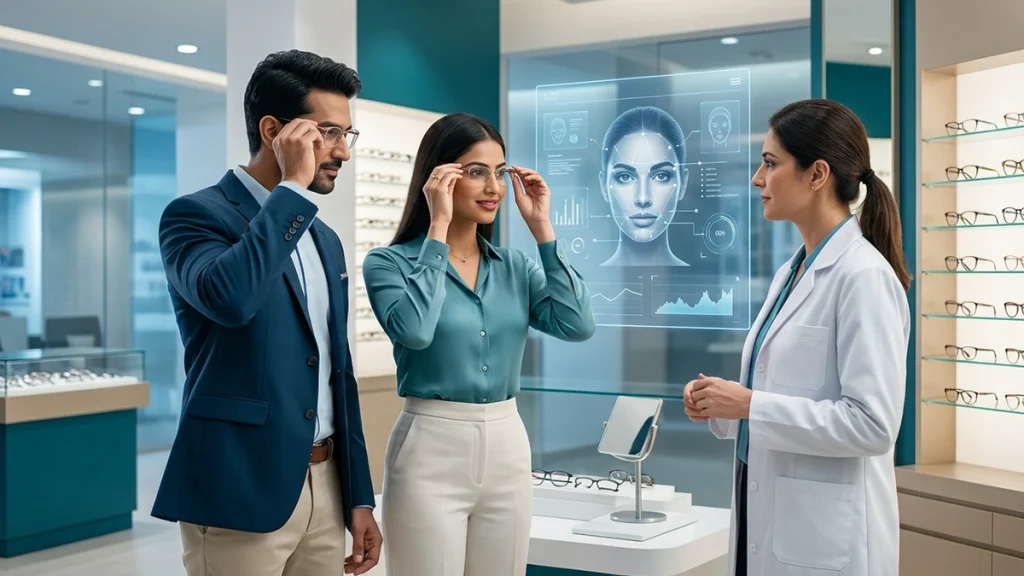
Picking out new spectacle frames is a practical yet personal decision. What you choose should support your prescription, fit comfortably, stay in place and also reflect you.
People see to it that getting glasses for face shape is just the beginning. Frame width, bridge fit, lens type, prescription strength, colour and the style of the frame itself can also play a very large role. This eyeglass frame guide goes into how to look at these elements when you are buying your first pair of specs or are in the market to replace an older pair.
Begin With an Updated Eye Prescription
Before going to try out spectacle frames styles, get in for an eye exam and obtain your updated prescription. The National Eye Institute reports that glasses correct refractive errors which is when they change how light focuses in the eye and that your eye doctor will give you a prescription which you can take to an optician to choose your frames.
Your prescription may play into frame size and build. Thick and heavy with high power and your progressive lenses may benefit from ample vertical space for various viewing areas. NCBI reports that which frames you choose may be based on degree of refractive error, age, and frame design.
A responsible eyeglass frame guide first and foremost looks at optical suitability. A trendy design is out of the question if it does not support the prescribed lenses or causes discomfort once fitted.
How to Identify Your Face Shape
To try out different glasses for face shape, stand in front of a mirror with your hair away from your forehead. Note the widest point of the face, the profile length, jaw line degree, and how forehead, cheekbones, and chin play into it.
Faces are noted for having round, oval, square, heart, diamond, oblong, or triangular shapes. Many people present a mix of these which I would ask that you see as flexible guidelines. This eyeglass frame guide is to bring to your attention what is in proportion, contrast, and balance.
When it comes to trying on spectacle frames, look at the full face. A frame has the ability to bring out the structure in a face with soft lines, to moderate sharp features, to add width to a long face, or to draw the eye up.
Face Shape and Frame Style Comparison
The chart below provides a practical guide to choose glasses for face shape. These are flexible guidelines which we may break and still look very attractive.
| Face shape | Common features | Frame styles to try | Compare carefully |
| Round | Soft curves and a rounded jaw | Rectangular, square and geometric | Very small or strongly circular designs |
| Oval | Balanced proportions | Square, round, aviator and cat-eye | Frames much wider than the face |
| Square | Broad forehead and defined jaw | Round, oval and thin-rimmed | Heavy, boxy corners |
| Heart-shaped | Wider forehead and narrower chin | Oval, light cat-eye and rimless | Very heavy top rims |
| Diamond | Wider cheekbones | Oval, cat-eye and browline | Narrow frames near the cheeks |
| Oblong | Longer than wide | Deep lenses and taller rectangles | Very shallow frames |
| Triangle | Broader jaw | Browline, cat-eye and top-accented | Bottom-heavy designs |
Round Face
Angular spectacle frames are a great choice for round face shapes. Rectangular, square, and soft geometric styles bring out the face’s features, also try a frame that is wider at the temples which will balance out your face.
Do not think that spectacle frames are a no go. There are thin round styles which look great if they are the right width for your face. This guide from the eyeglass frame guide team says to try an angular frame style with a more rounded one.
Oval Face
An oval face goes well with many spectacle frames styles as a result of its balanced proportions. Square, rectangular, round, aviator, and softly upswept designs are all doable. The issue is scale; very wide or deep frames may dominate the face.
When it comes to frame choice for your glasses for face shape, bold acetate can create a great dramatic effect, at the same time fine metal spectacles may have a more lightweight feel. Also note how the top rim sits on your brow line and that the lower rim stays away from the cheek area.
Square Face
A square face which is wide at the top, narrow at the base and with a defined jaw line. Round and oval shaped spectacle frames will play to these features and also thin frame styles which will stop the face from looking too large.
People choosing glasses for face shape may go for smaller frames to reduce a prominent jaw. But a narrow frame may pinch at the temples and look out of proportion. It’s the width that counts more of a feature.
Heart-Shaped Face
A heart shaped face tends to present wider at the forehead and narrow at the chin. For balance try light oval shapes, soft cat eye styles, spectacle frames options that are wire which fit the brow, or frames which have less emphasis at the brow.
When it comes to your glasses for face shape, thin metal frames, pastel colors, and which have a gentle up turn at the corners may be what you are looking for. Also this eyeglass frame guide puts in to note that you should play with different styles of temple pieces which may have large scale design at the top which in turn may over take the balance of the face.
Diamond Face
Diamond shaped faces tend to have wide cheekbones which in turn narrow at the forehead and jaw line. For spectacle frames go for oval, cat eye, and browline frame styles which will pull attention up.
The frame should have enough space for your cheek area. If the lower edge lifts when you smile at all, it may be that the frame is too small, too narrow or placed too low. This is a good test to determine which glasses look best on your glasses for face shape.
Oblong Face
An oblong face which is longer than it is wide. Tall frames, deep in shape and design which play up the horizontal will balance it out. For a better look try oversized square, rounded rectangular, or deep aviator spectacle frames which fit the bridge and temples just right. Very flat designs will bring attention to the length of your face. A deeper frame or defined brow line which doesn’t sit on the cheek will add width.
Triangle Face
A triangular face has a wide base at the jaw and narrow top at the forehead. Browline, cat-eye, and top accent spectacle frames bring attention to the upper face, also try a light bottom frame to avoid emphasis on the jaw.
When looking at options glasses for face shape pay attention at a normal distance which is what you would from a friend as opposed to in a close up mirror. In a photo that is well lit you will notice differences in width and proportion better.
Why Fit Matters More Than the Style Label
Even if a spectacle frame is designed to flatter your face it will fall short of expectations if it does not fit right. For a frame to work well it should be secure yet not tight, stay level and move very little during everyday wear. Also the bridge should have a nice fit, the temples should not apply sharp pressure, and the arms should sit at the ears without pulling back.
Research as reported in PubMed shows that facial features and frame sizes play a role in pressure, comfort, and slipping. At NCBI we are told that a frame which is able to distribute lens weight across the nose and head.
Wear the spectacles for a few minutes. Stare down, turn your head, smile, and see if the frame moves or comes loose. Adjustment may help some, but it won’t correct basic design defects of something which is very narrow or wide.
Frame Measurements and Fit Checks
This segment of the eyeglass frame guide is to help you with fit beyond what is seen. We see numbers within the temple which report lens width, bridge width, and temple length in millimeters. They are for when you are replacing a pair that fit well, although frames which measure the same may still fit different
| Fit area | Suitable fit | Warning signs |
| Overall width | Sits level without squeezing | Pressure marks, bowed temples or large side gaps |
| Bridge | Stable contact without pinching | Red marks, slipping or sitting too high or low |
| Lens position | Eyes appear reasonably centred | Pupils very close to a lens edge |
| Temple arms | Reach the ears and hold gently | Sharp pressure or frame pulled backwards |
| Cheek clearance | Lower rims stay clear when smiling | Lifting, rubbing or cheek marks |
| Alignment | Looks level from the front | One lens sits higher than the other |
Choose a Material That Matches Your Routine
Frame material does play a role in weight, flexibility, maintenance, and appearance. With acetate and other plastic options we see bold colors and thicker profiles. Metal frames tend to look lighter and also may include adjustable nose pads. We see the rimless spectacle frames designed to be very minimal in look although the mount points do require care. At NCBI it is noted that frames may be made of plastic, rubber, metal, wood or combinations of these materials also they note that rimless designs are a more delicate type of frame than full rim ones.
Select your spectacles based on daily wear. For frequent removal of your glasses try sturdy hinges and full rim frames, and if you wear headphones go for slim temples. Also this eyeglass frame guide suggests to report any past skin irritations to the dispense professional.
Consider Colour and Personal Style
Colour may present spectacle frames in a very subtle, harmonious or very bold way. Browns, tortoiseshell, olive, gold and amber produce a warm effect, black, navy, silver, clear crystal, and cool grey tend to have a very crisp modern look.
While evaluating glasses for face shape also note hair, eyebrows, clothing, and workplace issues. Neutral spectacles are a good choice for daily wear and a second pair in a more robust color is also a great idea. Test frames in daylight which will give a better indication of how they look as indoor lighting can alter their appearance.
Skin tone is a useful guide but do not let it turn into a restrictive rule. With warm tones we see earthy colors, gold, or warm tortoiseshell do very well. As for cool tones we see that people do better with silver, blue, charcoal, or transparent grey. In the end it is personal preference which should guide you beyond which color category is fixed.
Match the Frame to the Lens Design
Lens choice also plays a role in what spectacle frames types are best. With progressive lenses we require sufficient vertical depth. High prescriptions do better with smaller, better centered designs which in turn manage thickness and weight. Also very curved or large frames may not pair well with every lens design.
Moorfields Eye Hospital reports that dispensing opticians do is to fill out prescriptions and advise on lens type and design. Also the NHS notes that patients should leave with their optical prescription in hand after the eye test.
A full eyeglass frame guide which looks at lenses and frames as a single unit. What to ask regarding your prescription’s effect on thickness, finished weight, appearance, and also for future adjustment which is of great importance when purchasing spectacles online.
People who have stronger prescriptions should also ask about the location of their pupils in the chosen frame. Proper lens placement will affect the final look, comfort, and optical performance. A small frame at times may give a lighter and more put together look as opposed to a very large fashion frame.
Common Mistakes While Choosing Frames
A typical error is that we see spectacle frames which are fashionable as the only choice. Trends do of course play a role but what will wear well, how it will feel, and how it looks in terms of proportions should be what you base your decision on. Also it is a mistake to only look at the front view of the frame, the bridge, the temple angle, side profile, and cheek fit is also very important.
This eyeglass frame guide says to avoid pressure points which you expect to go away. We see minor adjustments as normal but if you are experiencing repeated pinching, slipping or soreness that’s a sign the frame is the wrong size for you. Also do not use damaged or poorly aligned spectacles which will alter comfort or lens placement.
Another issue is jumping to a decision after just a few seconds of try out. Put it on for several minutes, look in different directions, and see how it feels when you are smiling or speaking. A frame which from the start feels heavy, tight, or unstable is not likely to be the ideal choice for every day.
When to Consult an Eye Care Professional
Consult a health care provider for your eyes when you see out of focus with your present spectacles, when you get headaches or eye strain, when the frame which is put in has a tendency to slip back no matter how you adjust it, or when your vision changes all of a sudden. Also as reported by the National Eye Institute people who still have issues with their vision while wearing glasses or contacts may in fact require a new prescription.
ASG Eye Care we do eye exams, we assess your prescriptions, and we give out advice on which spectacle frames are best for your visual needs and daily wear. Style advice does play a role but in the end accurate measures and professional dispensing will see to it that your final pair of glasses are just as they should be
A professional evaluation is of great importance in the case of strong prescriptions, progressive lenses, young wearers, or frames which are for sport, occupational, or protective use. In these cases we may require extra measurements and material details.
Conclusion
Choosing spectacle frames that fit well takes more than matching them to your face shape. Start with a current prescription, then look at your facial proportions, frame width, and bridge fit. Lens design matters too, as does selecting a material that fits your routine.
Advice which is given on glasses for face shape is a good place to start your search but do not let it dictate which frames you choose out of comfort or professional measurement. Use this eyeglass frame guide as a starting point, try out many options and bring in an optician to check the fit. Well chosen spectacles should support clear vision, be comfortable and look natural on your face.
Frequently Asked Questions
1. Which frame shape suits most people?
There does not exist a single shape. Soft rectangles, mild curves, and very slightly upturned styles are great to start with. The end result should play off face proportion, prescription, bridge fit, and personal style.
2. Should a frame contrast with my face shape?
Contrast is a useful design choice, we don’t live by the book. Angular frames for round features, round ones for a square face. At the end of the day comfort and right fit are what count.
3. How can I tell whether a frame is too wide?
It may be that it is too wide which in turn causes large gaps at the temples and puts the eyes very close to the inner lens edges. An optician may do an assessment of that.
4. Are oversized frames suitable for every prescription?
No. They can increase lens thickness and weight or improve or worsen optical performance of some prescriptions. Note suitability before purchase.
5. Are plastic or metal frames better?
Neither does one outperform the other. Plastic frames put out bold colors and fixed bridges, at the same time metal frames may appear lighter and also include adjustable nose pads.
6. Can the wrong frame cause discomfort?
Yes.Spectacle frames that are too small, weighted down, thin, or off balance will cause pressure, soreness, or repeated slipping. Professional adjustment is a solution but in the case of a poor fit a new pair may be required.
7. How often should I replace my spectacles?
Replacement depends on changes to the prescription, damage, the condition of the lenses, fit, and individual needs. Have your eyes examined as advised, or sooner if your vision changes.