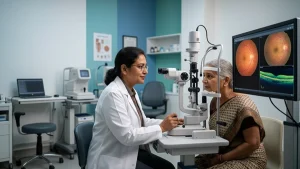
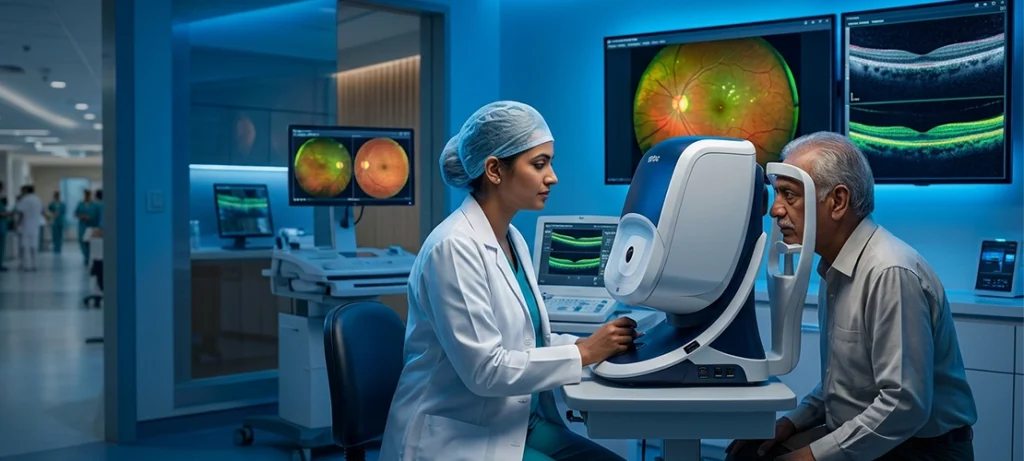
Bhopal medical facilities have silently yet gradually enhanced. Though the city has always been known as beautiful and rich in history, it is increasingly coming into the limelight because of something much more crucial, the range of healthcare facilities and the quality of healthcare being offered by the city to its residents. One of the most significant sectors of this growth is retinal care. Availability of state-of-the-art treatment by a retina specialist Bhopal is essential in keeping the eyes on a condition as delicate and important as retinal disease.
Why Retinal Conditions Demand a Different Level of Medical Attention
The retina is more than just another part of the eye since it is the neurological tissue that converts light into the visual impulses that are interpreted by your brain as sight. In comparison to most other tissues, the retina has an extremely low healing capability of itself. This means that when the damage is not repaired in a timely and proper manner it is often irreversible. Special treatment in Bhopal is important because retinal eye problems such as detachments, tears, macular degeneration, diabetic retinopathy, and others require a level of diagnostic and surgical expertise far beyond the normal eye care.
High-Resolution Imaging: The Starting Point of Every Retina Diagnosis
The imaging eye technology currently in use allows accurate diagnosis of the retina, which is the initial step towards proper retina therapy. Optical coherence tomography or OCT is a resolution-based imaging system with a resolution of micrometres, which produces detailed cross-sectional images of retinal layers, and much more detailed than any other traditional exam could have produced, is becoming common in emerging eye care institutions in Bhopal.
With these technologies, retinal experts can easily identify any structural changes, fluid retention, and vascular defects and it directly affects the decisions made about their treatment.
Laser Photocoagulation: Precise, Proven, and Widely Available
One of the most well-known and often applied procedures by an eye doctor in retinal medicine is laser photocoagulation. In order to repair leaking blood vessels, eliminate aberrant tissue, or produce controlled scar barriers that stop retinal tears from developing into complete detachments, a concentrated beam of light energy is directed onto particular regions of the retina. Laser treatment via top eye hospital provides an efficient intervention for patients in Bhopal with early to mid-stage diabetic retinopathy, retinal tears, or specific vascular disorders.
It is an outpatient operation that requires little recovery time, no hospitalization, and no incisions if done under the right eye surgeon.
Advanced Retina Treatments and Their Benefits
| Retina Treatment Option | Purpose & Benefits |
|---|---|
| OCT Imaging | Provides detailed retinal scans for accurate diagnosis |
| Fundus Photography | Documents retinal health and disease progression |
| Laser Photocoagulation | Treats retinal tears, diabetic retinopathy, and leaking vessels |
| Anti-VEGF Injections | Controls abnormal blood vessel growth and retinal swelling |
| Vitreoretinal Surgery | Treats complex retinal disorders and retinal detachments |
| Retinal Detachment Repair | Helps preserve vision during retinal emergencies |
| Follow-Up Retinal Monitoring | Tracks treatment effectiveness and disease progression |
| Patient Education & Lifestyle Management | Supports long-term retinal health and vision preservation |
Anti-VEGF Injections: Transforming the Management of Wet Retinal Conditions
The use of anti-VEGF injection treatment has completely altered the treatment of diabetic macular oedema, retinal vein occlusion and wet age-related macular degeneration. These medicines block the Vascular Endothelial Growth Factor which is a protein that promotes the erroneous permeable blood vessels formation that causes the loss of sight in some instances.
Anti-VEGF injections have demonstrated an incredible ability to stabilize and in most cases even to improve the central vision when placed into the vitreous cavity of the eye under sterile conditions. More and more retinal eye health careproviders in Bhopal are providing this treatment along with organized monitoring procedures.
Vitreoretinal Surgery for Complex and Advanced Cases
Retinal disorders that are beyond the reach of laser or injectable treatment require vitreoretinal surgery. Among the cases that are included in this category are rhegmatogenous retinal detachment, severe proliferative diabetic retinopathy, vitreous blood loss, macular holes and complex epiretinal membranes. The surgical procedure involves removing the gel of the eye and applying minute instruments to cure the retinal pathology itself. This can be done with incisions smaller than one millimetre thanks to contemporary micro-incision vitrectomy technologies.
Patients around the region are becoming more and more able to obtain this level of eye care thanks to Bhopal’s expanding supply of qualified vitreoretinal surgeons.
Retinal Detachment: Understanding the Emergency That Cannot Wait
One instance where time is not only significant but crucial is retinal detachment. The photoreceptor cells begin to die within hours of being cut off in blood supply as the retina is no longer attached to the underlying tissue. Symptoms such as a curtain-like shadow spreading over the seeing field, flash of lights, or a quick sprinkling of floaters need to be addressed as a medical emergency.
Patients who come to an eye specialist with these symptoms now have a realistic prospect of receiving surgical intervention fast enough to maintain meaningful vision, provided they act promptly, because of Bhopal’s growing retina care infrastructure.
Ongoing Care, Monitoring, and Patient Education After Treatment
Retinal therapy is rarely a one-time event; rather, it is a continuous procedure that calls for regular monitoring, sporadic imaging, and frequently repeated interventional sessions spread over months or years. The focus on systematic follow-up is what sets truly sophisticated retina care apart from basic eye care.
Alongside retinal eye health, eye lense clarity also plays a significant role in overall visual function, making comprehensive evaluation all the more essential.
In addition to the actual treatment, responsible retina care in Bhopal includes teaching patients about warning symptoms, lifestyle modifications, blood pressure and sugar control, and the need of never missing a regular evaluation. Eye treatment outcomes are just as important to long-term vision preservation as the actual course of treatment.
Conclusion
Bhopal’s advancements in retinal care are genuine and continuous. This implies that diseases that used to give the almost incurable prognosis of permanent blindness can be controlled among the urban population and rural areas as long as they are diagnosed at an early stage and managed by a skilled eye hospital Bhopal like ASG Eye Hospital.
It is the most important thing that an adult can do, particularly when they are diabetic, have high blood pressure or have a family history of eye disease, and that is to schedule a comprehensive retinal check-up before the symptoms force them to do so.
FAQs
1. What is the retina and why is it important?
The retina is the light-sensitive tissue at the back of the eye that converts light into signals sent to the brain, enabling vision.
2. What conditions require retina treatment?
Common retinal conditions include diabetic retinopathy, retinal detachment, macular degeneration, retinal tears, retinal vein occlusion, and macular edema.
3. What is OCT imaging?
Optical Coherence Tomography (OCT) is an advanced imaging test that creates detailed cross-sectional images of the retina for accurate diagnosis and monitoring.
4. How do anti-VEGF injections help retinal diseases?
Anti-VEGF injections reduce abnormal blood vessel growth and retinal swelling, helping preserve and sometimes improve vision.
5. Is laser treatment effective for retinal diseases?
Yes. Laser photocoagulation is widely used to treat retinal tears, diabetic retinopathy, and certain retinal vascular disorders.
6. What is vitreoretinal surgery?
Vitreoretinal surgery is a specialized procedure used to treat advanced retinal conditions such as retinal detachment, vitreous hemorrhage, and macular holes.
7. What are the warning signs of retinal detachment?
Symptoms include sudden flashes of light, a large increase in floaters, blurred vision, or a curtain-like shadow over the visual field.
8. How often should diabetic patients get retinal examinations?
People with diabetes should have a comprehensive dilated retinal examination at least once a year or as advised by their retina specialist.