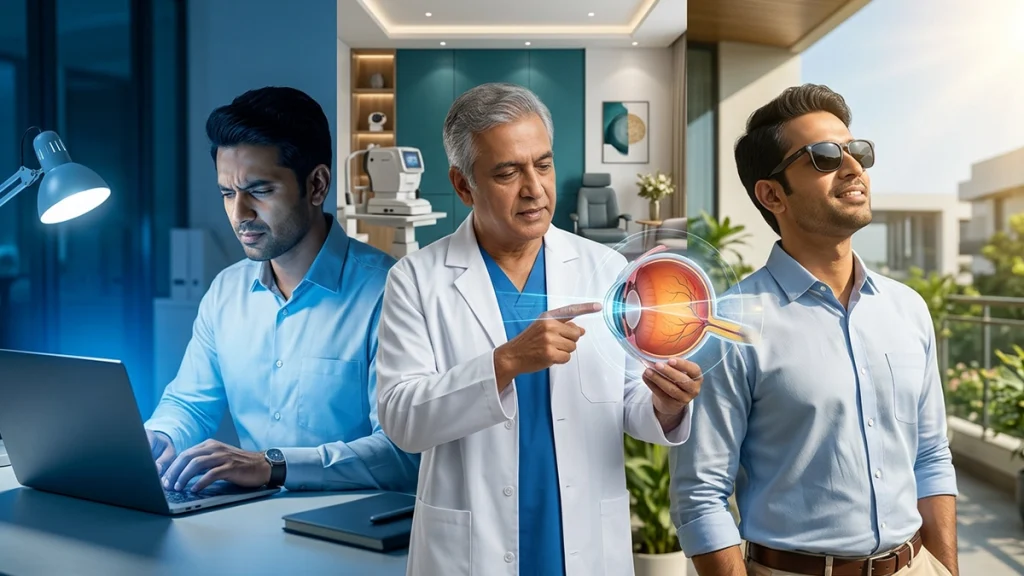
Digital devices and sunlight are everyday exposures, making Blue Light vs Sunlight a common question. Sunlight has greater proven tissue damage as it includes UV radiation and is by far more intense than that of a phone or computer. Screens rather have been connected to dryness and temporary discomfort.
The fact that there is no proven Blue Light Eye Damage does not mean that device habits are unimportant. We see that Long Screen Time plays a role in Digital Eye Strain which we attribute to reduced blinking, close focusing or poor screen position. A sensible Eye Care plan and source specific Eye Protection treat screen discomfort and UV Eye Damage as different problems. Understanding Blue Light vs Sunlight supports Healthy Vision without unnecessary fear.
Understanding Blue Light vs Sunlight
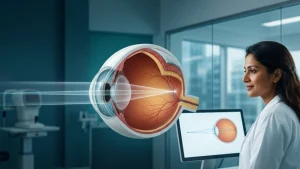
Blue light is a part of the visible spectrum. The sun is the best everyday source of it, LEDs, televisions, laptops and smartphones put out less. While we see reports that large scale research exposure causes Blue Light Eye Damage we do not at present have proof that regular use of screens does in fact damage the retina. In a light between blue light from the sun and that from screens we must look at intensity, distance, duration and wave length. An indoor screen does not equal solar exposure although late and long use may affect comfort and sleep. As for good Eye Care we should address these issues without reporting that routine screen use is a cause of retinal injury which in turn will help in the maintenance of Healthy Vision.
Why Blue Light vs Sunlight Treats Sunlight Differently
Sun out puts out visible light and also UVA and UVB which makes UV Rays and Eyes health a special issue. We see that excessive UV affects the cornea, conjunctiva, lens, eyelids and nearby tissue. The World Health Organization reports on photokeratitis, photoconjunctivitis, cataract, pterygium and cancers in or around the eye which in turn stresses the issue of UV Rays and Eyes health protection. Sun and Eye Health is an important issue all year round. Sunlight and Eye Health Health info is key because UV Rays and Eyes exposure is a go on through clouds and reflects in water, snow, sand and white surfaces. Cumulative UV Eye Damage from repeated exposure may happen without immediate pain which is why Sunlight and Eye Health protection should be a routine practice.
In the case of Blue Light vs Sunlight, as compared to Sunlight what we see is that which is the base for the sun’s protection is UV which also is the main reason why we do put forth more care for the sun. It is not right to consider these two sources equal just because they may have some blue visible light in them.
Blue Light vs Sunlight: Key Differences
| Factor | Digital screens | Natural sunlight |
| Main exposure | Low-intensity visible blue light, glare and near focusing | Intense visible light plus UVA and UVB |
| Common concern | Dryness, headache, blurred vision and Digital Eye Strain | Surface injury and cumulative UV Eye Damage |
| Evidence of retinal harm | Ordinary use has not been proven to cause retinal Blue Light Eye Damage | Direct sun viewing can injure the retina |
| Practical response | Breaks, blinking, correct viewing distance and controlled Screen Time | UV-blocking sunglasses, shade, a brimmed hat and suitable Eye Protection |
| Special lenses | Blue Light Glasses may improve subjective comfort for some users | Sunglasses blocking 99–100% UVA and UVB support Healthy Vision |
The table presents that Blue Light vs Sunlight should not be put into a simple color based comparison. Sunlight has greater intensity which also includes UV radiation which we see as a greater risk for Eye UV Eye Damage. For screens we see mostly behavioral and ergonomic issues presented as opposed to the same type of radiation health risks.
Does Blue Light From Screens Harm the Retina?
Research which has looked into Blue Light Eye Damage has been done in the lab and in animals with controlled exposure. These studies do not show that phones or laptops harm the retina during normal use. Reviews that are indexed by the US National Library of Medicine report no evidence that everyday at home LEDs or screens are retinotoxic, although long term exposure is still a question. In regard to Sunlight this is a distinction which does matter because what is experienced as tired or burning eyes may in fact be Blue Light Eye Damage which is permanent. Also reduced blinking, dryness, uncorrected vision, glare or continuous near work are more common causes.
When it comes to Blue Light vs Sunlight, what you should know is that daylight has much more blue light than what you find on screens. For outdoor safety do your best to avoid direct sun exposure and UV rays; for digital comfort get into the habit of taking breaks, improving your posture, lighting in the room and managing your Screen Time.
What Causes Digital Eye Strain?
The issue of Blue Light vs Sunlight comes into play when it comes to Digital Eye Strain which is a result of extended device use. Symptoms include dryness, burning, watering, headache, temporary blur, difficulty in refocusing and posture related neck pain.
Concentration decreases the amount of full eye blinks which in turn causes the tear film to dry out faster, also constant near work fatigue the visual system. As a result it may be that what can be done is to control Screen Time and improve the workspace which in turn may turn out to be more helpful then use of Blue Light Glasses.
Every 20 minutes take a break and look at an object 20 feet away for at least 20 seconds. This break will relax near focus and also get you to blink which is a great Healthy Vision practice. It is an easy step but we still recommend you see a professional for persistent issues. Health issues also affect the eyes.
For Blue Light vs Sunlight, the clearest short-term example of UV Eye Damage is photokeratitis, an inflammatory injury similar to sunburn on the eye surface. It may bring about pain, redness, tearing, light sensitivity and blurry vision. Snow blindness is a very serious form of photokeratitis related to intense reflected UV exposure at high altitude. V Rays and Eyes exposure is the more important concern for Sunlight and Eye Health.
UV radiation is related to cataracts, pterygium and skin cancers in and around the eye area. The WHO estimates that a proportion of global cataract-related blindness may be attributable to UV exposure. These established risks make the UV Rays and Eyes connection more medically significant than ordinary screen emissions. UV Rays and Eyes also means recognising that directly viewing the sun is a separate danger. It can injure the retina without immediate pain, including during an eclipse. Regular sunglasses are not safe for direct solar viewing. This is another reason the practical outcome of Blue Light vs Sunlight favours stronger caution around sunlight.
Do Blue Light Glasses Work?
In Blue Light vs Sunlight, Blue Light Glasses which are a type of filter for part of the visible spectrum. Some people find them to be a comfortable option, but we have that large scale reviews which don’t support that they in fact prevent Digital Eye Strain, retinal disease or meaningful Blue Light Eye Damage better than ordinary lenses. personal comfort choice, but Blue Light Glasses do not correct a prescription, treat dry eye, improve posture or replace breaks. They also differ from sunglasses designed for UV Rays and Eyes.
For night use we see that lowering screen brightness which in turn allows for a warmer display and less stimulating Screen Time before bed may improve sleep hygiene. This is to say we aren’t to report that Blue Light Glasses prevent eye disease.
Everyday Protection for Screens and Sun
| Situation | Practical action | Main benefit |
| Long computer work | Take distance breaks, blink fully and enlarge small text | Helps reduce Digital Eye Strain |
| Dry indoor environment | Avoid direct air flow and discuss suitable lubricating drops with an ophthalmologist | Supports comfortable Eye Care |
| Glare or reflections | Adjust the screen angle, room light and brightness | Improves comfort during Screen Time |
| Normal outdoor activity | Wear wraparound sunglasses blocking 99–100% UVA and UVB | Reduces exposure involving UV Rays and Eyes |
| Water, snow or high altitude | Add a broad-brimmed hat and close-fitting eyewear | Strengthens Eye Protection against reflected radiation |
| New pain or vision change | Arrange an eye examination promptly | Protects Healthy Vision and identifies conditions needing treatment |
The practical Blue Light vs Sunlight answer is source-specific: effective Eye Protection must match the source. Outdoors the priority is in UV protective eyewear. The CDC and the National Eye Institute recommend that you wear sunglasses which block 99-100% of UVA and UVB, limiting UV Eye Damage even on cloudy days. Sunglasses for Healthy Eyes
For Sunlight and Eye Health, and sunlight protection it is not true that dark lenses are the best. We put out that proper sunglasses should clearly label they block 99 100% of UVA and UVB or have the label UV400. Also which frame is which — wrap around frames are best for Eye Protection as they reduce side entry of rays. And a wide brimmed hat is a plus which also improves Eye Protection and further supports Sunlight and Eye Health.
Sunlight and Eye Health practices which should start in childhood as exposure is a cumulative factor. We should teach children about UV Rays and Eyes which in turn will form the habits for lifetime of Healthy Vision. Contact lens wearers also included in this they still need to wear sunglasses for best Eye Protection and to reduce UV Eye Damage.
For Sunlight and Eye Health, and other issues, which types of Blue Light Glasses serve different roles. Outside wear for protection from UV, at home you may use Blue Light Glasses for the other part of the visible spectrum. Also, neither is for looking at the sun directly.
Better Screen Habits for Daily Eye Care
Healthy device use starts with breaking up Screen Time. Put the monitor at a comfortable distance, place it near or a little below eye level, also enlarge text and set the display brightness to that of the room. Reflects from windows or overhead lights should be minimized.
Blink fully and frequently during intense work. For those that have Digital Eye Strain which is a recurring issue, in that case do get in for a check up, especially if your symptoms persist after rest. Go to the professional Eye Care provider which may be able to identify dry eye, allergy, an uncorrected prescription or a focusing issue that may not be resolved by at home solutions.
Parents may look out for repeated headaches, squinting, eye rub, blurred vision or that your child is holding in too close. Don’t assume that these are a result of Blue Light Eye Damage. A proper examination is the safer way to protect a child’s Healthy Vision.
Blue Light vs Sunlight: Which Is More Harmful?
In terms of which light is riskier for the eyes between Blue Light vs Sunlight it is determined that in fact sunlight puts out the greater proven health risk to eye tissue. It’s UV radiation which causes the bulk of the damage from acute surface injury to cumulative UV Eye Damage. Public-health guidance on Sunlight and Eye Health therefore emphasises sunglasses, hats, shade and avoiding direct sun viewing.
Screens present a different issue. What has not been proved is that use of them causes retinal Blue Light Eye Damage, but do note that long term device use does play a role in Digital Eye Strain. In terms of management Screen Time, analysis, eye exercises, taking visual breaks and fixing glare are more supported by research than is the case for Blue Light Glasses.
The best response to Blue Light vs Sunlight is a practical one rather than a fearful one. Use proper outdoor Eye Protection, improve your desk top set up and see an Eye Care professional when symptoms persist. These practices maintain Healthy Vision at the same time they address digital and solar exposure.
Frequently Asked Questions
1. Is the phone blue light more dangerous than sunlight?
No. In Blue Light vs Sunlight,which is present in the natural environment, what we see from a phone is of much weaker intensity and does not produce the same level of outdoor UV exposure. While phones may play a role in Digital Eye Strain, sun can cause proven UV Eye Damage without proper protection.
2. Can normal screen use permanently damage the eyes?
At present there is no evidence that everyday use of screens causes retinal Blue Light Eye Damage. We see that extended Screen Time still produces dryness, headache and temporary blurred vision. For persistent symptoms it is best to see an Eye Care professional.
3. Are blue-light-filtering spectacles essential?
Blue Light Glasses are optional for most users. They may report comfort but study has not fully proven that they do in fact prevent eye disease. What is more important for Healthy Vision are breaks and a suitably prescribed treatment.
4. What sunglasses should I choose?
Select out those sunglasses which label to block 99–100% of UVA and UVB or which are marked UV400. Wrap around frames do a better job of Eye Protection, in particular near reflective surfaces. This is the best day to day solution for the issues with UV Rays and Eyes.
5. Can cloudy weather still affect the eyes?
Yes. UV radiation can reach the eyes through clouds and haze. Consistent precautions support Sunlight and Eye Health and reduce cumulative UV Eye Damage, even when the day does not feel extremely bright.
6. When should screen-related symptoms be checked?
Seek out a professional Eye Care which is to say that if you are still having issues get your eyes checked also if what you are going through is in fact Digital Eye Strain it may be a different issue.
7. Is it safe to look at the sun through sunglasses?
No. Regular sunglasses don’t protect your eyes from the sun’s rays during an eclipse. For that you need certified solar viewers. Daily wear sunglasses are for routine Eye Protection, not for looking at the sun.
8. What daily habit is most useful for screen users?
Break up Screen Time, look into the distance regularly and blink fully. These habits can reduce discomfort and help maintain Healthy Vision without assuming that every symptom represents Blue Light Eye Damage.