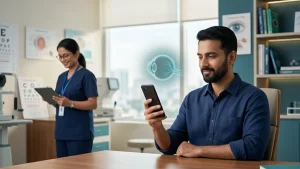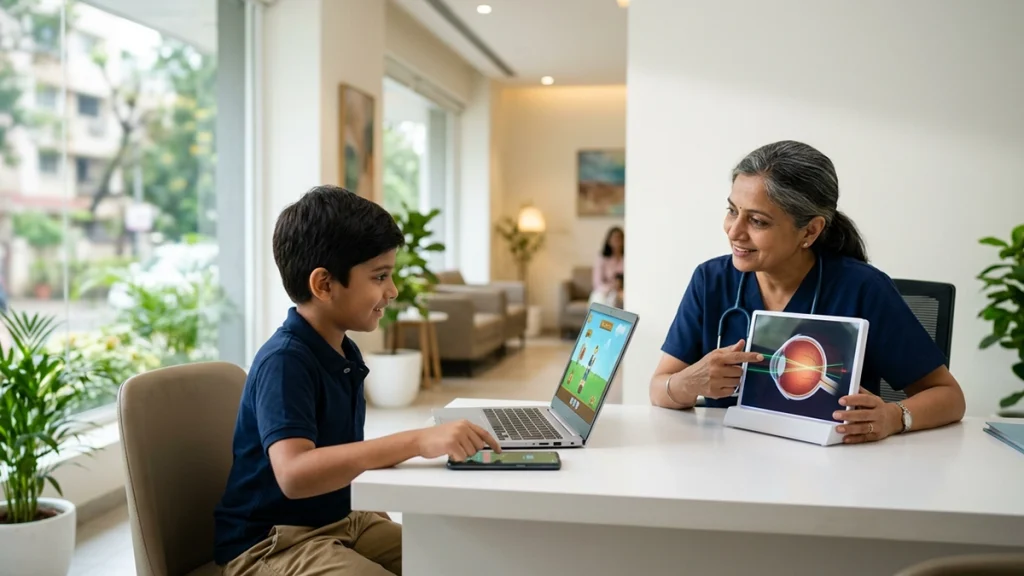
When at the eye hospital parents report that they see their kids spend large amounts of time on mobile phones, tablets, laptops and in online classes which is a cause of concern for them. What they usually report is that their child has been sitting very close to the TV, is having trouble reading what is written on the classroom board or is coming in for stronger glasses yearly. That which they see is a pattern which points to progressive myopia in which the power of the eye which is corrected with minus lenses is increasing over time.
It is true that screens are not the only cause of this issue. Genetics, indoor based lifestyle, long hours of close work, little outdoor activity, and early development of nearsightedness in childhood myopia also play a role. Also we can’t ignore the connection between screen time and vision which is present when a child is mostly at a close distance for many hours and is not getting enough natural outdoor light.
At ASG Eye Care what we do is report that myopia is not a simple issue of wearing glasses. A child with nearsightedness may see up close what is put in front of them but have trouble with distance. As this power of myopia increases over time what we see is myopia progression. We aim to catch the issue early, control the rate of this growth, and in the long term protect the health of the child’s eyes.
What Does This Condition Mean?
Progressive myopia is a type which progresses through growth which is during the years of growth. In a normal eye light focuses directly on the retina. In the case of nearsightedness the eye is usually longer than average, which in turn causes light to focus in front of the retina instead of on it which in turn causes blur in distance vision.
At first it may be that the child will only require glasses for distance vision but as time goes by the power may go up. This continuous increase is what we term myopia progression. If progressive myopia goes unmonitored the child may become more myopic which in turn increases the risk of retinal thinning, retinal detachment, glaucoma, cataract and other eye issues later in life.
Parents should not panic but also do not ignore the issue of myopia. Through regular eye checkups, proper prescription, health based daily routines, and appropriate myopia control options progressive myopia may be managed better.
Can Too Much Screen Time Cause Myopia?
Too much screen time in and of itself does not see that every child will develop progressive myopia but it can play a role when put in to the mix with other variables. Screens have the effect of keeping the eyes at a close focus point for large periods of time. Also similar to other near work like reading, writing, drawing, or study which is done at very close range. What we see is the issue is amplified when we have long term near work which also has little to no outdoor play.
The issue of screen time and vision is a great concern in the case of children who are still in the stage of eye development. A child which is into very close proximity phone use, for long hours into small screens, is not getting enough outdoor play, and also has a family history of nearsightedness may be at greater risk for development of childhood myopia and faster myopia progression.
It is best to view screen time in the context of the whole lifestyle. Doctors don’t usually identify with one device or habit. What they do is look at how much close work the child does, how frequently the child takes breaks, how that time is balanced with outdoor activity, and also if the eye power is changing. This in turn gives a better picture of progressive myopia.
| Risk Factor | How It May Affect the Eyes | Practical Parent Action |
| Long near work | May increase eye strain and power increase | Encourage breaks and proper reading distance |
| Excessive digital use | Makes digital balance harder to maintain | Limit unnecessary screen use |
| Less outdoor activity | May increase the chance of early myopia | Aim for daily outdoor play |
| Family history | Children of myopic parents may have higher risk of myopia | Schedule regular eye exams |
| Early onset | More years are available for power to increase | Monitor progressive myopia closely |
Why Outdoor Time Matters
Outdoor activities are a very practical aspect of a healthful lifestyle for kids at risk of progressive myopia. Sunlight and distance oriented play gives the eyes a break from continuous near work. Also we see that kids who spend more time outside may have a lower myopia risk, and playing al fresco supports better visual health.
This doesn’t mean that parents should forgo glasses, eye drops, contact lenses, or doctor’s supervision which is still very much a part of the treatment when power increases have already begun. What we are saying is that lifestyle does play a role. A child with childhood myopia should be put on a balanced program of school work, digital learning, and outdoor activity.
For better visual health and screen time and vision, kids should stay away from dark rooms, keep phones at a distance and take regular breaks. These easy steps may not reverse nearsightedness, but they do improve comfort and reduce stress.
Symptoms Parents Should Watch For
The first signs of progressive myopia may go by unnoticed. Also many a time kids do not report that which may pass off as poor vision to you because they do not know what normal vision is. A child may squint, stand very close to the TV, complain of headaches, copy wrong from what is on the class board, or may lose interest in outdoor games.
Frequent changes in prescription are also a sign of myopia progress. If the degree of myopia progression. is increasing every few months or every year the child should have a full evaluation. In childhood myopia early diagnosis is of value because young children have many more years in which their eye power may change.
Parents also pay attention to what kids do with digital devices. If a child is very close to the screen, rubs at their eyes often, or reports tired eyes after online classes the issue may be related to screen time and vision strain. An eye exam can determine if the child has simple nearsightedness or progressive myopia which is in it’s early stage.
How Doctors Check a Child’s Eye Power
A full eye exam is recommended for any child that has progressive myopia. The doctor will check distance vision, near vision, spectacle power, eye alignment, and over all eye health. In kids we may use dilating drops to relax the focusing muscles and get a full assessment of their prescription.
A full eye exam is recommended for any child that has progressive myopia. The doctor will check distance vision, near vision, spectacle power, eye alignment, and over all eye health. In kids we may use dilating drops to relax the focusing muscles and get a full assessment of their prescription.
| Eye Check-Up Component | Why It Is Important |
| Vision testing | Shows how clearly the child sees at distance and near |
| Refraction after drops | Gives an accurate measurement of nearsightedness |
| Prescription comparison | Helps identify power increase over time |
| Eye health examination | Checks the retina and rules out other eye problems |
| Lifestyle discussion | Helps understand digital-use patterns |
| Follow-up planning | Supports long-term care for myopic children |
Treatment Options to Slow Increasing Eye Power
Treatment of progressive myopia is based on the child’s age, current power of the myopia, rate of increase, eye health, and lifestyle. At this time we see that glasses which are prescribed for the child may improve their vision but in many cases may not reverse the progress of myopia. In some children however doctors will recommend special treatments such as myopia control glasses, contact lenses, low dose atropine eye drops, or any other evidence based methods.
The goal of treatment is to slow the myopia progression and to reduce the chance of high myopia in adulthood. It is important for parents to know that treatment does not work immediately. This is a managed condition which requires regular follow ups and consistent care.
Many times the doctor will put forth the idea of changing up daily routines. This may include less of that which is close at hand, better posture, more play in the great outdoors, and a re-think of screen time and vision habits which support the care plan. For kids with childhood myopia, we are asking that these changes become a part of their lives every day.
Is Myopia Always Progressive?
Not all of the time does a child who is nearsightedness see their prescription change very quickly. Some kids may have minor myopia and what we see in them is that which is stable over years. Also, some may see myopia progression, increase especially if the condition presents at an early age or there is a large family history.
This is what we see with follow up. A single prescription is a static solution. Over time through many tests the eye doctor is able to see if the child’s nearsightedness is stable or if they are developing progressive myopia. If the power of the prescription is increasing rapidly the doctor will put the child in for myopia control programs.
How Parents Can Help at Home
Parents play a great role in the management of progressive myopia. We see that they should see that their child wears them as prescribed by the eye care professional. Also we may look at creating a routine that is beneficial for the eyes. That includes breaks during reading and screen use, time spent outdoors, sitting with proper lighting, and also to keep devices at a distance.
The 8 minute rule is also a good practice for reducing digital eye strain. For every 20 minutes of screen time the child should step away for at which point they look at something far away for 20 seconds. This is an easy tip to implement in between screen time and vision comfort. It is not a substitute for childhood myopia treatment but does report to be effective in reducing fatigue during close work.
Parents also should not put off follow up visits. If myopia progression early intervention is more useful than waiting until it becomes severe. Regular checks allow the doctor to modify the plan as needed.
Myopia Care at ASG Eye Care
At ASG Eye Care we provide in-depth assessment for children with progressive myopia which includes vision testing, prescription evaluation, eye health exam, and lifestyle review. We see each child as an individual. Some may only require regular glasses and monitoring, others will benefit from myopia control treatment.
Doctors also report to families on screen time and vision, outdoor play, study routines, and follow up schedules. For kids with childhood myopia, we are after not just clear vision at present but also better eye health in the future. If we detect myopia progression early that is when we can put together the best treatment plans.
Families are urged to take their child to an eye specialist if they notice blurred distance vision, frequent changes in prescription, or a history of nearsightedness in the family. Timely care plays a large role in the management of progressive myopia.
Key Takeaway
Too much screen time isn’t the only issue in the development of progressive myopia which also includes poor digital habits, long near work, and reduced outdoor time. Parents should pay close attention to their child’s screen time and vision, and eyesight which is of great importance when the child has onset myopia at a young age or there is a childhood myopia history in the family.
The key is in the early diagnosis, regular monitoring, healthy outdoor activity, correct glasses, and doctor prescribed treatment as needed. With consistent care this issue may be managed in a which we protect present vision and future eye health.
Frequently Asked Questions
1. Can too much screen time make myopia worse?
Too much screen time is a factor which when put into play over long hours of close work and very little outdoor activity may cause myopia to progress. It is not the main cause but may be a very important risk factor.
2. What does it mean if minus power keeps increasing?
Myopia progression is a process in which the degree of myopia increases over time. This is a common issue in school age children and should be monitored regularly.
3. What does myopia in children mean?
A child at which myopia appears is what we term childhood myopia. It requires attention as early onset gives more time for it to progress.
4. Is myopia the same as being short-sighted?
Yes. Nearsightedness is what we see as a time when close up things are clearer than far away ones. Also known as myopia.
5. How can parents manage digital habits safely?
Parents may control screen time and vision issues by reducing on screen activity, getting kids out to play, to place screens at a proper distance, see to it that there is adequate lighting, and to schedule regular eye check ups.
6. Can increasing myopia be controlled?
This issue may be handled with routine check ups, proper glasses, lifestyle changes, and as prescribed by the doctor myopia control options. We aim to reduce the progression of myopia and to protect long term eye health.
Reference
National Eye Institute, NIH – https://pubmed.ncbi.nlm.nih.gov/39982728/
National Eye Institute, NIH – https://pmc.ncbi.nlm.nih.gov/articles/PMC12070634/