
Vitamin D which supports bones and muscles and also plays a role in immunity has also been the subject of research which looked at its possible function in the eye and in fighting inflammation. This has put forward the question from many that there is a direct connection between Vitamin D Deficiency and Eyesight. We see some association reported especially with issues related to the ocular surface but low vitamin D is not in itself a common stand alone cause of sudden or permanent vision loss.
At ASG Eye Care we offer Vitamin D for Eye Health program which is not to say it is a substitute for an eye exam. Any person that is experiencing Blurred Vision, irritation or Dry Eyes should get to the bottom of what is causing the symptom and if relevant have a separate look at whether a Vitamin Deficiency is a factor.
What Is Vitamin D Deficiency?
Vitamin D plays a role in calcium absorption, bone health, muscle function and also in immune regulation. We also see it in terms of a 25 hydroxyvitamin D, also known as 25(OH)D, blood test. The National Institutes of Health reports that which levels fall below 30 nmol/L or 12 ng/mL there is a deficiency, while we do see that at 50 nmol/L or 20 ng/mL and up there is adequate for the large part of people. These results should be looked at by a clinician.
Vitamin Deficiency results from low intake, limited sun exposure, poor absorption, obesity, age, kidney or liver issues, or certain medications. These factors play a role inVitamin D Deficiency and Eyesight issues but do not prove cause and effect.
Can Vitamin D Deficiency Affect Your Eyes?
The association between Vitamin D Deficiency and Eyesight is a more accurate description than a cause and effect relationship. Vitamin D receptors and related enzymes are present in ocular tissues also vitamin D plays anti inflammatory and immune regulatory roles. Reviews which looked at this issue reported on possible connections with dry eye disease, diabetic retinopathy, age related macular degeneration, myopia, uveitis and other conditions. But many of these studies are observational which do not prove that deficiency is a cause of the eye disease.
This issue is important in the context of Vitamin D for Eye Health
We see that correcting a proven deficiency may improve general health and may also help some patients who present with ocular surface symptoms at the same time as low vitamin D. It does not mean that vitamin D supplements can fix the need for glasses, reverse cataract, cure glaucoma or that they are a solution for every retinal condition.
Possible Eye Symptoms and Other Explanations
Some people report that they have tired eyes, fluctuating vision clarity or irritation which is what I’m putting forward as not very specific symptoms. Dry Eyes is a cause of temporary visual disturbance which results from an unstable tear film that doesn’t allow light to focus properly on the cornea. The National Eye Institute reports that a scratchy or burning sensation, redness, light sensitivity and blurry vision are among the most common dry eye symptoms.
| Eye complaint | Possible connection | Why examination is important |
| Intermittent Blurred Vision | May occur when the tear film becomes unstable | Refractive error, cataract, diabetes and retinal disease can cause similar symptoms |
| Burning or gritty Dry Eyes | Some studies report an association with low vitamin D | Screen use, medicines, contact lenses, ageing and autoimmune disease are common causes |
| Eye fatigue | May occur alongside general fatigue from a Vitamin Deficiency | Uncorrected power and prolonged near work should also be checked |
| Light sensitivity | Can accompany ocular-surface irritation | Corneal inflammation, uveitis and migraine may also be responsible |
| Reduced visual comfort | Treating confirmed deficiency may support overall wellbeing | Persistent symptoms need a targeted eye-care plan |
The chart reports what we see as separate issues in terms of overlap that is to say Vitamin D Deficiency and Eyesight are independent. Also at the point of a confirmed low vitamin D from a blood test other eye related issues may be present. For a thorough look into the issues related to Vitamin D Deficiency and Eyesight we must start with diagnosis instead of preconceived ideas.
Vitamin D and Dry Eye Disease
In the area of research related to Vitamin D for Eye Health, dry eye disease has drawn the most attention. What we see is that Vitamin D plays a role in inflammation, immune activity and the issue of the epithelial barrier which is present on the eye’s surface. A study which we looked at reported that many empirical studies put forth a report of a connection between vitamin D levels and dry eye but some studies did not report a significant relationship. The authors put forth a call for larger scale and better controlled trials.
A recent report of a systematic review on oral vitamin use for dry eye. Some small studies noted improvement in symptoms with vitamin D supplements which we saw less of with tear production and tear film stability outcomes. That report also found the current data does not support the use of oral vitamins as a proven treatment for dry eye disease.
For in patients we must put forward a cause and a degree of severity into account. We may recommend artificial tears, screen breaks, environmental changes, eyelid care, prescription drops or treatment of an issue at hand. Should a Vitamin Deficiency be confirmed we will correct it at the same time as we treat the eye issue. This supports Eye Health we do not present one nutrient as a cure all.
Can Low Vitamin D Cause Blurred Vision?
Blurred vision does not present as a sure or early indicator of low vitamin D. What it may do in some cases is become noticeable when dryness creates an irregular tear layer, which in fact is an indirect cause. More direct causes include refractive errors, cataract, corneal disease, diabetes related changes and retinal disorders. The National Eye Institute reports that refractive error is a very common reason for blurry vision and that an ophthalmic exam is recommended to determine appropriate treatment.
The issue at hand is which patterns of Blurred Vision present. We see that improvement in Clarity which occurs with blink may point to Dry Eyes, also a gradual issue with distance or near sight may indicate a change in spectacle power. As for sudden Blurred Vision, a dark curtain, new flashes, many floaters, eye pain or partial loss of visual field, these require urgent care. Also do not put off questions related to Vitamin D Deficiency and Eyesight which may in fact be an emergency eye care issue.
Other Eye Conditions Being Studied
Research reports on Vitamin D for Eye Health have looked at myopia, diabetic retinopathy, macular degeneration, glaucoma, uveitis, keratoconus and cataract which have had mixed results. Age, outdoor activity, diabetes, obesity, diet and blood pressure play a role in both vitamin D status and eye disease risk. Thus Vitamin D Deficiency and Eyesight must be put in the context of the larger health picture. Adequate nutrition is important but screening, disease management, UV protection and prompt treatment are the base of Good Eye Health.
Who Is More Likely to Have Low Vitamin D?
Older age, dark skin tone, little sun exposure, obesity, and conditions which reduce fat absorption may see greater levels of vitamin D deficiency. Also risk may increase post gastric bypass surgery and in some kidney and liver diseases. The NIH reports that natural non fortified foods may not supply enough vitamin D for all.
Indoor work places you in a low sunlight environment at the same time which you are on your screens for long hours and using air conditioning which may contribute toDry Eyes issue. We must therefore look at the whole person in a consultation instead of separating out the issues of Vitamin D Deficiency and Eyesight
How Are Vitamin D Levels and Eye Symptoms Checked?
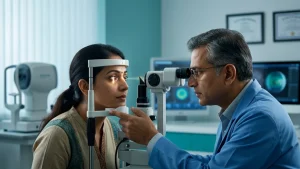
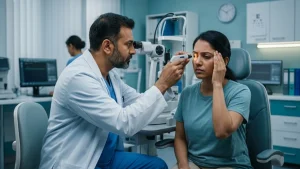
A doctor will order a 25(OH)D blood test when medical history, symptoms or risk factors point to deficiency. Also it is not routine to test for Vitamin Deficiency in healthy individuals. An ophthalmologist may also check visual acuity, glasses power, tear quality, cornea, eye pressure, lens, retina and optic nerve.
| Assessment | What it checks | How it helps |
| 25(OH)D blood test | Vitamin D level in the bloodstream | Confirms or excludes a Vitamin Deficiency |
| Visual-acuity and refraction test | Near and distance clarity | Shows whether Blurred Vision is related to spectacle power |
| Slit-lamp examination | Eyelids, tear film, cornea and front of the eye | Helps diagnose Dry Eyes, allergy, infection or corneal disease |
| Tear break-up time or tear measurement | Tear stability and production | Guides ocular-surface treatment |
| Dilated retinal examination | Retina, macula and optic nerve | Detects conditions that may threaten Eye Health |
The National Eye Institute reports that during a dilated eye exam we are able to see and treat eye disease at its early stage which in turn may catch issues that do not yet have noticeable symptoms. This is so for Vitamin D Deficiency and Eyesight which often requires both medical testing and a full eye assessment. That combined approach puts patients in a better clinical stand point
Should You Take Vitamin D Supplements for Your Eyes?
Vitamin D supplements are for confirmed or likely deficiency as determined by a health care professional, not for simple tired eyes. Dose is based on blood level, age, diet, pregnancy, digestive health, kidney function and medicines. Over dose of vitamin D may raise calcium levels in the blood which the NIH reports can cause health issues.
When it comes to the issue of Vitamin D Deficiency and Eyesight at the same time treatment may be a multi track approach. A physician will address the deficiency issue and an ophthalmologist will handle the eye problem. Patients may require vitamin correction as well as artificial tears, a new prescription for glasses, diabetes management or some other treatment. We do not recommend using Vitamin D for Eye Health as a stand alone solution. In practice what we see is that Vitamin D for Eye Health should support, not supplant, a diagnosis based care plan.
Food sources of it include fortified drinks, egg yolk and fatty fish. Sunlight on your skin is a source of vitamin D which we use for health, but beware of looking directly at the sun. For Eye Health it is recommended that you wear sunglasses and a hat to protect from ultraviolet exposure
Supporting Your Eyes and General Health
People who are at risk of a Vitamin Deficiency should talk to a doctor about which diet, sun exposure, and also getting tested is best. As for those that experience eye issues they can try to break up long screen time, and also reduce direct fan and smoke exposure while at the same time following the ophthalmologists’ advice. In terms of preventative care Vitamin D Deficiency and Eyesight and Eye Health.is just a piece of the overall health puzzle in it also includes how we eat, sleep, manage disease, protect against UV rays and have regular eye exams.
When Should You See an Ophthalmologist?
Arrangements should be made for an eye exam when you have persistent, recurring Blurred Vision; it also includes when it affects your reading or driving or is accompanied by redness, pain, discharge, light sensitivity or headaches. In the case of sudden vision loss, severe pain, a curtain like shadow, new flashes, many floaters, eye injury, chemical exposure or when you also have weakness or speech difficulty go to the emergency room. Also do not attribute warning signs to aVitamin Deficiency without getting an exam.
At ASG Eye Care we find that which eye issue you may have is best determined by an assessment. Also we see that when low levels of vitamin D are an issue we work with a physician for overall health and at the same time give the eye issue the care it needs for its specific condition. This team approach we take is the best way to go about managing Vitamin D Deficiency and Eyesight.
Conclusion
The issue of what is a true link between Vitamin D Deficiency and Eyesight is a scientific question which is at the same time very interesting but also very much over reported. While low levels of vitamin D may play a role in ocular surface inflammation and in some eye conditions we see that it is not usually the primary cause of visual symptoms. We do know that correcting a confirmed Vitamin Deficiency is a health priority but at the same time the eye issue must be looked into and diagnosed properly. So the best approach to the subject of Vitamin D Deficiency and Eyesight is a careful and evidence based one.
Maintaining good nutrition, practicing safe sunlight habits, having regular eye exams and getting prompt care for Blurred Vision or discomfort will support long term Eye Health. As for use of Vitamin D for Eye Health we ask that patients go by blood tests results and an ophthalmic exam before trying self treatment. This approach to Eye Health is also about not over promising what a supplement can do.
Frequently Asked Questions
1. Can vitamin D deficiency permanently damage eyesight?
Current research does not support that low vitamin D in itself is a cause of permanent vision loss. We see associations in many ocular health issues but that does not prove cause and effect. What we do see are persistent changes which should be looked at in depth instead of putting forward Vitamin D for Eye Health solution. This is very true when it comes to new visual changes that present with Vitamin D Deficiency and Eyesight issues.
2. Can low vitamin D cause dry eyes?
Low intake of vitamin D has been reported in many studies to be associated with Dry Eyes disease which may be due to its role in inflammation and the health of the ocular surface. It is also true that Dry Eyes has many causes and at present vitamin D supplements do not stand out as a definitive single treatment
3. Is blurred vision a symptom of vitamin D deficiency?
Blurred vision is not a sure sign of low vitamin D. Refractive error, cataract, corneal disease, diabetes and retinal issues are more common. An eye exam is required to determine the cause and to best protect Eye Health.
4. Will vitamin D supplements improve eyesight?
Supplements will correct a diagnosed Vitamin Deficiency, but they do not usually remove spectacle power or cure cataract, glaucoma or retinal disease. As for the role of Vitamin D for Eye Health that depends on the person’s true vitamin status and diagnosis. Thus advice about Vitamin D for Eye Health should be personal.
5. Which test checks vitamin D levels?
The typical blood test measures 25 hydroxyvitamin D, or 25(OH)D. A physician should interpret the report. This test is not a substitute for an eye exam which is to be done when you have pain, irritation or a change in vision related to Vitamin D Deficiency and Eyesight Blood tests and eye tests answer different aspects of Vitamin D Deficiency and Eyesight.
6. Can sunlight improve vitamin D and eyesight?
Sunshine which reaches the skin is a source of vitamin D but looking at the sun damages the retina. For good Eye Health and in the interest of balance in the discussion ofVitamin D Deficiency and Eyesight. issues we advocate safe sun practices and eye protection.
7. Should everyone with dry eye get a vitamin D test?
Not all dry eye patients require a test, also Dry Eyes is a condition which should not be diagnosed via a vitamin result. A doctor may get to that decision when there are present additional risk factors, dietary restrictions or issues with absorption. During a Dry Eyes evaluation of the tear film and ocular surface will still be assessed.
8. When is blurred vision an emergency?
SuddenBlurred Vision, severe pain, a curtain over your field of vision, new flashes, many floaters or other vision changes which may come with weakness or speech difficulty are reasons to seek medical attention right away. Do not delay to get in to see a health care provider when it is related to Vitamin D Deficiency and Eyesight which present with acute symptoms.
Also read : Omega-3 for Eye Health: Benefits for Dry Eyes, Retina & Vision Protection
Reference Links
- National Institutes of Health, Office of Dietary Supplements: Vitamin D Fact Sheet for Consumers
https://ods.od.nih.gov/factsheets/VitaminD-Consumer/ - National Institutes of Health, Office of Dietary Supplements: Vitamin D Fact Sheet for Health Professionals
https://ods.od.nih.gov/factsheets/VitaminD-HealthProfessional/ - National Eye Institute: Dry Eye
https://www.nei.nih.gov/eye-health-information/eye-conditions-and-diseases/dry-eye - National Eye Institute: Refractive Errors
https://www.nei.nih.gov/eye-health-information/eye-conditions-and-diseases/refractive-errors - National Eye Institute: Get a Dilated Eye Exam
https://www.nei.nih.gov/eye-health-information/healthy-vision/finding-eye-doctor/get-dilated-eye-exam - National Library of Medicine, PubMed Central: Vitamin D and Ocular Diseases: A Systematic Review
https://pmc.ncbi.nlm.nih.gov/articles/PMC9032397/ - National Library of Medicine, PubMed Central: Oral Vitamin Supplementation in Dry Eye Disease: A Systematic Review
https://pmc.ncbi.nlm.nih.gov/articles/PMC13369572/