ASG Eye Hospital

Cataract in Children: Causes, Symptoms, and Treatment

Cataracts are commonly associated with aging, but they can also affect children. While less common than in adults, pediatric cataracts can have a significant impact on a child’s vision and overall development. Let’s understand the causes, diagnosis, and treatment options for cataract in children.


What Causes Cataracts in Children?

Congenital Cataracts: Some children are born with cataracts, a condition known as congenital cataracts. This can be due to genetic factors, infections during pregnancy, or metabolic disorders.

Traumatic Cataracts: Injury to the eye can result in the development of cataracts in children. This could be due to accidents, falls, or trauma that damages the eye lens.

Secondary Cataracts: Certain medical conditions, such as diabetes or inflammation of the eye, can lead to the development of cataract in children.


What are the Symptoms of Cataract in Children?

It might be difficult to diagnose cataracts in children since small children may not be able to express their vision issues clearly. Parents and other guardians need to take care and identify any indications that can point to the development of cataracts. These are a few typical symptoms:

  • Cloudy or Hazy Pupil: The most noticeable symptom is a cloudiness or haziness in the pupil of the affected eye. This may appear as a white or gray spot that can be observed in certain lighting conditions.
  • Poor Visual Responsiveness: Infants or young children with cataracts may show poor visual responsiveness. They may not focus on objects, fail to make eye contact, or show a lack of interest in their surroundings.
  • Abnormal Eye Movements: Children with cataracts may exhibit abnormal eye movements, such as uncontrolled eye shaking (nystagmus) or repetitive movements.
  • Sensitivity to Light (Photophobia): Children with cataracts may be sensitive to light, leading to discomfort in brightly lit environments.
  • Squinting or Closing One Eye: Children may squint or close one eye to try to compensate for the decreased clarity in their vision.
  • Delayed Developmental Milestones: Cataracts can affect a child’s overall development. Delayed motor skills or difficulty in reaching developmental milestones that involve visual coordination may be indicative of vision issues.
  • Frequent Rubbing of Eyes: Irritation caused by cataracts may lead to frequent rubbing of the eyes. Persistent eye rubbing can be a sign of discomfort or visual disturbance.
  • Abnormal Red Reflex: During an eye examination with a direct ophthalmoscope, a doctor may notice an abnormal red reflex, which can indicate the presence of a cataract.


How to Diagnose Cataract in Children?

Eye Examinations: Regular eye check-ups are essential for early detection. Pediatricians and ophthalmologists may use eye charts and specialized equipment to assess a child’s vision.

Retinoscopy: This test helps determine the refractive error in the eyes and is often part of the routine eye examination.

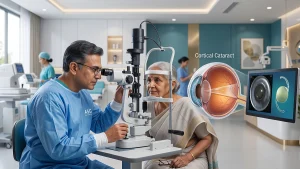
Slit-Lamp Examination: A slit lamp allows the doctor to examine the eye’s structures, including the lens, under high magnification and illumination.

Ultrasound: In cases where it’s challenging to visualize the eye structures, ultrasound imaging may be employed to get a clearer picture.


Treatment for Cataract in Children

Surgery: The primary treatment for pediatric cataracts is surgical removal of the cloudy lens. This is usually done under general anesthesia, and an artificial lens may be implanted to restore clear vision.

Contact Lenses or Glasses: In some cases, especially if an intraocular lens cannot be implanted, contact lenses or glasses may be prescribed to correct vision.

Visual Rehabilitation: After surgery, children may need vision therapy or rehabilitation to enhance their visual skills and adapt to the changes in their vision.

Follow-Up Care: Regular follow-up appointments are crucial to monitor the child’s progress and address any issues that may arise post-surgery.


Conclusion:

Cataracts in children can present unique challenges, requiring prompt diagnosis and appropriate intervention. Parents and caregivers are crucial in ensuring regular eye check-ups and seeking medical attention if any signs of visual impairment are noticed. With advancements in medical technology and surgical techniques, the prognosis for children with cataracts has significantly improved, allowing them to lead normal, healthy lives with clear vision. Early detection and intervention are key to minimizing the impact of pediatric cataracts on a child’s visual development and overall well-being.

Overview

Job Title: Consultant Ophthalmologist

Location: Pan India
Job Category: Medical Healthcare

Work Employment:  Full time

What you work:

  • Diagnose and treat patients with a focus on Ophthalmologist.
  • Collaborate with senior doctors and multidisciplinary teams.
  • Ensure patient-centric care and follow clinical protocols.
  • Contribute to research, training, or hospital initiatives (if applicable).

Mandatory skills:

  • Relevant medical degree / certification.
  • Strong knowledge of ophthalmology practices / healthcare protocols.
  • Excellent communication and patient-handling skills.
  • Ability to work in fast-paced healthcare environments.

Preferred Qualifications:

  • Experience: 3 to 6 years of experience
  • Prior experience in eye care / multi-speciality hospitals.
  • Fellowship or advanced training in Ophthalmologist.
  • Familiarity with advanced diagnostic tools and surgical techniques.
  • Passion for innovation, patient care, and continuous learning.

Apply For This Positions

This will close in 0 seconds

Overview

Job Title: Optometrist

Location: Amritsar, Punjab 

Job Category: Optometry

Work Employment:  Full time

What you work:

  • Conduct comprehensive eye examinations and vision assessments for patients of all ages.
  • Prescribe and fit spectacles, contact lenses, and low-vision aids.
  • Perform diagnostic tests including refraction, tonometry, perimetry, and OCT imaging.
  • Support consultant ophthalmologists in pre-operative and post-operative patient workups.
  • Counsel patients on eye care, lens hygiene, and follow-up schedules.
  • Maintain accurate clinical records and adhere to hospital protocols.

Mandatory skills:

  • Bachelor’s or Master’s degree in Optometry (B.Optom / M.Optom) from a recognised institution.
  • Valid registration with the relevant state or national optometry council.
  • Proficiency in refraction, slit-lamp examination, and contact lens fitting.
  • Working knowledge of autorefractors, tonometers, fundus cameras, and OCT equipment.
  • Strong communication skills in English, Hindi, and Punjabi.
  • Ability to manage high patient volumes in a fast-paced clinical setting.

Preferred Qualifications:

  • Experience: 1 to 5 years of clinical optometry experience.
  • Prior experience in an eye care or multi-speciality hospital in Punjab.
  • Exposure to paediatric optometry, binocular vision, or low-vision rehabilitation.
  • Familiarity with advanced diagnostic imaging and dry-eye management.
  • Passion for patient care, community eye-health camps, and continuous learning.

Apply For This Positions

This will close in 0 seconds

Overview

Job Title: Optical In-charge 

Location: Panjim, Goa / Mumbai-Worli (Lower Parel) 

Job Category: Optical

Work Employment:  Full time

What you work:

  • Manage day-to-day operations of the optical outlet, including sales, dispensing, and inventory.
  • Guide customers on frame selection, lens options, and coatings based on their prescription and lifestyle.
  • Take accurate frame measurements and ensure precise fitting, adjustments, and after-sales service.
  • Drive optical sales targets and monitor daily, weekly, and monthly business performance.
  • Maintain optimum stock levels, coordinate with vendors, and control shrinkage through periodic audits.
  • Supervise and train optical staff on product knowledge, dispensing standards, and customer service.
  • Coordinate with optometrists and consultants to ensure smooth prescription-to-delivery flow.
  • Ensure visual merchandising, display hygiene, and adherence to brand and hospital standards.

Mandatory skills:

  • Diploma or Bachelor’s degree in Optometry (D.Optom / B.Optom) or equivalent optical dispensing qualification.
  • Minimum 3 years of experience in optical supervisory or in-charge role.
  • Sound knowledge of lens types, coatings, frame materials, and dispensing principles.
  • Hands-on experience with edging, fitting, and basic optical workshop equipment.
  • Proven ability to achieve sales targets and manage inventory and billing systems.
  • Strong communication and interpersonal skills in English, Hindi, and Konkani or Marathi.
  • Working knowledge of POS / retail software and MS Office.

Preferred Qualifications:

  • Experience: 3 to 7 years in optical retail or an eye care hospital optical division.
  • Prior experience managing an optical outlet in Goa or the western region.
  • Exposure to premium and progressive lens brands and specialty eyewear.
  • Familiarity with contact lens dispensing and after-care support.
  • Team leadership, customer relationship management, and continuous learning mindset.

Apply For This Positions

This will close in 0 seconds

Overview

Job Title: Optometrist

Location: Pan India 


Job Category: Optometry

Work Employment:  Full time

What you work:

  • Conduct comprehensive eye examinations and vision assessments for patients of all ages.
  • Prescribe and fit spectacles, contact lenses, and low-vision aids.
  • Perform diagnostic tests including refraction, tonometry, perimetry, and OCT imaging.
  • Support consultant ophthalmologists in pre-operative and post-operative patient workups.
  • Counsel patients on eye care, lens hygiene, and follow-up schedules.
  • Maintain accurate clinical records and adhere to hospital protocols.

Mandatory skills:

  • Diploma / Bachelor’s or Master’s degree in Optometry (D.Optom / B.Optom / M.Optom) from a recognised institution.
  • Valid registration with the relevant state or national optometry council.
  • Proficiency in refraction, slit-lamp examination, and contact lens fitting.
  • Working knowledge of autorefractors, tonometers, fundus cameras, and OCT equipment.
  • Ability to manage high patient volumes in a fast-paced clinical setting.

Preferred Qualifications:

  • Experience: 1 to 5 years of clinical optometry experience.
  • Exposure to paediatric optometry, binocular vision, or low-vision rehabilitation.
  • Passion for patient care, community eye-health camps, and continuous learning.

Apply For This Positions

This will close in 20 seconds