The term eye surgery covers a wide range of procedures some that restore lost vision, some that eliminate the need for glasses, and some that prevent deterioration from progressing. This guide explains the most common types of eye surgery performed in India today, without assuming prior medical knowledge.
LASIK Surgery
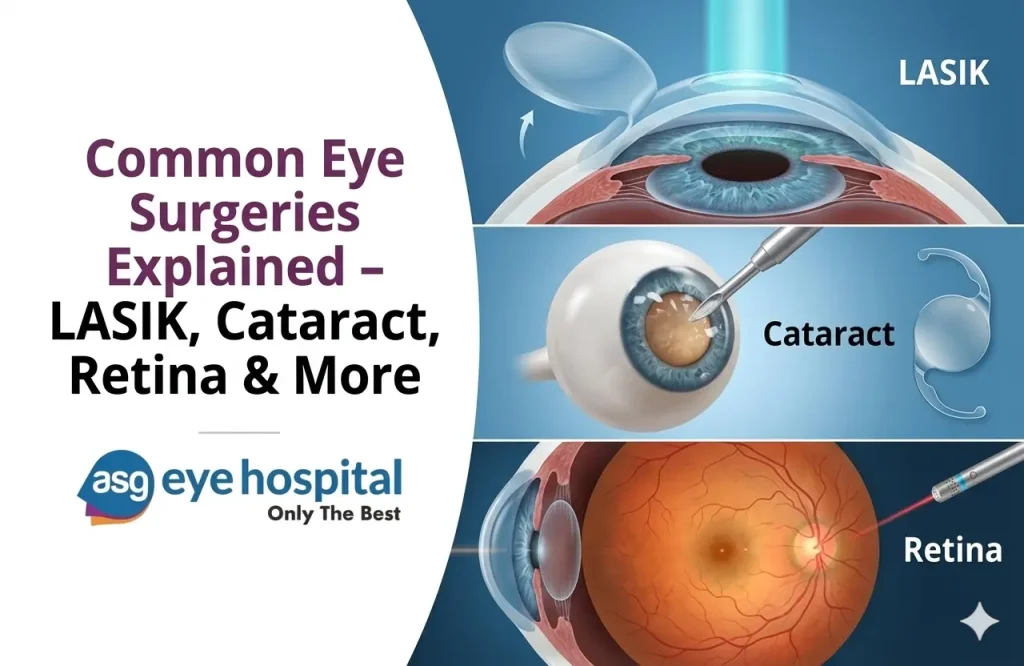
LASIK surgery corrects short-sightedness, long-sightedness, and astigmatism by reshaping the cornea with a laser. A thin flap is created, the underlying corneal tissue is ablated to change its curvature, and the flap is repositioned without stitches. The procedure takes around 15 minutes per eye, and most patients see clearly within 24 hours.
Candidates need corneas of sufficient thickness, a stable prescription for at least a year, and no corneal disease such as keratoconus. PRK and SMILE are alternatives for patients who are unsuitable for LASIK -PRK removes the surface epithelium rather than creating a flap, and SMILE uses a smaller flapless incision.
Cataract Surgery
Cataract surgery is the most performed eye operation in the world and one of medicine’s most predictable procedures. The clouded natural lens is broken up with ultrasound energy (phacoemulsification), suctioned out, and replaced with a clear artificial intraocular lens (IOL). It takes around 15–20 minutes under local anaesthesia.
The IOL choice is the most significant variable. A standard monofocal lens corrects distance vision, with reading glasses still needed. Toric lenses correct astigmatism at the same time. Multifocal and extended depth-of-focus lenses aim to reduce dependence on glasses at all distances. IOL type also drives most of the variation in eye operation cost.
Retina Surgery
Retina surgery addresses conditions at the back of the eye. Vitrectomy -the core technique -involves removing the vitreous gel and working directly on the retinal surface through small ports. It is used for retinal detachment repair, diabetic vitreous haemorrhage, macular hole closure, and epiretinal membrane removal.
Retinal detachment is the most urgent retina surgery indication. Once the macula detaches, visual recovery after repair is significantly reduced. Laser photocoagulation treats retinal tears and leaking blood vessels in an outpatient setting, without incisions, and is used at earlier stages before detachment occurs.
Glaucoma Surgery
Glaucoma surgery lowers intraocular pressure to prevent further optic nerve damage. It does not restore vision already lost. Trabeculectomy creates a new drainage channel in the eye wall and remains the standard for moderate to severe glaucoma. Minimally invasive glaucoma surgery (MIGS) uses smaller incisions and works with the eye’s existing drainage anatomy -lower risk, less IOP reduction, typically combined with cataract surgery.
Other Common Eye Surgeries
Beyond LASIK, cataract, retina, and glaucoma procedures, several other operations are frequently performed:
- Corneal transplant -replaces damaged corneal tissue with donor cornea, in full or partial thickness, depending on which layers are affected
- Pterygium surgery -removes the conjunctival growth extending onto the cornea, with a graft to reduce recurrence
- Oculoplastic surgery -corrects eyelid conditions, including ptosis, entropion, and tear duct obstruction
- Squint surgery -adjusts extraocular muscle tension to realign eyes that point in different directions
Eye Operation Cost – What Influences It
The implant or technology used is the primary cost variable across most eye surgeries. In cataract surgery, a premium multifocal IOL costs significantly more than a standard monofocal. In LASIK surgery, an all-laser bladeless platform costs more than a microkeratome-assisted approach. The facility, surgeon experience, and post-operative care all contribute to the total figure.
Is a lower-priced procedure the same as a higher-priced one if it has the same name?
No, the comparison is only valid on like-for-like terms: same IOL type, same laser platform, same surgeon grade. The pre-operative consultation is the right place to understand exactly what each quoted cost includes.
Final Thoughts
Most common eye surgeries today are safe, fast-recovering, and highly effective when performed on appropriately selected patients. The right procedure depends on a proper evaluation of the individual eye.
ASG Eye Hospital, with centres in Kolkata, Delhi, Pune, Noida, and more, offers the full range of eye surgeries described here. Every recommendation follows a detailed pre-operative evaluation and a clear discussion of options and costs.
FAQs
1. What are the most common types of eye surgery?
Cataract surgery and LASIK are the most frequently performed. Retina surgery, glaucoma surgery, corneal transplant, and oculoplastic procedures are also among the most common worldwide.
2. Is LASIK surgery permanent?
The corneal reshaping is permanent, but the eyes continue to age naturally. Most patients enjoy clear vision for many years, though reading glasses become necessary with age-related presbyopia regardless of LASIK.
3. How long does cataract surgery recovery take?
Most patients see clearly within a few days. Full stabilisation takes four to six weeks. Restrictions on driving, lifting, and swimming apply for the first one to two weeks.
4. Is retina surgery painful?
Most retina surgeries are performed under local anaesthesia with sedation, so there is no pain during the procedure. Some discomfort and restriction on activity are expected in the days following surgery.
5. What drives the difference in eye operation cost?
The implant or technology chosen is the main variable. IOL type in cataract surgery, the laser platform in LASIK, and the materials used in retina surgery all affect the final figure, alongside facility and surgeon fees.