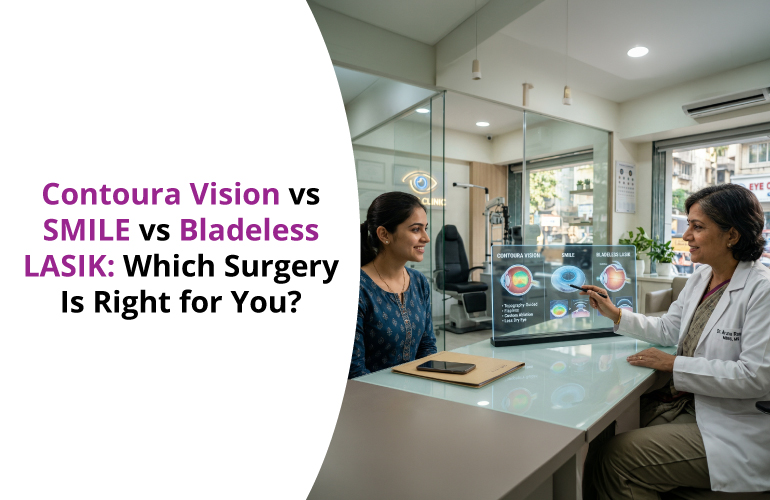
Over the last ten years, refractive eye surgery has developed into a field that provides various surgical methods that enable patients to treat their myopia, hyperopia, and astigmatism. The three main surgical methods that exist today are Contoura Vision, SMILE, and Bladeless LASIK.
Patients need to understand the differences between these procedures because they help them achieve better visual results while experiencing fewer complications after surgery. The article presents a precise clinical assessment of the surgical procedures, which assists readers in making educated choices.
Overview of Refractive Surgeries
Refractive surgeries use corneal reshaping techniques to treat refractive errors, which helps patients achieve better vision without needing contact lenses or eyeglasses. The standard procedure for decades has been LASIK, but newer methods such as Contoura Vision and SMILE provide better accuracy and safer outcomes.
The different medical procedures offer distinct benefits and drawbacks which determine their appropriate use for various patient conditions.
Contoura Vision
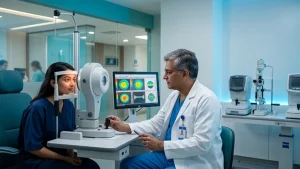
Contoura Vision represents an advanced variation of laser-assisted in situ keratomileusis (LASIK), which uses topography-guided technology for its operation. The Contoura Vision system creates a custom ablation pattern through its mapping process, which analyses more than 22000 corneal points.
The high-definition mapping technology enables precise treatment of corneal surface irregularities, which results in decreased higher-order aberrations and improved visual performance.
Key Features
- Precision: The laser treatment, which uses topography maps, targets particular corneal irregularities.
- Visual Outcomes: Patients who undergo this procedure experience better vision results than those who receive standard LASIK treatment.
- Suitability: The procedure works best for patients who have corneal irregularities and severe astigmatism and who want to achieve high-quality visual results.
SMILE (Small Incision Lenticule Extraction)
The SMILE procedure performs eye surgery through a compact method to treat myopia and astigmatism. The surgical technique of SMILE removes a lenticule through a small corneal incision while preserving the complete structure of the cornea, which is different from LASIK, which needs a corneal flap to be made.
Key Features
The surgical technique requires no flap creation, which results in fewer chances for patients to develop flap-based medical complications. The procedure maintains corneal biomechanical stability through its preservation of corneal strength. The procedure results in decreased postoperative drying symptoms while patients experience faster vision stabilization.
The modern bladeless LASIK system represents an advanced version of traditional LASIK operations. The key difference between this system and traditional LASIK operations comes from its method of creating a flap: a femtosecond laser creates the corneal flap instead of using a mechanical microkeratome. The laser then reshapes the cornea to correct the refractive error.
Indications for SMILE, LASIK, and Contoura Vision Surgery
Contoura Vision: Recommended for patients who have irregular corneal topography with high astigmatism or for patients who wish to achieve the highest-quality visual results.
SMILE: Appropriate for patients with mild to moderate degrees of myopia with astigmatism who are concerned about flap-related risks to the eye.
Bladeless LASIK: Applicable to a wide range of refractive error candidates; those patients seeking quick recovery from their procedure, as well as good long-term success rates.
Recovery and Postoperative Care
Recovery time between these procedures is similar between SMILE and LASIK patients (approximately 1–3 days to achieve functional vision); however, patients undergoing Contoura Vision may take longer to adapt, as this procedure is customised according to the cornea’s surface contour.
In addition, symptoms of mild discomfort, fluctuation in vision, and dry eyes are normal within weeks following laser corrections. It is essential that all postoperative instructions regarding medication compliance, follow-up appointments, and avoidance of putting strain on the eyes are followed for the best postoperative outcomes.
Which is better: Contoura, SMILE or LASIK?
The choice between the Contoura, SMILE and LASIK methods should be based on specific patient characteristics, which include their corneal thickness, their refractive error, their daily activities and their desired visual results.
Contoura Vision provides patients with the most precise treatment option, which works to minimize their visual impairments. SMILE offers a less invasive treatment method, which does not require a flap to be created, and this method helps maintain better corneal strength during the procedure.
Bladeless LASIK operates as a dependable treatment option that doctors use to help patients achieve fast visual improvements. The most suitable surgical method requires an ophthalmologist to perform a complete preoperative evaluation.
Safety and Long-Term Outcomes
The three surgical methods of Contoura Vision, SMILE and Bladeless LASIK show high safety results while delivering expected visual outcomes. When skilled surgeons operate with sophisticated equipment, the procedure results in minimal complications. The research demonstrates that long-term results maintain their effect through time with only slight backward movement.
The selection process needs to select appropriate patients who should follow their recovery instructions because this practice helps to decrease dangers, which include dry eyes, infections and remaining refractive mistakes.
Patient Considerations
The decision to perform surgery depends on multiple factors:
1. Corneal Thickness: SMILE becomes the preferred option for patients with thin corneas because the procedure preserves most corneal structure.
2. Refractive Error Severity: Contoura Vision provides advantages for patients who experience high myopia or astigmatism.
3. Occupational Needs: People who work in jobs with high chances of eye injuries choose SMILE because it does not require them to cut corneal flaps.
4. Visual Quality Preference: Patients who want to achieve maximum visual acuity in dim light conditions should think about using Contoura Vision.
Difference Between Contoura Vision and SMILE and LASIK
The difference between Contoura Vision, SMILE and LASIK lies primarily in flap creation, corneal mapping, and procedural invasiveness. Contoura Vision focuses on customized corneal reshaping using detailed topography. SMILE emphasises its goal of preserving corneal structural integrity through its approach of reducing surgical impact.
Bladeless LASIK creates accurate corneal flaps, which result in reliable vision correction outcomes. The process of selecting an appropriate treatment method requires knowledge of these treatment options.
Choosing the Best Laser Eye Surgery Contoura vs SMILE vs LASIK
The assessment of which laser eye surgery method, between Contoura and SMILE and LASIK, provides optimal results requires evaluation of three factors, which include individual eye structure, patient lifestyle needs and their expected recovery results.
The selection process requires a complete preoperative assessment, which includes corneal mapping, refractive measurements and ocular surface testing. Patients should talk with an experienced eye doctor about their potential results, dangers and recovery time before they decide.
Conclusion
All three eye surgeries, Contoura Vision, SMILE and Bladeless LASIK, present special benefits that match different requirements of patients. The selection of the most suitable surgical procedure needs to consider both clinical assessments and the objectives of the patient and the recommendations of eye care specialists. The ASG Eye Hospital system provides advanced refractive surgery services through its multiple locations, which permit patients to obtain professional consultation and medical care.
The ASG Eye Hospital provides medical services across India, which include ASG Eye Hospital in Mumbai, ASG Eye Hospital in Delhi, ASG Eye Hospital in Rajasthan, ASG Eye Hospital in Haryana and ASG Eye Hospital in Lucknow The assessment process for visual possibilities requires two components, which include assessment and expert direction to reach optimal vision outcomes while maintaining eye health throughout life.
Frequently Asked Questions
What is the difference between Contoura Vision and SMILE and LASIK?
The process of vision correction performed using topographically mapped corneas with Contoura is different from SMILE, which is a non-invasive (without a flap) procedure, and bladeless LASIK, which uses a femtosecond laser to precisely create flaps in the cornea.
Which is best suited to treat someone with high amounts of astigmatism?
The use of customized corneal mapping to perform Contoura surgery allows a decrease in the amount of higher-order aberrations that patients with high amounts of astigmatism have, which translates to better treatment outcomes.
Do I have the freedom to select my surgical procedure, or is medical examination necessary to determine my treatment?
A comprehensive preoperative assessment is essential to determine which laser eye surgery is best for vision correction based on corneal thickness, refractive error, and lifestyle factors.
What is the main distinction that separates Contoura Vision from SMILE and LASIK?
Contoura Vision technology uses topography mapping to execute its vision correction process, while SMILE functions as a non-invasive procedure without requiring a surgical flap, and Bladeless LASIK uses a femtosecond laser system to create precise corneal flaps.
Which procedure is most effective for treating high astigmatism?
The customized corneal mapping system of Contoura Vision enables superior treatment of high astigmatism because it reduces higher-order aberration problems.
What is the duration of recovery time after patients undergo SMILE or LASIK eye surgery?
Most patients achieve functional vision within 1–3 days, with minimal discomfort or dryness.
Do all three surgical methods provide identical levels of safety?
The three procedures show safe results according to experienced ophthalmologists, who find that they produce predictable long-term outcomes with Contoura Vision, SMILE, and Bladeless LASIK.