When a patient receives a diagnosis of a corneal transplant, the first reaction is often worry. Many think that the whole eye will have to be put out of service which is not the case. In fact in many patients only the affected layer of the cornea requires treatment. DSEK surgery is an advanced option we see which is that of replacing the unhealthy inner layer of the cornea while at the same time leaving the healthy outer layers intact.
DSEK surgery which stands for Descemet Stripping Endothelial Keratoplasty is a type of cornea surgery we turn to when the inner layer of the cornea which is the endothelium begins to fail. The endothelium functions as a pump which removes extra fluid from the cornea thus keeping it clear. Upon failure of the endothelium the cornea may become swollen and cloudy which in turn causes blurred vision, glare, and issues with performing daily tasks.
What we should note is that DSEK surgery is a different procedure from a full thickness corneal transplant. In a full thickness transplant the full depth of the cornea may be replaced. In endothelial keratoplasty, however, the surgeon focuses on the affected internal layer. This makes the treatment more precise, tissue conservation greater, and often the recovery for the patient is easier.
What Is DSEK Surgery?
DSEK surgery is a partial thickness transplant which we use for diseases that primarily affect the corneal endothelium. We remove the diseased endothelial layer and in its place we put in healthy donor tissue. The donor material includes the endothelium, Descemet’s membrane, and a thin layer of supportive corneal tissue.
This type of cornea surgery is reported to be very common in cases of Fuchs’ endothelial dystrophy, pseudophakic bullous keratopathy, or corneal swelling post previous eye surgery. In each of these diseases the internal pump cells do not function properly. As fluid accumulates in the cornea which results in foggy vision, patients report that their vision is misty and as if they are seeing through a frosted over lens.
In contrast to a full thickness corneal transplant, DSEK surgery does not remove the whole cornea. The front and the middle layers are left in place. Also the eye is not opened up as wide which is what happens in a full transplant and as a result the natural strength of the eye is better preserved. Many patients also report a more smooth recovery.
Why Is It Considered a Modern Alternative?
A traditional corneal transplant is used for total cornea scarring and structural damage. But if it is the inner endothelial layer which has failed we may do DSEK surgery instead which targets only the affected layer and leaves the healthy tissue alone.
This is what has brought about the change in the management of corneal diseases via endothelial keratoplasty. We see now that instead of the one full thickness procedure for each and every patient we have at our disposal a tissue specific approach. This may mean less sutures, reduced astigmatism, quicker visual recovery, and better conservation of the natural eye structure.
At present DSEK surgery is a type of cornea surgery. is very delicate. We see that it requires in depth preparation of the donor tissue, precise graft placement, and also regular post op care. Outcomes depend on the health of the eye, the surgeon’s experience, and the patient’s compliance with aftercare instructions.
| Feature | Traditional transplant | DSEK surgery |
| Tissue replaced | Full thickness of the cornea | Mainly the damaged inner layer |
| Common use | Full-thickness scars or severe corneal damage | Endothelial failure with corneal swelling |
| Stitches | Usually more sutures | Fewer or no major corneal sutures |
| Eye structure | More structural change | More natural corneal structure is preserved |
| Recovery pattern | Visual recovery may take longer | DSEK recovery is often smoother in suitable patients |
Who May Need This Procedure?
A patient may require DSEK surgery when the cornea which has become opaque reports to not be as dry and transparent as normal. In which mostly reports of Fuchs’ endothelial dystrophy play a role in which over time endothelial cells degenerate. Also, patients may report a gradual onset of blurred vision in the morning, glare while driving at night, or a continual decrease in visual clarity.
In many cases what we see is that endothelial keratoplasty is performed for corneal swelling which is a result of cataract surgery or any other eye procedure. Also in some patients the endothelial cells may be weak preoperatively. Post surgical stress may cause the cornea to not clear properly which in turn may require a targeted cornea surgery for restoration of transparency.
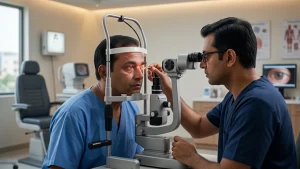
Doctors also will at times turn to this procedure post failed graft or when a past corneal transplant does not improve clarity. We do an in depth exam which includes slit lamp study, pachymetry, endothelial study, visual acuity test, and an overall eye health review.
How Is the Procedure Done?
Before performing the DSEK surgery, the ophthalmologist does a close examination of the cornea, goes over the patient’s health and eye history, and goes into detail regarding what to expect. Also we inform the patient of the post op eye drops, activity restrictions, follow up visits, and the expected DSEK recovery time. This is an important process because although the operation itself may be brief the healing process requires discipline.
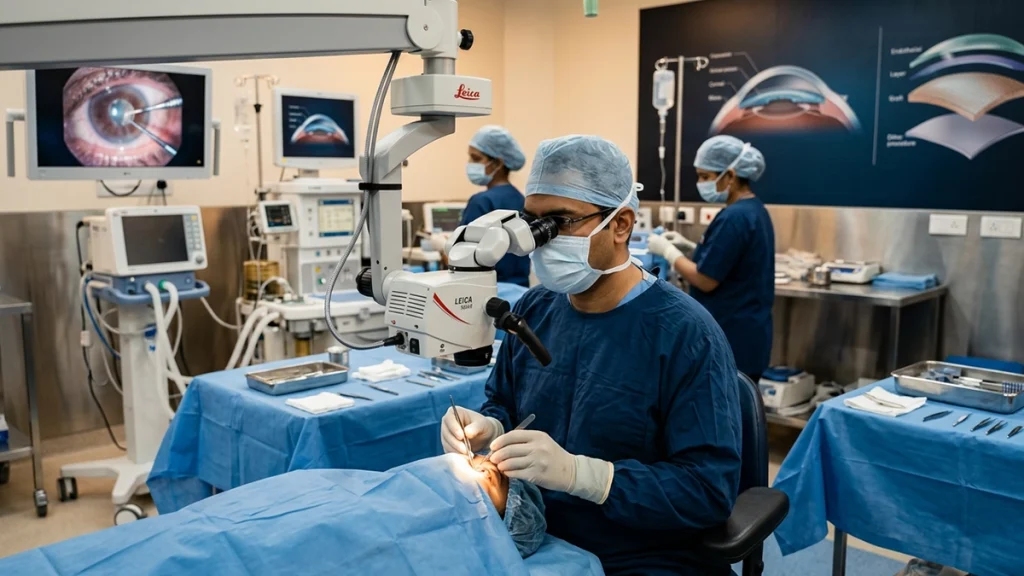
During the DSEK surgery, the damaged inner cornea layer is removed. We insert a prepared donor graft into the eye and we place it at the back of the cornea. We use an air bubble to press the graft into place which in turn allows it to attach properly. Post op the patient may be asked to lie in a specific position for a while which in turn is to support the graft.
In an operating room setting this type of endothelial keratoplasty is performed under local or general anesthesia which is determined by the patient’s age, health status and comfort. As with any cornea surgery, the goal is to perform the procedure safely as well as to have the graft attach and begin to function.
| Stage | What usually happens |
| Before surgery | Eye testing, corneal assessment, counselling, and medication planning |
| During surgery | The damaged endothelial layer is removed and donor tissue is placed |
| Immediately after surgery | An air bubble supports the graft, and positioning advice may be given |
| First few weeks | Drops, follow-up visits, and graft checks are important |
| Longer term | Vision improves gradually as swelling reduces and the graft works better |
What to Expect During Recovery
DSEK recovery is a gradual process. In some patients’ cases we see improved clarity of vision within a few weeks but for some it takes many months. The cornea changes over time, the graft has to fully attach, and the swelling goes down. Early on there may be mild discomfort, watering of the eye, sensitivity to light, or hazy vision.
During DSEK recovery, it is very important that patients use the prescribed eye drops. Steroids are given to reduce inflammation and the risk of graft rejection. We may also use antibiotic drops for a short while which is a measure to reduce the risk of infection. At each follow up visit the doctor will check graft adhesion, state of the cornea, eye pressure, and the progress of the healing process.
The key to DSEK recovery is consistency. Patients must not discontinue meds without recommendation, skip visits, or attempt to rub the eye. Symptoms of sudden redness, pain, light sensitivity, or reduction in vision should be reported right away as early intervention may preserve the graft.
Benefits of DSEK
In DSEK surgery what we see is that it repairs the affected inner layer which at the same time preserves the healthy front section of the cornea. This tissue conservation is in part what has made endothelial keratoplasty a very good choice for patients with endothelial disease.
Compared to a full corneal transplant, which is a full replacement of the cornea our procedure has the advantage of less suture issues and a reduced chance of large scale changes in corneal shape. Also because we aren’t replacing the entire outer layer of the cornea the eye itself may stay more stable. For right patients this procedure can produce very meaningful vision and comfort improvement.
However that treatment does not apply to all corneal issues. If the front layers of the cornea are scarred, irregular, or very damaged a different cornea surgery may be required. A cornea specialist will determine the best option which is based out of which layer of the cornea is affected.
Risks and Possible Complications
In that which concerns eye surgeries there is risk and DSEK surgery is no exception. We see that the graft may partially detach which in turn may require what is commonly referred to as a rebubbling procedure. Also there is a temporary increase in eye pressure, inflammation, infection, rejection, and graft failure which is a possibility though with prompt care and regular follow up serious complications are made less so.
A patient going in for endothelial keratoplasty should know the signs of rejection. Redness, light sensitivity, pain, or sudden change in vision should always be reported. These symptoms require immediate attention by an eye specialist.
The risk profile for DSEK is different from that of a full corneal transplant. In full transplants’ case you see more issues related to wounds which is not the issue in DSEK that rather has problems with graft attachment and endothelial cell function. Also it is key that both procedures be very well planned out, use of very sterile surgical technique, and have very long term follow up.
How It Compares with Other Treatment Options
There are various types of cornea surgery, which are chosen for different reasons. Penetrating keratoplasty replaces the full depth of the cornea. DALK which stands for Donor Lamellar Keratoplasty treats the front and middle layers of the cornea while preserving the endothelium. DMEK or Descemet Membrane endothelial keratoplasty uses a very thin donor layer.
There are various types of cornea DSEK surgery which are chosen for different reasons. Penetrating keratoplasty replaces the full depth of the cornea. DALK which stands for Donor Lamellar Keratoplasty treats the front and middle layers of the cornea while preserving the endothelium. DMEK or Descemet Membrane Endothelial Keratoplasty uses a very thin donor layer.
DSEK at ASG Eye Care
At ASG Eye Care we have a very thorough evaluation of patients which present with corneal swelling, cloudy cornea, or early signs of endothelial disease before we recommend DSEK surgery. The exam may include vision testing, slit lamp evaluation, measurement of corneal thickness, analysis of endothelial cells, checking of eye pressure, and we may also do a retinal assessment as is needed.
The issue is what to do: we put our money into endothelial keratoplasty or into a different treatment, into watchful waiting or another type of cornea surgery. Some patients may do fine with no intervention at all, while in other cases early intervention may prevent the corneal condition from worsening.
Patients are given information on DSEK recovery, use of donor tissue, follow up visits, eye drop regimens, and signs which require urgent care. This in turn reduces fear related to the transplant recommendation and allows patients to put forth informed and confident decisions.
Key Takeaway
DSEK surgery procedure which is a relatively new option for patients that have a cloudy cornea due to the endothelial layer’s poor function. It is a part of the category of endothelial keratoplasty which in turn only includes the damaged internal layer rather than the full cornea.
In the same way that other cornea surgery does, it requires careful diagnosis, skill in surgical planning, and proper after care. For the right patient it may be a strong option to a standard corneal transplant. DSEK recovery may be smooth for many patients’ but healing is a slow process and follow up is very important.
Frequently Asked Questions
1. What is DSEK?
DSEK surgery is a partial-thickness operation in which the damaged endothelial layer of the cornea is removed and replaced with healthy donor tissue. It is mainly used when endothelial failure causes corneal swelling and cloudy vision.
2. Is DSEK the same as a transplant?
It is a type of corneal transplant, that is not a full thickness one. It replaces what is damaged in the inner layer of the cornea and leaves the healthy outer layers alone.
3. How long does recovery take?
DSEK recovery is variable among patients. In many it improves within weeks, but full visual recovery may take several months. It is important for follow up and that which of the prescribed eye drops be used properly.
4. Is endothelial treatment better than a traditional transplant?
This treatment is best for what is contained in the inner layer of the cornea. When the full cornea is scarred or has structural damage, other transplant options may be a better fit.
5. Is this considered a corneal procedure?
Yes. This is what we term cornea surgery as it directly works on the corneal tissue but it is more precise than a full thickness transplant.
6. What precautions are needed after surgery?
During DSEK recovery, patients should refrain from rubbing the eye, use eye drops as directed by the doctor, attend all follow up appointments, and report to your health care provider immediately at the onset of sudden pain, redness, light sensitivity, or reduced vision.