Jaipur’s population is aging faster than its healthcare conversations are catching up. A large proportion of people in the city have intraocular pressures which are higher than normal, or early optic nerve changes that are not discussed by their GP and are not picked up by their optician. Glaucoma is not an uncommon disease in Jaipur. The thing that’s unusual is when the patient discovers it before his peripheral vision begins to close up.
This disconnect between intraocular events and patient’s awareness is the hallmark of glaucoma therapy. It is also one of the reasons why glaucoma treatment Jaipur should have to take place earlier, more frequently, and with a better diagnostic facility as compared to what it is in Jaipur.
What Is Glaucoma?
Glaucoma is a serious eye disease that damages the optic nerve due to increased eye pressure or poor optic nerve health. It develops slowly without early symptoms and can cause permanent vision loss if untreated. Early glaucoma treatment in Jaipur through regular eye check-ups, pressure testing, OCT scans, and visual field analysis helps protect vision and prevent blindness.
Why Glaucoma Behaves Differently From Other Eye Conditions
Most eye problems announce themselves. Cataract blurs vision gradually. A retinal issue produces floaters or flashes. Dry eyes cause daily discomfort. Glaucoma does none of these things in its early stages. Intraocular pressure builds. Optic nerve fibres die. Visual field shrinks from the periphery inward. And the patient feels absolutely nothing.
The brain is very efficient at making up for peripheral vision deficits. It fills in the gaps automatically, without the patient registering that anything has changed. By the time the loss becomes noticeable, it typically represents a significant and permanent reduction in optic nerve function. No glaucoma treatment reverses this loss. Every treatment option available to an eye specialist Jaipur is designed to prevent further damage, not recover what has already gone.
The Risk Profile That Jaipur Patients Should Know
Not every person in Jaipur carries equal glaucoma risk. The risk factors are prevalent enough, however, that talking about it is important for all adults past age 40. The risk of glaucoma is 4-9 times higher if there is a family history of glaucoma. Diabetic patients carry significantly elevated risk. High myopia, a condition that has become considerably more prevalent among Jaipur’s younger working population, places mechanical stress on the optic nerve that normal intraocular pressure can still damage over time.
Individuals on long-term steroid medication, whether prescribed for asthma, skin conditions, or joint problems, also carry higher risk because steroids elevate intraocular pressure as a side effect that most prescribing physicians do not monitor for. An eye doctor who knows a patient is on chronic steroids should be checking pressure at least annually. Many do not.
What Glaucoma Treatment Jaipur Actually Looks Like
The good news for Jaipur patients is that glaucoma treatment, when started at the right time, is highly effective at preserving existing vision. The treatment pathway is staged based on the severity of the condition at presentation.
For early and moderate glaucoma, pressure-lowering eye drops form the foundation of eye treatment. Daily application reduces intraocular pressure and protects the remaining optic nerve fibres from further damage. The most common reason this treatment fails is obedience, not because the drug doesn’t function, but rather because a patient who doesn’t feel anything is not told every day that missing doses has effects.
When drops are insufficient, selective laser trabeculoplasty offers an office-based procedure that improves aqueous drainage without incision. This procedure, available at ASG Eye Hospital’s Jaipur eye clinic, reduces pressure sustainably and is well-tolerated with minimal recovery time.
Even if more serious glaucoma will require surgery when other treatments are unsuccessful when pressure is not under control. The new drainage holes made during the trabeculectomy and tube shunt surgeries have long-lasting effects on lowering intraocular pressure. They are done at the specialist eye hospital by an eye surgeon who has special training in treating glaucoma.
Common Glaucoma Symptoms & Recommended Eye Care Actions
| Glaucoma Sign | Recommended Action |
|---|---|
| Blurred vision | Eye check-up |
| High eye pressure | Glaucoma screening |
| Peripheral vision loss | Visit eye specialist |
| Family history | Annual eye exam |
| Eye pain/headache | Emergency consultation |
Why ASG Eye Hospital Is the Right Choice for Jaipur Patients
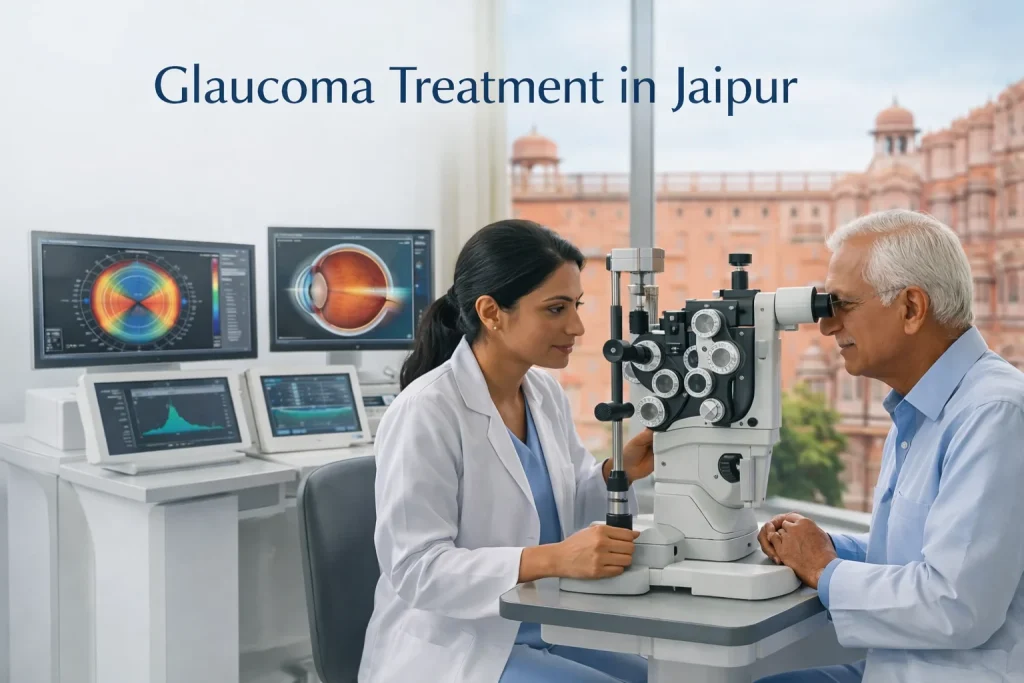
ASG Eye Hospital brings to Jaipur the diagnostic and surgical infrastructure that glaucoma management requires at every stage of the disease. The eye specialist Jaipur team at ASG conducts comprehensive evaluations that include applanation tonometry, optical coherence tomography for optic nerve fibre layer imaging, and automated visual field testing.
This combination — pressure measurement, structural imaging, and functional assessment — is the diagnostic standard that separates a thorough glaucoma evaluation from a basic eye care appointment. Patients who have only ever had their pressure checked are not receiving complete glaucoma screening.
The Appointment That Costs Nothing to Keep and Everything to Miss
A single comprehensive glaucoma evaluation at an eye hospital like ASG takes under two hours. For a patient with no symptoms and no diagnosis, this appointment is the only mechanism available to find what they cannot feel.
Jaipur has the eye care infrastructure to catch glaucoma early. The question is whether patients will make use of it before the condition makes the decision for them.
FAQs
1. What are the early symptoms of glaucoma?
Early glaucoma usually has no noticeable symptoms. Peripheral vision loss develops slowly and may go unnoticed until significant optic nerve damage occurs.
2. Can glaucoma cause permanent blindness?
Yes. Glaucoma-related optic nerve damage is irreversible. Early diagnosis and treatment are essential to protect remaining vision.
3. Who is at higher risk of glaucoma?
People above 40 years, diabetics, patients with high eye pressure, family history of glaucoma, high myopia, and long-term steroid users are at higher risk.
4. What tests are used to diagnose glaucoma?
Glaucoma diagnosis includes eye pressure testing, OCT optic nerve scans, visual field testing, pachymetry, and gonioscopy.
5. Is glaucoma treatment permanent?
Glaucoma treatment controls eye pressure and slows further optic nerve damage, but it cannot restore lost vision permanently.
6. What are the treatment options for glaucoma?
Treatment options include medicated eye drops, laser glaucoma treatment, and glaucoma surgery depending on disease severity.
7. Is glaucoma surgery safe?
Modern glaucoma surgeries are considered safe and effective when performed by experienced glaucoma specialists at advanced eye hospitals.
8. How often should glaucoma screening be done?
Adults above 40 or those with risk factors should undergo comprehensive glaucoma screening every 1–2 years.