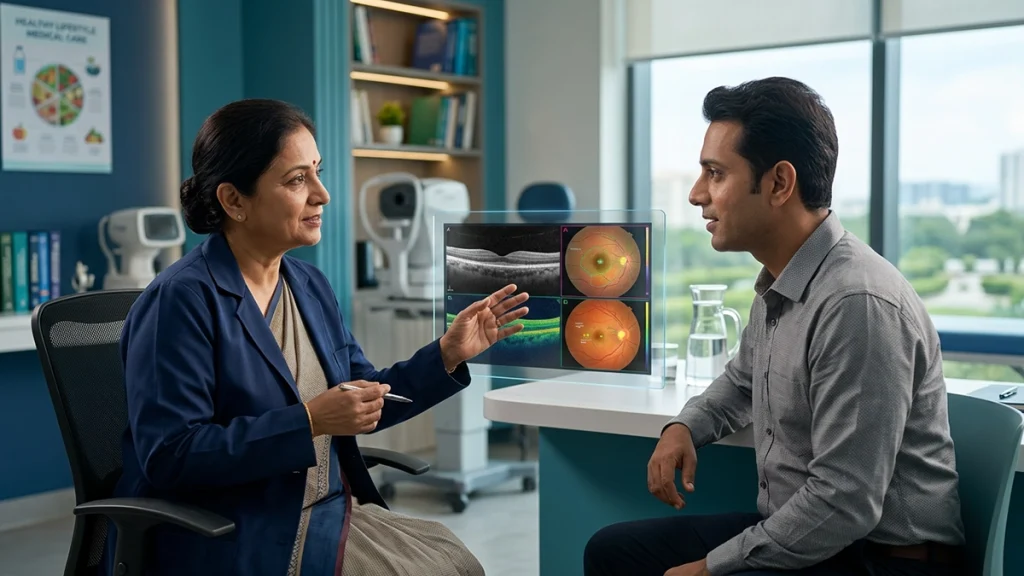
Questions related to GLP-1 Weight Loss Drugs and Vision are put forth often. Patients report issues with focus or concern over diabetic retinopathy and rare optic nerve issues. GLP-1 Weight Loss Drugs and Vision have many paths of connection which depend on the drug used, glucose levels, present eye disease, and symptom picture.
This guide presents GLP-1 Eye Side Effects, Semaglutide Vision Changes, Weight Loss Drugs and Eyes, Ozempic Vision Problems, Wegovy Eye Side Effects, and Monjaro Vision Changes. Most users of GLP-1 Medications will not see serious eye damage, but we do pay attention to Eye Health, Blurred Vision, and Retina Health in people with diabetes.
What Are GLP-1 Medicines?
GLP-1 receptor agonists produce a gut hormone related to appetite, insulin release, and glucose regulation. Semaglutide is in Ozempic, Wegovy, and Rybelsus which also includes Zepbound in Monjaro and Zepbound that acts on GIP and GLP-1 pathways. As for GLP-1 Weight Loss Drugs and Vision, which is what this is relevant to, it is important to note that what we see with semaglutide may not apply to all drugs in the group.
Doctors put out GLP-1 Medications for type 2 diabetes and obesity related care. Weight Loss Drugs and Eyes may see direct toxicity but in many cases what is noted is from rapid glucose changes or from diabetes itself. For GLP-1 Weight Loss Drugs and Vision and Vision we must look at the patient’s history as we do the drug name. Also different GLP-1 Medications have their own specific details.
Why Can Vision Become Blurry?
High blood sugar can cause changes in the body’s fluids which in turn affect the eye’s ability to focus. As treatment which reduces glucose progresses the focus may change again which presents as Blurred Vision. Some Semaglutide Vision Changes may be transient until glucose stabilizes although a new symptom still requires evaluation by the prescriber and ophthalmologist. This is to say that Weight Loss Drugs and Eyes should be evaluated clinically and not so much on online assumption.
The practical issue with GLP-1 Weight Loss Drugs and Vision is that timing and what we see is a matter of pattern. We see mild, variable blurring in both eyes as opposed to sudden painless loss of sight in one eye. Reports of Ozempic Vision Problems may bring together unrelated Eye Health issues. An Eye Health exam is what will separate out a focus shift from retinopathy, cataract, dry eye, retinal disease, or an optic nerve emergency. That is the key to GLP-1 Weight Loss Drugs and Vision.
Diabetic Retinopathy and Rapid Glucose Improvement
Diabetic retinopathy is a result of diabetes which affects small blood vessels in the retina. In the main it is well that good long term glucose control protects Retina Health, but we see that a large and quick improvement in HbA1c may in fact temporarily worsen pre-existing retinopathy. It is in the people which have retinopathy to begin with, high starting HbA1c, insulin use, or a large early drop in glucose that we see the greatest concern regarding GLP-1 Eye Side Effects
Current Ozempic prescribing information reports diabetic-retinopathy complications in 3.0% of semaglutide-treated participants and 1.8% of placebo-treated participants in a two-year trial involving people with type 2 diabetes and high cardiovascular risk. These findings inform conversations about Ozempic Vision Problems, but they do not predict harm for every patient. Monitoring is appropriate when considering GLP-1 Weight Loss Drugs and Vision, particularly when Retina Health is already affected.
What the Product Information Says
Wegovy’s prescribing info reports on diabetic retinopathy issues in patients with type 2 diabetes. In a weight loss study which included adults with type 2 diabetes retinopathy was reported in 4.0% of the Wegovy treated group and 2.7% of the placebo group. These results are what has put forth the issue of Wegovy Eye Side Effects. Any suspected Wegovy Eye Side Effects with Wegovy still has to be looked at in context of retinal status and glucose change.
Mounjaro’s label reports that the drug has not been studied in patients with serious or treatment requiring diabetic retinopathy and they recommend to closely monitor people with that history. This is an issue when patients report Manjaro Vision Changes. Also because Monjaro Vision Changes are a symptom instead of a diagnosis it does not prove retinal toxicity. In the discussion of GLP-1 Weight Loss Drugs and Vision, diabetes and quick glucose improvement still are very much players.
Eye Symptoms and What They May Mean
| Symptom or situation | Possible explanation | Appropriate response |
| Fluctuating Blurred Vision in both eyes | Glucose-related focusing shift, dry eye, or spectacle-power change | Contact the treating doctor; arrange an eye examination if it persists |
| New floaters, flashes, dark patches, or distortion affecting Retina Health | Retinal bleeding, swelling, tear, or diabetic-retinopathy progression | Seek prompt ophthalmic assessment |
| Sudden painless clouding or loss of vision in one eye | Possible retinal or optic nerve emergency | Obtain urgent emergency eye care |
| Suspected GLP-1 Eye Side Effects after a dose change | Glucose change, another medicine, or an unrelated eye condition | Record the timing and obtain medical advice |
| Concerns about Semaglutide Vision Changes, Ozempic Vision Problems, Wegovy Eye Side Effects, or Mounjaro Vision Changes | Each medicine and symptom needs individual assessment | Share the product and dose, diabetes history, and eye history |
Semaglutide and the Rare NAION Warning
In a recent safety update GLP-1 Weight Loss Drugs and Vision have become a clinical issue. In early 2026 the UK Medicines and Healthcare products Regulatory Agency reported that out of very large number of patients treated with semaglutide which is a form of GLP-1 weight loss drug, a very small number reported with non-arteritic anterior ischaemic optic neuropathy or NAION. NAION is a condition which affects blood flow to the front of the optic nerve and which in turn usually causes sudden, painless sight loss which may also present as a clouding of vision and which also tends to present in one eye.
The MHRA estimated that the possible reaction may affect up to 1 in 10,000 people taking semaglutide and advised urgent ophthalmological assessment for sudden vision loss. The warning is relevant to Semaglutide Vision Changes, including sudden Semaglutide Vision Changes, Ozempic Vision Problems, and Wegovy Eye Side Effects. It does not mean all GLP-1 Eye Side Effects are NAION. Other GLP-1 Eye Side Effects may have different causes.
The European study came to a similar result for semaglutide. In the UK update other GLP-1 agonists were left out. Also Monjaro Vision Changes should not be put forth as the same specific signal for semaglutide. We put forth clear communication on GLP-1 Weight Loss Drugs and Vision which in turn avoids the dismissal of real symptoms at the same time puts down unnecessary alarm.
Who May Need Closer Monitoring?
People which include in the groups of diabetic retinopathy, macular oedema, past retinal treatment, very high HbA1c, long term diabetes, kidney disease, insulin use, or optic nerve disease may require greater collaboration between their physician and ophthalmologist. In these cases we recommend that an Eye Health care plan be put in place at the start of or soon after commencement of intensive glucose lowering treatment. Also we see that Careful use of GLP-1 Medications may be tailored to each patient’s Eye Health needs.
A baseline dilated retinal examination documents the retina and optic nerve. People with diabetes commonly need regular dilated examinations, with frequency adjusted to risk. It can help interpret later Blurred Vision and identify meaningful Semaglutide Vision Changes. This does not mean GLP-1 Medications are unsuitable for everyone with retinopathy; it means GLP-1 Weight Loss Drugs and Vision should be reviewed together. The benefits, glucose-lowering plan, and follow-up schedule should be personalized when evaluating GLP-1 Weight Loss Drugs and Vision.
A baseline dilated retinal exam reports the retina and optic nerve. In diabetics we see very often the routine of dilated exams which is to be adjusted according to risk. It also helps in the interpretation of later Blurred Vision and to identify meaningful Semaglutide Vision Changes.This is not to say that GLP-1 Medications are off the table for all with retinopathy; we mean that GLP-1 Weight Loss Drugs and Vision should be looked at as a pair. The benefits, glucose lowering plan and follow up schedule should be tailored to each person when looking at GLP-1 Weight Loss Drugs and Vision.
Practical Eye-Monitoring Plan
| Treatment stage | What to check | Why it matters |
| Before starting | HbA1c, retinal history, previous treatment, current vision, and baseline Eye Health | Establishes risk and a comparison point |
| Early weeks or after dose increases | Glucose trend, Blurred Vision, floaters, flashes, distortion, or field loss | Helps identify focusing shifts and urgent disease |
| During follow-up | Dilated examination and imaging to review Retina Health | Detects retinopathy progression or macular swelling |
| Reviewing GLP-1 Eye Side Effects | Exact drug, dose, start date, symptoms, and speed of glucose reduction | Prevents every symptom being blamed on one medicine |
| Discussing Weight Loss Drugs and Eyes | Coordination between the prescriber and ophthalmologist | Supports safe, individual decisions |
Should You Stop Treatment After a Vision Change?
Do not discontinue a medication at which you read about Weight Loss Drugs and Eyes online. Concerns about Weight Loss Drugs and Eyes require medical review, not self-directed changes. Changing treatment without advice from your health care provider can destabilize glucose. Contact the prescriber and also in for an eye exam. The plan may include monitoring, eye treatment, dose adjustment, or a different medicine.
Sudden loss of vision, rapid onset of cloudiness, a curtain going over the eye, many new floaters, flashes of light, severe eye pain, or loss of part of what you see requires right away care. In any report of GLP-1 Weight Loss Drugs and Vision, the best rule of thumb is that any sudden or quick onset of vision changes needs acute attention especially during semaglutide treatment.
How an Ophthalmologist Investigates Symptoms
Assessment may consist of visual acuity, refraction, eye pressure, dilation, retinal photography, optical coherence tomography, or visual field testing. These tests put GLP-1 Eye Side Effects in comparison to diabetic retinopathy, macular edema, cataract, glaucoma, dry eye, vascular disease, and optic neuropathy. Also they clarify if what is reported as GLP-1 Eye Side Effects is a result of the medication.
This is true for terms like Ozempic Vision Problems or Wegovy Eye Side Effects, in which a brand name is not a diagnosis. For Monjaro Vision Changes also many other causes exist. As for the issue of GLP-1 Weight Loss Drugs and Vision we present that which is best answered by a physical exam which includes close attention to Retina Health and the optic nerve.
Protecting Vision During Treatment
Diabetes is the base of Eye Health. Those on GLP-1 Medications should have regular Eye Health checks. Follow your glucose targets, manage your blood pressure and cholesterol, get dilated eye exams and report any vision changes right away. Use only products from authorized pharmacies.
If you notice Blurred Vision, report which eye or eyes are affected, if it is fluctuating, if it follows a dose change, or if it comes with flashes, floaters, distortion, headache, or pain. Persistent Blurred Vision shouldn’t be ignored. This info will make for better discussion of Semaglutide Vision Changes, Weight Loss Drugs and Eyes, and GLP-1 Weight Loss Drugs and Vision more useful.
Balancing Benefits and Eye Risks
For large numbers of people GLP-1 Medications report great results in diabetes and weight management. We must present a balanced picture in the safety discussion of GLP-1 Weight Loss Drugs and Vision. What we see is better long term glucose control which in turn reduces diabetes related complications. We do not want to dissuade from proper treatment but to identify who requires more in depth monitoring and which symptoms are a priority.
Research on GLP-1 Weight Loss Drugs and Vision and the Eye is ongoing. We see that there is a report of temporary early onset of diabetic retinopathy in some patients and also a rare case of NAION with semaglutide. This does not mean that we have identified a single cause for each issue related to Weight Loss Drugs and Eyes. What we do know is that sensible monitoring is key to Retina Health. By having a regular review of Retina Health. We are able to make treatment decisions which take into account the whole patient.
Frequently Asked Questions
1. Can GLP-1 medicines cause permanent vision loss?
Serious visual impairment is atypical, but diabetic retinopathy, retinal disease, or a rare issue with the optic nerve may put vision at risk. GLP-1 Eye Side Effects include a variety of causes. Sudden loss of vision requires urgent assessment. The issue of GLP-1 Weight Loss Drugs and Vision should be individualised, especially when Ozempic Vision Problems are reported.
2. Are semaglutide vision changes always dangerous?
No. Some Semaglutide Vision Changes may be temporary like focusing issues, in other cases they may be a sign of retinal or optic nerve disease. Persistent blurred vision, sudden clouding, or partial visual loss require evaluation to protect Eye Health.
3. Are Ozempic vision problems the same as diabetic retinopathy?
Not always. Ozempic Vision Problems is not a diagnosis. Symptoms may present with glucose fluctuation, pre-existing retinopathy, macular oedema, cataract, dry eye, or some other condition. Ozempic info does report on diabetic retinopathy complications in patients that have a history of retinopathy.
4. What should I know about Wegovy eye side effects?
Wegovy Eye Side Effects deserve attention. In the UK and Europe also reports of very rare NAION with Semaglutide. Sudden single eye vision loss is a medical emergency. Do evaluate Possible Wegovy Eye Side Effects out which may present themselves rather than assume anything.
5. What do Manjaro vision changes mean?
Monjaro Vision Changes which may result from fluctuating glucose, diabetic retinopathy, or an unrelated issue. At this time we recommend that you monitor patients with a history of diabetic retinopathy. The semaglutide specific incidence of NAION does not in itself prove a tie to tirzepatide; Manjaro Vision Changes require their own evaluation.
6. Do all GLP-1 medications affect the retina?
No single effect is true for all drugs. GLP-1 Medications vary and also diabetes is a large scale cause of retinal damage. For protection of Retina Health we do risk evaluation, glucose control, and eye exams instead of looking at one size fits all class wide effects.
7. When is blurred vision an emergency?
Blurred Vision is a medical emergency when it is sudden, rapid in its progression, mainly in one eye, or associated with a dark curtain, field loss, flashes, many new floaters, severe pain, or partial blindness. These symptoms require prompt assessment.
8. How often should I have an eye examination?
People with diabetes also have a regular eye exam at least once a year, also reports of increased frequency of visits when retinopathy is present or when glucose levels are fluctuating much. In terms of Weight Loss Drugs and Eyes which may cause vision issues, follow the health care provider\’s recommendation. This is the best approach for dealing with GLP-1 Weight Loss Drugs and Vision.
Conclusion
The issue of GLP-1 Weight Loss Drugs and Vision requires a level head, not panic. Transient focus changes, early onset of pre-existing diabetic retinopathy, and very rare reports of NAION are separate issues. Into the question of possible GLP-1 Eye Side Effects we go in order that patients may seek care at the right time.
At ASG Eye Care, we find that an exam may identify if Vision Changes from Semaglutide Vision Changes, Ozempic Vision Problems, Wegovy Eye Side Effects, or Mounjaro Vision Changes are a transient issue or a case of a eye health issue that requires treatment. Timely assessment is key in the safe use of GLP-1 Medications, protects Eye Health, strengthens long-term Eye Health, and maintains attention to Retina Health. Concerns about Weight Loss Drugs and Eyes should be discussed early.