What Are Refractive Errors?
Refractive errors are among the most common vision problems worldwide. They occur when the shape of the eye prevents light from focusing directly on the retina, resulting in blurred vision. These conditions can affect people of all ages and may worsen over time if not properly managed.
How Many Types of Refractive Errors Are There?
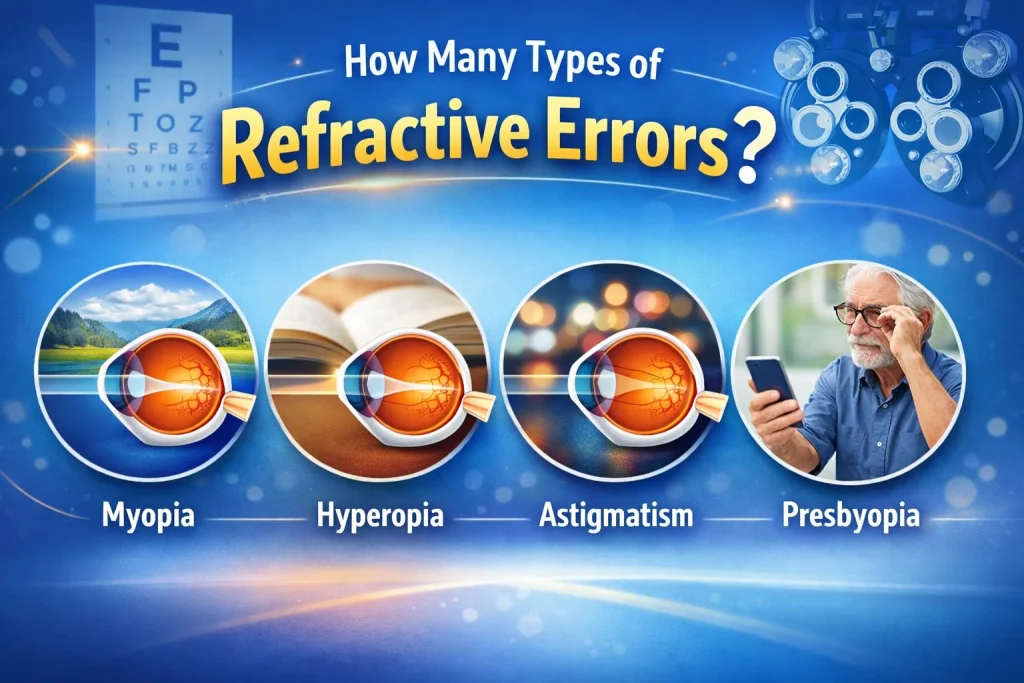
There are four main types of refractive errors:
- Myopia (Nearsightedness)
- Hyperopia (Farsightedness)
- Astigmatism
- Presbyopia
Each type affects vision differently and requires specific treatment approaches.
Myopia (Nearsightedness)
Myopia is a condition where distant objects appear blurry while nearby objects remain clear. This happens because light focuses in front of the retina.
Common Symptoms:
- Difficulty seeing distant objects
- Squinting
- Eye strain and headaches
Causes:
- Elongated eyeball
- Genetic factors
- Excessive screen time
Hyperopia (Farsightedness)
Hyperopia causes difficulty in seeing close objects clearly, while distant vision may remain relatively normal. In this case, light focuses behind the retina.
Symptoms:
- Blurry near vision
- Eye fatigue
- Headaches after reading
Causes:
- Shorter eyeball
- Family history
Astigmatism
Astigmatism occurs when the cornea or lens has an irregular shape, causing distorted or blurred vision at all distances.
Symptoms:
- Blurry or distorted vision
- Difficulty seeing at night
- Eye discomfort
Causes:
- Irregular curvature of the cornea
- Genetic factors
Presbyopia
Presbyopia is an age-related condition that affects near vision, typically occurring after the age of 40. It happens when the eye’s lens loses flexibility.
Symptoms:
- Difficulty reading small print
- Need to hold objects farther away
- Eye strain during close work
Common Symptoms of Refractive Errors
While symptoms vary by type, common signs include:
- Blurred vision
- Headaches
- Eye strain
- Difficulty focusing
- Squinting
Early diagnosis is essential to prevent worsening vision.
Causes of Refractive Errors
Refractive errors can develop due to:
- Genetics
- Aging
- Excessive screen time
- Lack of eye care
- Environmental factors
Lifestyle habits play a major role, especially in children and young adults.
Treatment Options for Refractive Errors
The good news is that refractive errors are easily manageable with proper treatment:
Glasses
The most common and simplest solution.
Contact Lenses
Provide a wider field of vision and are suitable for active individuals.
LASIK Surgery
A long-term solution that reshapes the cornea using laser technology to correct vision.
Can Refractive Errors Be Prevented?
While not all refractive errors can be prevented, you can reduce the risk and slow progression by:
- Limiting screen time
- Following the 20-20-20 rule
- Maintaining proper lighting while reading
- Getting regular eye check-ups
- Spending more time outdoors
Refractive Errors Comparison Table
| Condition | Vision Issue | Cause |
|---|---|---|
| Myopia | Blurry distance vision | Eye too long |
| Hyperopia | Blurry near vision | Eye too short |
| Astigmatism | Distorted vision | Irregular cornea |
| Presbyopia | Age-related near vision loss | Lens stiffness |
Final Thoughts
Refractive errors are common but manageable vision problems. Understanding the different types—myopia, hyperopia, astigmatism, and presbyopia—can help you take the right steps toward better eye health. Early diagnosis and proper treatment can significantly improve your quality of life and prevent complications.
If you experience any vision issues, consult an eye specialist for a comprehensive eye examination.
Frequently Asked Questions
How many types of refractive errors are there?
There are four main types: myopia, hyperopia, astigmatism, and presbyopia.
Can refractive errors be cured permanently?
They can be corrected with glasses, lenses, or LASIK surgery, but not always cured naturally.
Which refractive error is most common?
Myopia (nearsightedness) is the most common refractive error worldwide.
Is LASIK safe for all refractive errors?
LASIK is safe for many patients, but eligibility depends on eye condition and doctor evaluation.