Choosing contact lenses is a more complex process than that of picking out a pair of glasses or ordering a certain product online. What you do is that you put these lenses right on the eye and as such they have to fit your prescription, corneal shape, tear quality, lifestyle, and wear patterns. What you can get out of the right fit is clear vision, comfort, and confidence all day long. Put in the wrong pair and you run the risk of dry eyes, redness, irritation, infection, and in some cases poor vision correction.
Many people search for the best contact lenses thinking there is one perfect brand or one lens that suits everyone. In reality, the best contact lenses are the ones that fit your eyes safely, correct your vision properly, and remain comfortable for the number of hours you need to wear them. This is why professional contact lens fitting is an important step before you start using lenses regularly.
Many people look for the best contact lens brands out there which in turn they think is the perfect pair for all. In fact what we see is that the best contact lenses are those which fit your eye structure well, correct your vision issues precisely and also are comfortable to wear for the time you put them in. This is also the reason why we stress on getting a professional fit before you go on to use the lenses daily.
Why Contact Lenses Need Proper Selection
Contact lenses we put in for vision correction but also they are medical devices which require proper care and professional guidance. As opposed to glasses which are a few inches away from the eye, contact lenses sit on the tear film over the cornea. This means oxygen flow, moisture balance, lens movement and hygiene is of great importance.
A person that has dry eyes may not do well with the same lenses as someone with normal tear production. A patient with astigmatism may in fact require a toric design as opposed to a regular spherical lens. At 40 and up people often find they need multifocal contact lenses. as they struggle with near work. This is so that which is the best contact lens for you is determined by your full eye exam and not just which brand you prefer.
A quality lens will vision correction well, wear comfortably on the eye, move properly with every blink, and allow in enough oxygen for the cornea. If the lens is too tight, too loose, too dry, or doesn’t suit your eye shape at all, you may experience discomfort and complications.
Understanding the Main Contact Lens Types
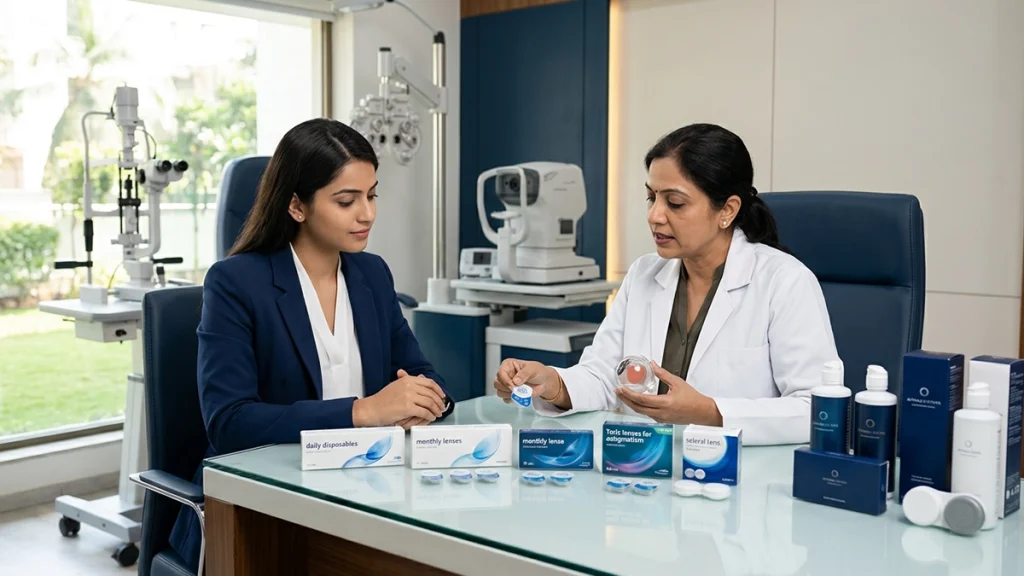
Different contact lens types for different needs. Soft lenses are very popular due to their comfort and ease of wear. RGP lenses are recommended in some cases for better sharpness of vision which in turn is also great for irregular corneas. Toric for astigmatism, multifocal for a patient which needs both distance and near vision correction.
Daily disposable contact lenses are a choice for patients that value convenience and better hygiene which is achieved by discarding the lenses after each use. For monthly or bi-weekly lenses which may suit regular users we ask that they be properly cleaned and stored. Cosmetic or colored lenses may change look but they still require a valid prescription and safe fit.
| Contact Lens Type | Best Suited For | Key Benefit |
| Daily disposable lenses | Occasional users, busy professionals, hygiene-focused users | Fresh lens every day with less maintenance |
| Monthly soft lenses | Regular users who can follow cleaning routine | Cost-effective for frequent wear |
| Toric lenses | Patients with astigmatism | Better stability and clearer vision |
| Multifocal lenses | Patients with age-related near vision issues | Helps with distance and near vision |
| Rigid gas permeable lenses | Selected irregular cornea or high clarity needs | Sharp vision in specific cases |
| Colored lenses | Cosmetic use with prescription | Changes eye appearance safely when prescribed |
Before you choose a contact lens type an eye specialist will check your power, eye surface, corneal curvature, tear film, and wearing needs. This is to make sure that the contact lenses we choose are not only clear but also safe for the long term.
What Makes the Best Contact Lenses for You?
The best contact lenses are not always the most expensive or the most advertised. What may work well for one person may not for another. Your best bet is that which meets your prescription needs, has a fit for your eye, improves with your tear quality, which also takes into account your age, your work environment, how much time you spend on screens, and how many hours a day you will wear them.
For example a student which only requires lenses for sports may do well with daily disposable contact lenses. A professional with long screen time may require lenses with better moisture retention. A patient with astigmatism may benefit from toric lenses for accurate vision correction. A person with early presbyopia may do so from multifocal lenses.
During contact lens fitting, your doctor also will evaluate how the lens does on your eye. The lens should sit in the center, move a little with blinking, and not cause redness or discomfort. Even if your prescription is correct the fit may still be poor which in turn may make the contact lenses uncomfortable or unsafe.
Why Contact Lens Fitting Is Important
Contact lens fitting is what we do when we choose and try out which lenses which suit you best. This process is different from what we do with glasses. A glasses prescription gives the power required to improve your vision, but a contact lens prescription also includes the lens diameter, base curve, material, and brand which works best for you.
During contact lens fitting, our health care professional may put a trial lens in your eye and assess its movement, centering, comfort, and clarity. Also at this time the doctor will look at the cornea, eyelids, tear film, and overall eye health. This step is key, which is that poorly fit contact lenses may cause irritation, dryness, corneal scratches or infection.
Patients should not base their contact lens purchase on the power of their glasses. Each Contact lenses prescription is separate from that of your glasses as the lens sits directly on the eye. Also the power in contact lenses may differ slightly from that of your glasses especially in high prescriptions.
Matching Contact Lenses to Your Lifestyle
Your lifestyle is a great determinant in what type of best contact lenses. you choose. If you travel a lot, daily disposables may be the best option. If you play sports contact lenses may give you a larger field of view and a more practical choice than glasses.
Patients that are on screens for long hours should be extra careful. Screen use decreases blink rate which in turn makes contact lenses dry. In such cases your doctor may recommend lubricating drops, reduced wear time, or a different lens material that is more comfortable.
For young and first time users daily lenses may be better in terms of hygiene. As for adults with set routines, monthly lenses do well if proper cleaning is done. And for those with special prescriptions at times special contact lens types are required for best results.
Safety Rules Every Contact Lens User Should Follow
Even the best contact lenses will present issues if not used as directed. Before handling lenses, always make sure to wash and dry your hands. Do not use tap water to rinse your lenses. Do not sleep in your lenses unless your eye care provider has prescribed lenses which are OK for that use. Get into the practice of replacing your lens case at regular intervals and to use only the recommended solution.
Patients also must avoid wearing contact lenses while swimming or bathing as water is a carrier of microorganisms which may cause serious eye infections. If you experience redness, pain, watering, light sensitivity or your vision becomes blurry remove the lenses and see an eye care professional.
| Do’s for Contact Lens Users | Don’ts for Contact Lens Users |
| Wash and dry hands before handling lenses | Do not sleep in lenses unless advised |
| Use fresh solution every time | Do not use tap water on lenses |
| Follow replacement schedule | Do not overuse expired lenses |
| Attend follow-up visits | Do not ignore redness or pain |
| Store lenses in a clean case | Do not share lenses with anyone |
| Remove lenses if discomfort starts | Do not buy lenses without prescription |
Safe care is just as important as which lens you choose. Contact lenses do what no other vision correction device does but they also require discipline and proper care.
Common Mistakes While Buying Contact Lenses
One issue is that people buy contact lenses with only their prescription glasses. Also it is a problem to switch brands without first speaking to an eye specialist. Even if the power is the same, which brand you use may cause issues with the material, thickness, moisture content, diameter, and base curve.
Some patients do in fact wear their lenses past the recommended time, sleep in daily wear lenses, and at times use them even when they have redness in their eyes. These are risky habits that can lead to corneal infection. Also an issue is the use of cosmetic lenses. While colored contact lenses may look very attractive, they should at all times be fit by a professional and filled with prescribed solutions, not at all times should they be used without prescription.
Another issue is that we assume which discomfort is normal. Maybe some mild awareness in the first few days but pain, persistent dryness, redness, or blurred vision should not be put up with. The best contact lenses should feel very comfortable once they are broken in and should not cause the eyes to appear red or unhealthy.
Contact Lenses for Different Eye Conditions
For simple myopia and hyperopia soft contact lenses will do. In case of astigmatism toric lenses are what is usually required as they tend to stay in the same position on the eye. For presbyopia we may look at multifocal or monovision options. And for irregular corneas which include keratoconus or post surgical corneal changes specialized lenses may be required.
In regards to professional contact lens fitting this is of even greater importance. In such a case the lens does not only serve for basic vision correction but instead provides for an improved quality in vision in which glasses may present insufficient clarity.
Patients who have dry eye, allergy, frequent eye infections, or corneal disease should be evaluated in detail before beginning contact lenses.. Also at times treatment of the eye surface first will improve comfort and lens tolerance.
How ASG Eye Care Helps You Choose Contact Lenses
At ASG Eye Care we go beyond prescribing contact lenses, rather our aim is to have patients pick out options that are safe, which also suit their comfort level and lifestyle. We start with a detailed eye exam, prescription update, corneal assessment and we talk through daily routine, screen time, work environment, and wear expectations.
The doctor will put you into contact lens types which are best for your eye power and eye health. We may trial fit them to check the fit, comfort, and clarity. After the fitting we will go over insertion, removal, cleaning, storage, replacement schedule and also what signs to look out for which will require medical attention.
For first time users we see great results from proper training. Many folks are nervous at first but with the right guidance contact lenses become very easy to handle. At ASG Eye Care we also stress follow up visits which in turn will monitor eye health and lens comfort.
When Should You Avoid Contact Lenses?
At times contact lenses may not be right, at which point you may get the advice from your doctor to take them out for a while. Should you have an active eye infection, very dry eyes, uncontrolled allergies, a corneal injury, or very red eyes, do not put in your lenses your eye health is at issue. Also during an infection or inflammatory state of the eye we don’t recommend wearing contacts as it may in fact make the issue worse.
You should also take out your lenses if you have pain, sudden blurry vision, discharge, severe watering, or light sensitivity. These symptoms may be a sign of something serious which in turn should be checked by an eye specialist.
For some patients glasses, refractive surgery, or other treatment options may do better than contact lenses. The final choice should always be based on what is safe, what is comfortable and what is best for the long term health of the eye.
Key Takeaway
Choosing to go with contact lenses should be a well thought out decision. What is best for you is what matches your prescription, fits in your eyes right, supports your lifestyle, and which also in the end will promote eye health. Also it is important you have a good understanding of contact lens types, you do the proper contact lens fitting, and that you follow hygiene instructions which all together will present you with safe and effective vision correction.
If you are looking to start or try contact lenses, out get in to ASG Eye Care for a full eye exam. A professional assessment will help you to avoid the guess work in your purchase and to choose which lenses will best suit your eyes.
Frequently Asked Questions
1. How do I know which contact lenses are best for my eyes?
The best contact lenses for your eyes is a fit which is based off of your prescription, corneal shape, tear quality, lifestyle, and wear schedule. An eye specialist will do an exam of your eyes and fit you with the safest, most comfortable option
2. Are contact lenses better than glasses?
Contact lenses and also glasses do present vision correction, options but they do so for different issues. Lenses which are a choice for sports or active settings have a larger field of view, while glasses may be a better option for when the eyes are dry or irritated and also for easy maintenance.
3. What are the main contact lens types?
Main contact lens types include daily disposables, monthlies which are soft, toric for astigmatism, multifocals for presbyopia, rigid gas permeable and cosmetic. Your doctor will base the recommendation on your prescription and eye health.
4. Is contact lens fitting necessary?
Yes, contact lens fitting is a must as the lenses sit directly on the eye. It also confirms the right size, movement, comfort, and clarity. Without proper fitting even great powered contact lenses may cause discomfort or eye issues.
5. Can I buy contact lenses online?
You can purchase contact lenses online only if you have a valid prescription. Do not order the lenses based on your glasses prescription. The brand, size, curve, and material should match what your eye specialist has prescribed.
6. Can contact lenses damage the eyes?
Contact lenses do in fact present a safe option when they are prescribed for you, fit properly, well cared for, and used as directed. Issues usually present when lenses are worn past their due date, not cleaned properly, come into contact with water, are shared with another person, or used despite redness or pain.
7. How long can I wear contact lenses in a day?
Wear time is a variable which depends on the type of lens, state of your eyes, and what the doctor says. Some people may wear their contact lenses for many hours without issue, while for others they will require a break sooner due to dryness or sensitivity.
8. Are daily lenses better than monthly lenses?
Daily lenses are easy and healthy which is a new pair is used every day. Monthly lenses may be a better deal for regular users but they do require you to properly clean and store them. The best contact lenses are which ones that suit your eyes, budget, and lifestyle.