What makes contact lenses great? Learning how to remove contact lenses can bring on soreness, watering, or irritation of the eyes. It is also a part of taking care of the cornea which in turn is a daily practice. New wearers may feel out of their element, more experienced may feel they have it in the bag. Both at these stages may end up rough with the handling.
Research into glaucoma genetics shows that some forms have strong inherited links, while in the case of adult onset glaucoma what we see is a combination of genetic and environmental factors which include age, eye pressure, anatomy and health history. Family history of glaucoma is important for an ophthalmologist to know but is not in itself a diagnosis. The full range of glaucoma risk factors must be looked at. A genetic tendency does not guarantee that a person will develop the disease, some individuals with predisposing genetic variations may never in fact see the disease appear.
Why the Right Removal Method Matters
The eye’s surface is delicate. Use of nails to remove a lens, a pinched instead of a proper lens out, or use of dirty and wet hands for lenses may cause irritation and also introduce germs. FDA reports that improper lens and solution care practices which do increase the risk of infection and corneal ulcers also do exist. Also from the CDC which reports on the issue of hand washing and completely drying them before handling lenses. To avoid issues, do it right at lens removal. With soft lenses what you do is to gently slide it from the center of the cornea to the white of the eye, then lift it with the fleshy pad of your fingers. This is very important in the contact lens removal tips as trying to pull the lens out straight from the center is usually an uncomfortable experience.
Proper care of your contact lenses is a result of good contact lens care. Follow the wear, clean, store, and replace instructions given by your eye care professional and the lens manufacturer.
Preparation: How to Remove Contact Lenses More Easily
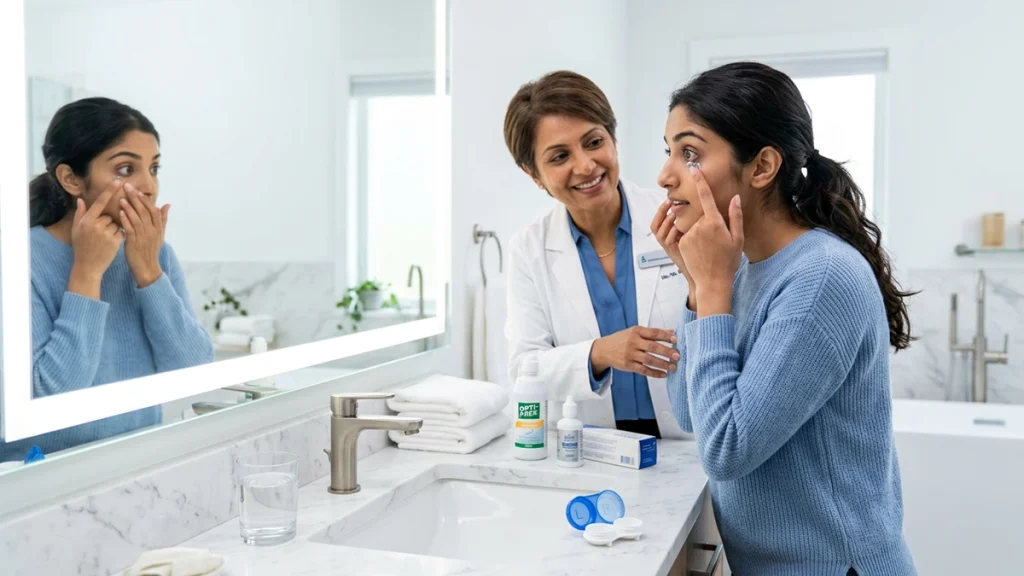
Before you practice how to remove contact lenses do so in a clean well lit room by a mirror. Stay away from open sinks or toilets. Have at hand the case, fresh solution and your glasses.
Wash hands well with soap and water then rinse off the soap fully, and dry them with a clean lint free towel. Moist fingers can cause a soft lens to dislodge which is hard to grab. Also as reported by the CDC and FDA you should keep your contacts away from water which is a home to harmful organisms and also causes soft lenses to stick to the eye. Keep nails short and use the pad of your fingers instead of tips. If you wear makeup, remove it before handling your lenses. These basic contact lens removal tips will make the process easier remove contact lenses safely and at the same time reduce your chance of scratching the eye or tearing the lens.
| Before removal | What to do | Why it helps |
| Hands | Wash with soap and dry fully | Improves grip and limits germ transfer |
| Fingernails | Keep them short and use fingertip pads | Reduces scratching and lens damage |
| Work area | Choose a clean, dry, well-lit surface | Helps you find a dropped lens |
| Supplies | Keep fresh solution, the case, and glasses ready | Supports correct contact lens care |
| Routine | Begin with the same eye every time | Prevents right and left lenses from being mixed |
How to Remove Soft Contact Lenses Step by Step
To get started on how to remove contact lenses look in the mirror and relax your face. Use your dominant hand’s middle finger to pull down the lower eyelid. With the other hand hold the upper lid at the base of the lashes which also will prevent you from blinking. Do not press into the eye.
Look up. Take your index finger and place it on the lens then gently slide it to the lower white part of the eye. Once it breaks away from the center pull it off with your index and your thumb. This is the basic method for the safe remove contact lenses safely which also protects the cornea.
If a lens comes out detach it gently. Do not use a nail to pry at the edge. Of all the contact lens removal tips which are most useful is to take a break when your grip goes. Blink, dry your fingers as required, then proceed very slowly.
Repeat the procedure for the other eye. Daily I go through the same routine which helps in the process of learning how to remove contact lenses, also it is noted that if the two eyes have different prescriptions which they do in my case you just go over the eye specific steps.
Daily when you use your disposable lenses you should throw them away. As for re-usable lenses, clean and disinfect them as instructed. At Moorfields Eye Hospital they also say to throw out your daily wear lenses after each use and that you clean your reuses before putting them away. Safe contact lens care is at the core of what we do.
How to Remove Contact Lenses When a Lens Feels Dry or Stuck
A soft lens may present to be non moving after a long day, dry air, or dozing off. Do not panic and do not push the lens in further. Close your eyes and blink a few times. If your eye care professional has put you on a regimen of contact lens compatible lubricating drops follow their direction exactly.
The best way to remove contact lenses in this situation is to be patient. We first put in some lubricant and then we see if the lens moves at all. If it does move, we use the usual slide and pull technique. To remove contact lenses safely do not try to force a lens that seems to be stuck to the eye.
Do not use tap, bottled water, spit or homemade salt water for that task. Water has the tendency to change the shape of a soft lens also it puts your eye at risk of very serious infection. Also out of the common contact lens removal tips we put into practice is to have on hand approved rewetting drops and a backup pair of glasses while you are out or working late.
If the lens will not move, or your eye becomes painful or your vision changes, stop immediately and see an ophthalmologist. Knowing when to stop is part of caring for contact lens care responsibly.
Common Mistakes to Avoid
People how to remove contact lenses may use their nails, pull out from the center, also they may also wait till the eye is sore. For regular wearers they tend to not wash hands and ignore discomfort. These actions turn what is supposed to be a simple task into an eye health issue.
Do not use tweezers, cotton swabs, common suction devices, or any sharp at home tools to remove a soft lens. Do not share lenses or cases. Also do not rinse a lens or case with tap, bottled, distilled, lake, or pool water. The FDA reports that we should use fresh solution and we are warned against putting in new solution over old. remove contact lenses safely* also means to accept that sometimes repeated failed attempts will irritate the eye. Stop, blink, use only what is recommended by your health care provider if they advise, and try again gently. These contact lens removal tips protect the eye better than does applying more pressure or speed.
| Situation | Safer response | Seek professional help when |
| Lens feels dry | Blink and use an approved rewetting drop if advised | The lens will not move or pain develops |
| Lens tears | Remove visible pieces gently and stop rubbing | A piece may remain or discomfort continues |
| Eye becomes red | Remove the lens and switch to glasses | Redness persists, worsens, or includes discharge |
| Vision becomes blurred | Remove the lens and do not reinsert it | Blurring continues after removal |
| Pain or light sensitivity occurs | Stop handling the eye | Arrange a prompt eye assessment |
| Reusable lens comes out normally | Clean and store it in fresh solution | It repeatedly causes discomfort |
After Learning How to Remove Contact Lenses: What Comes Next
Once you know how to remove contact lenses what you do next is based on the type of lens. With disposables you throw them away after each use. As for the reusables you clean and rinse them with the disinfecting solution as recommended then put them in a clean case which should be filled with fresh solution.
Never “top off” old solutions. After each use, empty the case out and clean with fresh contact lens solution and also let it dry as directed. CDC says to rub and rinse the case in with fresh solution, and FDA’s advice is to replace your case at regular intervals, which for most is every 3 months or as professional care may suggest. which forms the base of good contact lens care.
If you use a hydrogen peroxide system, follow the exact neutralization instructions and use the special case which comes with it. Unneutralized peroxide should not be put directly in the eye as it will sting, burn, and damage the cornea. Care of contact lenses means that each solution be treated as a separate product instead of the assumption that all bottles do the same thing.
Rigid and Specialty Contact Lenses
Rigid gas permeable lenses that is what we’re to discuss here. Also we say that they go about it this way; which is to have the eye open fully, the outer part of the lid at the back of the ear you pull, have a good blink, the lens will catch on that and you may pick it up with a clean hand. Also for that which can only be done with a tool which has been prescribed for you, use only that.
Do not take for granted that a single guide how to remove contact lenses is applicable to scleral, mini-scleral, hybrid, orthokeratology, or specially fit lenses. The best approach for these cases is to follow the exact fit which was demonstrated at the time of your fitting.
Clean of hand and of surface, we have the right solution and at the first sign of pain or persistent redness seek contact lens care. Personalized advice from the fit clinic is very much so when a removal plunger is a factor.
When to Stop Wearing Lenses and See an Eye Doctor
Knowing how to remove contact lenses properly also means to be aware of what to do if you shouldn’t put them back in. Remove the lenses and see a professional if you have pain, unusual redness, swelling, discharge, extreme light sensitivity, excessive tearing, or blurred vision. The FDA reports that contact lens related infections and corneal ulcers may present very quickly and are very serious. Put in a lens only when the eye has fully recovered after removal. Wear glasses till an ophthalmologist says that it is ok to resume wearing the lens. Safe removal is only one piece of the puzzle; quick response to warning signs is very important.
At ASG Eye Care we find that an exam may bring to light issues like dryness, poor fit, lens damage, allergy, abrasion, inflammation or infection. Members of our repeat customer base ask for a practical demo and personal contact lens removal tips. Also we see that regular follow ups support safe contact lens care when prescriptions or wear habits change.
Frequently Asked Questions
1. What is the easiest way to learn how to remove contact lenses?
The best way to learn how to remove contact lenses is to develop a routine which you follow daily. Wash and dry your hands, hold the eye open, look upwards a little, put the soft lens on the white of the eye and using your fingers tips press it in.
2. How can beginners remove contact lenses safely?
Beginners have it in them to remove contact lenses safely by using totally dry fingers out of which nails are kept away from the eye and which are moved slowly. It is better to pause and blink in this process rather than to make forceful attempts again and again. If difficulty persists, do ask for another professional demonstration.
3. Which contact lens removal tips help with slippery lenses?
The best advice for contact lens removal tips is to dry your fingers off completely and put the lens on the white of the eye before you pinch. Wet fingers tend to slide across a soft lens instead of grasping it.
4. Can I use water when learning how to remove contact lenses?
No. Water is not to be used for contact lenses or as a substitute for approved solutions. For the remove contact lenses safely when they feel dry blink and use a compatible lubricating drop which has been recommended for you. If the lens does not move, seek help.
5. What should I do if a lens tears during removal?
Stop the eye rubbing and check the removed lens. While practicing how to remove contact lenses do not go after a torn off piece with your nails. If you think some of the lens is still in the eye or irritation persists, see an eye care professional.
6. Should daily disposable lenses be cleaned after removal?
No. Daily throwaway lenses are for single use which means you should throw them out after each wear. It is not right to clean and reuse them. Follow the contact lens care instructions which may vary according to what type of lenses you have.
7. Why are my eyes sore after taking out my lenses?
Soreness can be due to dryness, over wear, rough handling, a damaged lens, poor fit, allergy, or an eye surface issue. If the soreness persists or comes with redness, discharge, light sensitivity, or blurred vision, review your contact lens removal tips, wear glasses in the meantime, and see your eye care professional.
Conclusion
Learning how to remove contact lenses is made easier with a calm and consistent approach. Have clean dry hands, use your fingertips not your nail tips, gently move the lens onto the white of the eye and handle the lens properly after removal for better comfort.
The goal is to remove contact lenses safely instead of just getting them out fast. What we have are the best contact lens removal tips which are to prepare the area, avoid water, do not force a dry lens, use the proper method for your lens type, and to stop wear when you see warning signs. With responsible contact lens care and regular eye exams also included these are habits which do protect the eyes.