People hoping to reduce their dependence on spectacles often ask the same question: PRK vs LASIK. Which procedure is more suitable for their eyes? Both are established forms of Laser Eye Surgery used to correct refractive errors such as myopia, hyperopia, and astigmatism. However, they differ in how the surgeon reaches the corneal tissue, how the eye heals, and which patients may be suitable for each approach.
The decision should not be based only on price, recovery time, or what worked for another patient. Corneal thickness, prescription stability, tear film health, age, occupation, lifestyle, and expectations all play a role. A thorough refractive evaluation allows an ophthalmologist to determine which of PRK Surgery, LASIK Surgery, or another vision correction option is best.
How Does Laser Vision Correction Work?
Clear vision is a result of light which properly focuses on the retina. A refractive error is what happens when the shape of the cornea or the size of the eye interferes with that. Glasses correct by changing the light’s path, while Laser Eye Surgery changes the cornea’s shape to improve light focus.
The National Eye Institute reports that which type of refractive procedures they perform is on changing the cornea’s shape and that in turn patients’ full eye work up is required prior to treatment. Also very important is the issue of stable visual acuity. A constantly changing prescription will only produce temporary benefits at best. It is the excimer laser that is used to remove small amounts of corneal tissue as determined by pretreatment analysis. The main difference is the way in which that tissue is accessed.
What Is PRK Surgery?
PRK Surgery which stands for Photorefractive Keratectomy is a surface procedure. The surgeon will remove the corneal epithelium which is the thin outer layer and then use an excimer laser to reshape the tissue beneath. A soft bandage contact lens is usually put in place to cover the eye as the epithelium heals.
Because PRK Surgery does not create a corneal flap it may be had for some patients which have thin corneas, are into contact sports, or which have jobs that put them at great risk of eye injury. At ASG Eye Hospital PRK is described as a flap free treatment for myopia, hyperopia and astigmatism which may suit patients that do not do well with LASIK. Also after PRK Surgery discomfort, watering, light sensitivity, and blurred vision may be present for several days while the surface heals. MedlinePlus also reports that scratchiness, tearing and sensitivity may last longer after PRK than after some other refractive procedures. surgery?
LASIK Surgery, or laser-assisted in situ keratomileusis, creates a thin corneal flap. The flap is lifted, the laser reshapes the tissue underneath, and the flap is repositioned without stitches.
A large reason why people choose to have LASIK Surgery is because of the quick results which they see right after the procedure. Many appropriate patients report improvement almost immediately post op and within a short time return to their desk based routines as is advised by their surgeon. MedlinePlus reports that LASIK is an outpatient procedure in which a flap is made which the laser uses to access and reshape the tissue. Not all are good candidates for this procedure. Thin or irregular corneas, very dry eye, keratoconus, active infection, unstable power, glaucoma, cataract, and other eye issues may rule some out. Government health authority recommends that careful screening out of these risks be done before treatment.
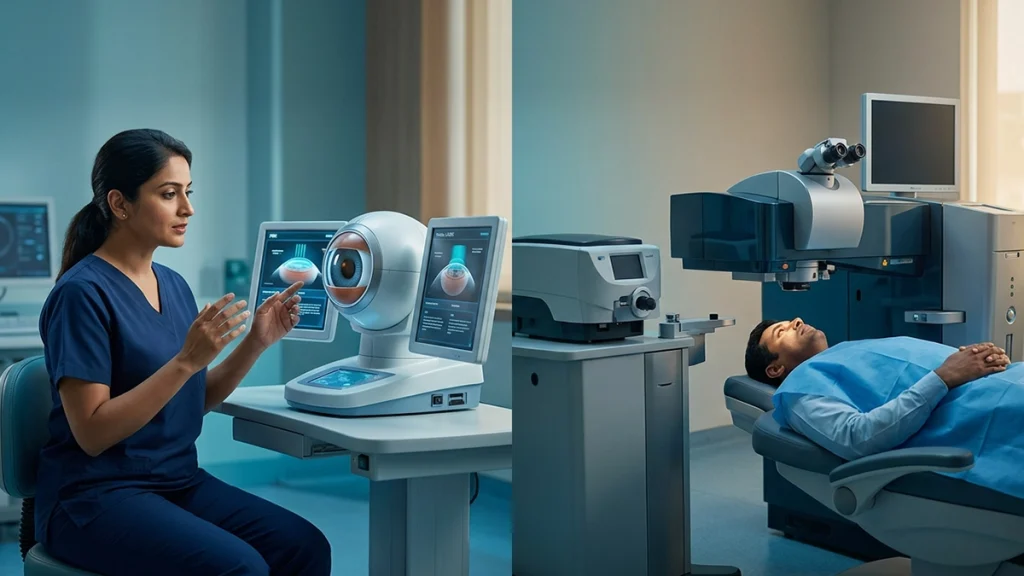
The simplest way to understand PRK vs LASIK is to look at the corneal surface. PRK removes the epithelium and allows it to regenerate. LASIK creates and replaces a flap. The laser correction may be similar, but the route used to reach the tissue changes the early healing experience.
| Comparison factor | PRK | LASIK |
| Corneal access | Surface epithelium is removed; no flap is created | A thin flap is created and repositioned |
| Early recovery | More gradual, with discomfort for several days | Usually quicker, with less early discomfort |
| Corneal profile | May suit selected thinner corneas after assessment | Requires adequate thickness and safe flap planning |
| Lifestyle | May be considered when eye trauma is a concern | Often considered when faster routine recovery matters |
| Follow-up focus | Surface healing and bandage-lens review | Flap position, dryness, and visual recovery |
This PRK vs LASIK comparison does not make one procedure universally better. The right option is the one that preserves appropriate healthy tissue and matches the patient’s eye measurements, health, and lifestyle.
Who May Be Suitable for PRK?
An ophthalmologist may bring up PRK Surgery as an option for patients which have thin, irregular corneas, work in hazardous environments, or play contact sports which may cause injury to the eye. A patient still requires stable power, healthy eyes, low to moderate correction needs and must have enough corneal tissue for safe treatment.
PRK Surgery is not a solution for all that LASIK is not. We have corneal disease, uncontrolled dry eye, infection, or poor healing issues which may put any elective corneal procedure out of the question. In the PRK vs LASIK decision, patients’ also must plan for a longer return to visually demanding work and for progressive improvement over many weeks.
Who May Be Suitable for LASIK?
A proper candidate for LASIK Surgery is of age with a stable refractive error, health of the corneas, manageability of or absence of dry eye, and does not have any conditions which would rule out flap creation. Corneal mapping and thickness testing are a must as subtle abnormalities may change the treatment plan.
The quick recovery which LASIK Surgery has may appeal to those that don’t have time off work. That said patients still require follow up visits, prescribed eye drops, protection from eye rub and also are restricted from swimming, eye make up, strenuous exercise and contact sports.
When comparing PRK vs LASIK, convenience should not be the only factor. A surgeon may recommend PRK when the patient prefers LASIK or advise against both if another option would better protect long-term corneal health.
Tests Required Before Treatment
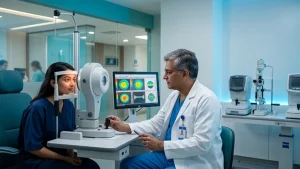
A safe Laser Eye Surgery plan goes beyond determination of spectacle power. What may be included in the assessment are refraction, corneal thickness, corneal topography or tomography, pupil size, tear quality, eye pressure, retinal health, and prescription stability. For contact lens wearers we may ask that they go without their lenses for a while prior to the test as lenses can temporarily change the corneal shape.
| Preoperative test | Why it matters |
| Refraction and prescription history | Confirms the required correction and power stability |
| Corneal topography or tomography | Detects irregular shape or possible corneal weakness |
| Pachymetry | Measures thickness for safe tissue planning |
| Dry-eye assessment | Identifies tear-film problems before surgery |
| Pupil measurement | Helps assess possible night-vision symptoms |
| Dilated retinal examination | Checks the retina and internal eye health |
These results which in turn inform the PRK vs LASIK recommendation also determine if the planned correction is in the safe range. The US Food and Drug Administration reports that thin corneas, large pupils, and certain eye diseases may raise the risk of complications. PRK and LASIK.
Recovery is a very notable difference between PRK vs LASIK. In PRK the epithelial surface is what grows back. For a while patients may experience soreness, tearing, light sensitivity and fluctuating vision. The bandage contact lens is taken out only once the surgeon determines that the healing is far enough along.
Following LASIK Surgery you may experience watering, mild burning, a grittiness, glare, or blurred vision right after the procedure. Also the FDA says do not rub the eye as this may disrupt the flap. They also recommend a post op visit at an early stage and then to keep up with the follow ups as your doctor directs. Laser Eye Surgery says to use the prescribed antibiotic, anti-inflammatory, and lubricating drops exactly as directed. Severe pain, increased redness, vision that is reducing, more discharge, or if in any way your symptoms get worse instead of better require you to seek medical care right away.
Benefits, Risks, and Realistic Expectations
The potential benefit of PRK vs LASIK is similar: reduced dependence on spectacles or contact lenses. Both may provide clear functional vision in carefully selected patients, but neither guarantees perfect eyesight. Some people may still require glasses for night driving, detailed work, or reading later in life.
The FDA reports that which is true of refractive surgery is that it may cause under correction or over correction, dry eye, glare, halos, double vision, reduced low contrast vision, and a continued requirement for glasses or contact lenses. These issues should be brought up during informed consent. Also it is a fact that healing is slower and less comfortable at first. With LASIK Surgery flask related issues and dry eye symptoms require attention. Rare but serious complications do occur with either procedure which is why accurate measurements, proper patient selection, sterile technique, and postoperative care is essential.
Are the Results Permanent?
The corneal change that is brought about by Laser Eye Surgery is for the long term, but the eyes still change as we age. Presbyopia, cataract, hormone changes, health issues, and natural vision prescript changes may play a role in later years. We may achieve successful results with the treatment which in turn does not stop the eye from aging normally or promise permanent freedom from glasses. In the long term PRK vs LASIK are quite similar which is at the time of early recovery they differ. The base prescription, age, healing process, and state of the cornea play a role in stability. Also for any touch up or repeat procedures we will require new measurements and also another safety evaluation.
PRK vs LASIK: How Should You Choose?
The best PRK vs LASIK choice is had after a refractive surgeon does an in depth evaluation of the eye which is to say not after a general comparison. A patient which has adequate corneal thickness and a healthy tear film may be a candidate for LASIK. As for a person which has thin cornea, a trauma prone profession, or certain corneal topography results they may be directed toward PRK. Some patients may be told to continue with glasses or to look at another refractive option.
Ask how much healthy corneal tissue will remain, how dry eye will be managed, what recovery is realistic for your work, and which symptoms need urgent medical review. Patients should also discuss night driving, screen use, sports, medicines, pregnancy plans, autoimmune conditions, previous eye infections, and eye injuries.
At ASG Eye Hospital, suitability for PRK vs LASIK can be assessed through detailed measurements and consultation with a refractive specialist. The purpose is not simply to remove spectacles but to select an approach that balances visual goals with long-term eye health.
Frequently Asked Questions
1. Is PRK better than LASIK?
Neither also is best for all patients. Between PRK vs LASIK it depends on corneal thickness, corneal shape, dry eye status, lifestyle, prescription, and recovery expectations. A full eye exam is required before we may recommend which option is best for you.
2. Is PRK more painful than LASIK?
PRK Surgery usually causes more discomfort during the first few days because the corneal surface is healing. Medication, lubricating drops, and a bandage contact lens support recovery. LASIK often causes milder early irritation, although individual experiences vary.
3. How quickly does vision improve after LASIK?
Vision does in fact improve very fast after LASIK Surgery, at the same time it may still present as hazy or fluctuating at first. The FDA also says that full visual stabilization is a process which may take longer for some and that issues like glare or halos may persist through the recovery period. With respect to PRK recovery, how long does it take?
After PRK Surgery the corneal surface will see action over a few days’ time which is also the case when it comes to vision improving, which does so rather slowly. As for full functional recovery and the realization of final visual results that is a different matter, so it is important to go by what your surgeon says.
5. Can thin corneas be treated?
Some patients with thinner corneas may be considered for PRK, but thickness alone does not determine suitability. Corneal shape, expected tissue removal, age, prescription, and other measurements must be reviewed before Laser Eye Surgery.
6. Will I never need spectacles again?
Both treatments aim to reduce spectacle dependence, but glasses may still be needed because of residual power, age-related near-vision changes, cataract, or later prescription shifts. Permanent spectacle-free vision should not be guaranteed.
7. Is laser vision correction safe?
For carefully selected patients, refractive treatment may provide useful vision correction, but every surgery has potential risks. Complete screening, informed consent, realistic expectations, and regular postoperative care are essential.
8. Which option may suit contact-sport athletes?
A flap-free procedure may be considered when direct eye trauma is an important concern. However, the final recommendation must be based on a complete eye examination rather than occupation or sporting activity alone.