Vision correction today is not limited to glasses or contact lenses. Many people in their 20s and 30s start exploring surgical options once daily tasks begin to feel dependent on lenses.
ReLEx SMILE eye surgery is one such option. It is often discussed as a newer alternative to LASIK, especially for people with myopia (nearsightedness). But what actually happens during the procedure? And who is it really meant for?
What Is ReLEx SMILE Eye Surgery and How It Works
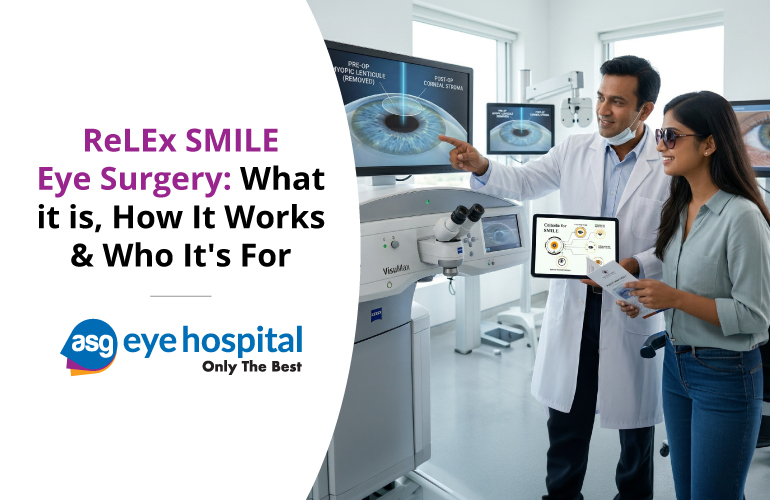
ReLEx SMILE (Small Incision Lenticule Extraction) is a laser-based vision correction procedure. Unlike LASIK, it does not involve creating a corneal flap. Instead, a femtosecond laser creates a small disc-shaped tissue (called a lenticule) inside the cornea. This lenticule is then removed through a tiny incision, usually 2–4 mm.
Because the corneal surface remains largely intact, the structure of the eye tends to stay more stable. And that’s the key difference many patients want to understand.
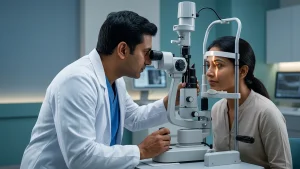
The ReLEx SMILE eye surgery process usually takes about 10–15 minutes per eye. Most people are awake during the procedure, with numbing eye drops used for comfort. A common clinical test done before surgery is corneal topography, which maps the surface of the cornea to check suitability.
SMILE Eye Surgery Procedure: Step-by-Step Overview
Understanding the SMILE eye surgery procedure helps set clear expectations.
Before the procedure
- Detailed eye examination (including pachymetry to measure corneal thickness)
- Vision stability check over the past year
- Screening for dry eye or corneal conditions
Most people walk in assuming they can get surgery immediately. But eligibility checks often take time.
During the procedure
- Numbing drops are applied
- Laser creates the lenticule inside the cornea
- Surgeon removes it through a small incision
No stitches are needed. And there is no flap creation.
After the procedure
- Vision may be slightly blurry for a day or two
- Eye drops are prescribed for healing and infection control
- Follow-up visits track recovery
So how soon can you return to normal work?
In most cases, people resume routine activities within 2–3 days. But screen-heavy work may need a short break, especially for those spending long hours on phones or laptops.
SMILE vs LASIK Eye Surgery: What Changes?
This is where most confusion comes in. Patients often ask, “Is this better than LASIK?” or “Why would someone choose SMILE instead?”
Key differences between SMILE and LASIK
- Flap creation: LASIK creates a flap; SMILE does not
- Incision size: SMILE uses a much smaller incision
- Dry eye risk: SMILE often shows lower incidence of post-surgery dry eye
- Recovery pattern: LASIK recovery may feel faster initially
But that doesn’t make one universally better. Because the choice depends on eye structure, lifestyle, and prescription. For example, people with thinner corneas or those prone to dry eye symptoms are often evaluated for SMILE.
Which Is Better SMILE or LASIK for You?
There isn’t a single answer. And that’s where clinical evaluation matters more than general comparisons.
A person with high myopia and stable corneal thickness may be a good candidate for ReLEx SMILE eye surgery. But someone with hyperopia (farsightedness) may still be guided toward LASIK. So what should you actually ask during consultation?
“Am I eligible for both procedures?” “What are the risks in my case?”
These questions usually lead to clearer decisions than simply comparing techniques online. Because suitability tends to vary from one patient to another.
ReLEx SMILE Surgery Benefits and Limitations
Like any medical procedure, SMILE has both advantages and boundaries.
Benefits of SMILE surgery
- Smaller incision with minimal disruption to corneal nerves
- Lower chances of flap-related complications
- Often less dryness after surgery
- Stable long-term outcomes for myopia
Limitations to consider
- Not suitable for all types of vision correction
- Slightly slower visual recovery in the first few days
- Enhancement procedures can be more complex than LASIK
And this is something many people don’t expect.
Recovery is not always instant clarity. Vision tends to improve gradually over a few days.
SMILE Eye Surgery Cost and What Affects It
The SMILE eye surgery cost in India can vary based on several factors.
- Technology used at the centre
- Surgeon’s experience
- City and location
- Pre- and post-operative care included
In most cases, the cost is higher than standard LASIK, mainly due to the advanced laser technology involved. But cost alone should not drive the decision, because long-term comfort, especially for those dealing with dry eyes from AC offices or dusty daily commutes, often becomes a deciding factor.
Who Is a Good Candidate for ReLEx SMILE Eye Surgery
Not everyone is suitable for this procedure. Most candidates meet the following criteria:
- Age above 18 years
- Stable vision for at least one year
- Myopia (with or without mild astigmatism)
- Healthy cornea without conditions like keratoconus
But screening goes deeper than this. Tests like tear film evaluation and corneal thickness mapping help determine safety. And sometimes, people who expect to qualify are advised against it.
Accessing ReLEx SMILE Eye Surgery at ASG Eye Care
ASG Eye Care offers evaluation and treatment for laser vision correction, including ReLEx SMILE eye surgery, across multiple centres. Patients often come in after years of relying on glasses, especially those managing long work hours on screens or frequent travel in polluted city conditions.
After a thorough evaluation, these procedures are available at ASG Eye Hospital in Parel, Dadar, Jaipur, Jodhpur, Ahmedabad and Udaipur.
FAQs: ReLEx SMILE Eye Surgery
1. Is ReLEx SMILE eye surgery painful?
The drops used in the procedure numb the area, so pain is usually not felt during surgery. You might feel a little uncomfortable or irritated for a short time afterwards.
2. How long does vision take to clear after SMILE?
Vision often improves within a few days, but full clarity may take a couple of weeks in some cases.
3. Can SMILE treat all vision problems?
No. It is mainly used for myopia and mild astigmatism. Other conditions may require LASIK or different treatments.
4. Is SMILE safer than LASIK?
Both are considered safe when done on suitable candidates. The choice depends on eye condition rather than one being universally better.
5. Will I need glasses again after SMILE?
Most people achieve good vision without glasses. Small residual power may still occur in some cases.
ReLEx SMILE eye surgery offers an option for people looking to reduce dependence on glasses, but its suitability depends on detailed eye evaluation and realistic expectations about recovery.