A search for LASIK surgery near me returns a long list of centres in most Indian cities. Many clinics have professional websites, patient testimonials, and promotional pricing. Very few make it easy to understand what actually separates one centre from another, and that difference determines whether your outcome is good.
This guide will help you to choose where to have LASIK surgery, what questions to ask before committing, and what the answers should be, if the centre is worth trusting.
The first question: which laser platform does the centre use?
Not all LASIK is the same. The laser platform determines the precision of the flap, the accuracy of the ablation, and the range of conditions that can be treated safely. There are two meaningful distinctions to understand.
Flap creation: a femtosecond laser creates the corneal flap with greater precision than a mechanical microkeratome blade. Bladeless all-laser LASIK, where both flap and ablation use lasers, is the current standard. Some centres still use microkeratome-assisted LASIK at a lower price point. This is not inherently unsafe, but it is an older method worth understanding when comparing costs.
Ablation type: standard LASIK removes tissue in a fixed pattern. Wavefront-guided LASIK maps each eye’s unique optical aberrations and customises the ablation accordingly. Topography-guided LASIK uses corneal surface maps to further personalise treatment. These customised approaches produce better night vision outcomes and are recommended for higher prescriptions or pre-existing irregularities.
The screening process: what it should include and why it cannot be rushed
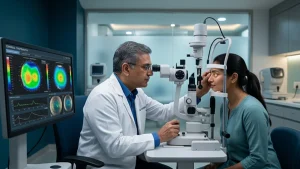
The pre-operative evaluation is the most important step in LASIK, more important than the surgery itself. It is where unsuitable candidates are identified and protected. A centre that spends fifteen minutes on screening and books surgery the same day is not doing this properly.
A thorough candidacy evaluation includes:
- Corneal topography – maps the surface shape of the cornea and detects keratoconus, irregular astigmatism, or other conditions that make LASIK unsafe. This is not a brief test; the maps should be studied carefully, not just generated.
- Pachymetry – measures corneal thickness at multiple points. There must be sufficient residual corneal tissue after ablation. Borderline thickness is a contraindication; a good centre will decline the patient rather than proceed.
- Dry eye evaluation – LASIK transiently reduces corneal sensitivity and worsens dryness. Patients with significant pre-existing dry eye are not suitable candidates for standard LASIK. This evaluation should include a Schirmer test or tear break-up time assessment, not just a questionnaire.
- Dilated refraction and pupillometry – the prescription entered into the laser must be accurate and stable. Pupil size in low light affects the risk of night vision changes post-operatively.
- Slit-lamp and fundus examination – to rule out corneal pathology, lens changes, and retinal conditions that might affect safety or outcomes.
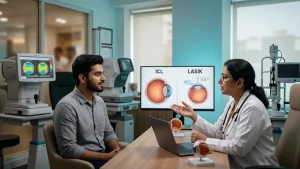
What should happen if the screening finds I am not suitable for LASIK?
A good centre examines the patient and explains why they are not suitable for LASIK surgery, then assesses whether PRK, SMILE, or an implantable collamer lens (ICL) is a safer alternative. If a centre has never declined a patient for LASIK, that is not a sign of quality – it is a sign of poor screening.
Surgeon experience: why volume matters more than credentials alone
A surgeon’s qualifications establish a baseline. What determines skill at the procedural level is volume – the number of LASIK procedures performed per year. A surgeon performing several hundred LASIK cases annually encounters the full range of corneal anatomies, the edge cases, and the occasional complication. A lower-volume operator does not.
Ask directly: how many LASIK procedures does the surgeon performing your operation do per year? A confident, experienced centre will answer this without hesitation. A deflected answer, “our team has decades of combined experience”, does not answer the question.
Affordable LASIK surgery near me: what the price should and should not include
The search for affordable LASIK surgery near me often surfaces a base price that looks attractive until the inclusions are examined. A complete LASIK price should cover the pre-operative assessment, the surgery on the named platform, post-operative drops, and follow-up appointments at specified intervals.
A quoted price excluding the pre-operative assessment is not a fair comparison with one that includes it. The assessment alone requires multiple instruments and an ophthalmologist’s time. When a centre quotes a very low base price, the right question is not “can I afford this?” but “what is not in this number?”
Red flags when evaluating a LASIK centre near me
Several patterns reliably indicate that a centre’s priorities are not aligned with patient outcomes:
- Same-day booking after a brief consultation – a thorough screening cannot be compressed into a single short visit
- No clear answer on which specific laser platform is used – platform transparency is basic; evasion suggests older equipment
- Pressure to decide quickly or accept a time-limited discount – LASIK is an elective procedure; urgency is a sales technique, not a clinical one
- No mention of enhancement rates or potential need for a follow-up procedure – honest centres disclose this upfront
- A quoted price significantly lower than the regional range, without a clear explanation of what is excluded
What to look for in the best LASIK eye surgery in India
The best LASIK eye surgery in India is defined by current-generation technology, a screening process that excludes unsuitable patients, a surgeon with high annual volume, and post-operative care that is included rather than extra. These are not premium features – they are the baseline of responsible practice.
ASG Eye Hospital, with centres in Ahmedabad, Surat, Indore, and more, offers LASIK, PRK, and SMILE on current-generation femtosecond and excimer laser platforms. Pre-operative candidacy assessments are comprehensive. Patients unsuitable for LASIK are assessed for alternatives at the same visit. Pricing is transparent and inclusive of the full care pathway. If you are searching for a top eye hospital for LASIK surgery near you, the evaluation is the place to start – not the price list.
FAQs
1. What should I ask when I find a LASIK surgery near me?
Ask which laser platform is used (femtosecond or microkeratome; standard or wavefront-guided ablation), what the pre-operative screening includes, how many LASIK procedures the surgeon performs annually, and what is included in the quoted price.
2. How do I identify the best LASIK eye surgery in India?
By the quality of the screening, not the marketing. The best centres use current-generation platforms, conduct thorough candidacy assessments, decline unsuitable patients, and have surgeons with high annual LASIK volume.
3. Is affordable LASIK surgery near me worth considering?
If the lower price reflects the same platform, the same procedure, and the same inclusions, yes. If it excludes the pre-operative assessment, post-operative drops, or follow-up visits, the comparison is misleading. Always ask what is and is not in the quoted figure.
4. What happens if screening shows I am not suitable for LASIK?
A good centre will explain the specific reason, then assess whether PRK, SMILE, or ICL is a suitable alternative. Being declined for standard LASIK does not necessarily mean you cannot have laser vision correction at all.
5. Why does surgeon volume matter when choosing a top eye hospital for LASIK surgery?
Volume builds the experience needed to handle the full range of corneal anatomies and the occasional complication confidently. Credentials establish a baseline; annual case numbers reflect active, current skill.