Advanced, Safe & Trusted Eye Care Across India
Cataract is one of the most common eye conditions affecting vision, especially with increasing age. At ASG Eye Hospital, we offer advanced cataract surgery using modern techniques and high-quality intraocular lenses, helping patients regain clear and comfortable vision with quick recovery and long-lasting results.
Why Choose ASG Eye Hospital for Cataract Surgery?
- Experienced cataract surgeons with years of expertise
- Latest cataract surgery technology (Phaco, MICS, Laser)
- Wide range of standard & premium intraocular lenses
- Safe, stitch-less and painless procedures
- Same-day discharge in most cases
- Transparent treatment approach
- Insurance & cashless facility support
- Multiple ASG Eye Hospital locations for easy access
- Dedicated pre- and post-operative care
What Is a Cataract?
A cataract occurs when the natural lens of the eye becomes cloudy, leading to blurred or dim vision. It can affect one or both eyes and usually develops slowly over time. Cataract surgery is the only permanent and effective treatment to restore vision.
Common Symptoms of Cataract
- Blurred or cloudy vision
- Difficulty seeing at night
- Sensitivity to light and glare
- Faded or yellowish colors
- Frequent change in spectacles
- Double vision in one eye
If these symptoms interfere with daily activities, cataract surgery may be recommended.
Types of Cataract
| Type of Cataract | Description | Common Symptoms |
| Nuclear Cataract | Forms in the center of the lens, usually age-related | Yellowing of vision, poor distance vision |
| Cortical Cataract | Develops on the outer edges of the lens | Glare, light sensitivity |
| Posterior Subcapsular Cataract | Forms at the back of the lens | Difficulty reading, poor night vision |
| Congenital Cataract | Present from birth or early childhood | Blurred vision in children |
| Secondary Cataract | Develops due to diabetes, medications, or after eye surgery | Gradual vision loss |
| Traumatic Cataract | Caused by eye injury | Sudden or delayed vision blur |
When Is Cataract Surgery Required?
Cataract surgery is advised when vision loss starts affecting daily life, such as:
- Reading or working on screens
- Driving, especially at night
- Recognizing faces
- Watching television
- Performing routine tasks safely
Types of Cataract Surgery
| Surgery Type | What It Involves | Key Advantages | Best For |
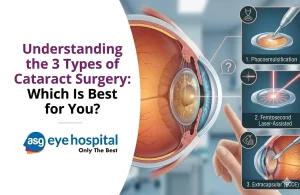
| Phacoemulsification (Phaco) | Cataract is broken using ultrasound and removed through a small incision | Stitch-less, quick recovery, minimal discomfort | Most age-related cataracts |
| Micro-Incision Cataract Surgery (MICS) | Advanced phaco technique using a very small incision | Faster healing, less inflammation | Patients seeking quicker recovery |
| Laser-Assisted Cataract Surgery (FLACS) | Uses femtosecond laser for precise incision and lens removal | High precision, bladeless, advanced technology | Patients opting for premium treatment |
| Extracapsular Cataract Extraction (ECCE) | Manual removal through a larger incision | Effective for hard or mature cataracts | Advanced or dense cataracts |
| Pediatric Cataract Surgery | Cataract removal in infants or children | Prevents vision development issues | Congenital or childhood cataract |
The type of surgery is selected based on eye condition, cataract severity, age, and surgeon’s recommendation.
Intraocular Lens (IOL) Types – Comparison
| Lens Type | Vision Provided | Key Features | Ideal For |
| Monofocal Lens | Single-distance vision | Clear distance vision, cost-effective | Basic vision correction |
| Multifocal Lens | Near & distance vision | Reduces dependency on glasses | Active lifestyle |
| Trifocal Lens | Near, intermediate & distance | Premium clarity at all ranges | Maximum spectacle freedom |
| Toric Lens | Distance + astigmatism correction | Corrects cylindrical power | Patients with astigmatism |
| EDOF Lens | Extended range of vision | Smooth intermediate vision | Computer & office users |
Benefits of Advanced Cataract Surgery at ASG
- Improved visual clarity
- Minimal pain and discomfort
- Faster recovery time
- Reduced dependency on spectacles
- Long-lasting vision correction
- High safety standards
Diagnostic Tests Before Cataract Surgery
- Visual acuity test
- Eye pressure measurement
- Retina examination
- Corneal evaluation
- Biometry (IOL power calculation)
Cataract Surgery Procedure at ASG Eye Hospital
- Eye examination & diagnosis
- Lens selection discussion
- Day-care cataract surgery (15–30 minutes)
- Post-operative care & follow-ups
Most patients can resume normal activities within a few days.
Insurance & Cashless Facility
- Cataract surgery is usually covered under health insurance
- Coverage may vary based on lens type and policy terms
- ASG Eye Hospital supports cashless and reimbursement processes
Frequently Asked Questions (FAQs)
Is cataract surgery painful?
No. Cataract surgery is painless and performed under local anesthesia.
How long does cataract surgery take?
The procedure usually takes 15–30 minutes.
How soon can I resume daily activities?
Most patients can resume normal activities within a few days.
Which lens is best for me?
Lens selection depends on your vision needs, lifestyle, and eye condition.
Is cataract surgery safe?
Yes, it is one of the safest and most commonly performed eye surgeries.
Book Your Cataract Consultation at ASG Eye Hospital
Restore your vision with safe, advanced, and trusted cataract treatment at ASG Eye Hospital.
📞 Call Now : 1800 1211 804
📅 Book an Appointment
💬 Consult Our Eye Specialists