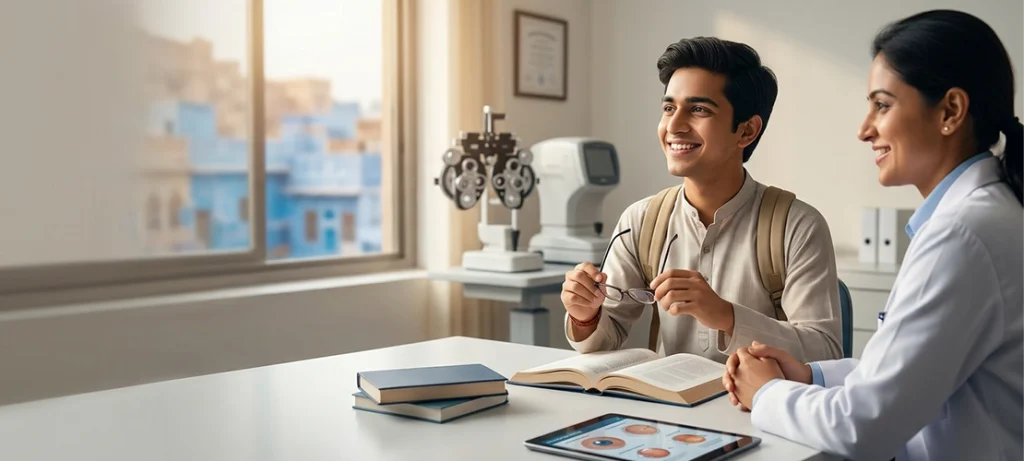
Students with mild to moderate myopia who wish to be free of glasses but are too young to undergo laser surgery would want to know about other alternatives for vision correction.
The presence of these options may vary in Jodhpur but before considering any option, it is important to discuss it with the skilled ophthalmologist. Knowing what treatment is best for your eye problems is the first step to seeing clearly and living confidently. Student eye health is becoming more widely recognized these days so many are looking into LASIK in Jodhpur services, so that they can correct their vision permanently as soon as they become eligible.
What Are the Best Vision Correction Options for Students?
Students can improve vision through eyeglasses, contact lenses, anti-glare glasses, blue-light filtering lenses, Orthokeratology (Ortho-K), and LASIK surgery for eligible adults. The right option depends on age, prescription stability, lifestyle, and overall eye health. A comprehensive eye examination helps determine the most suitable solution.
Knowing the Signs: When Should a Student Seek Help?
Many students overlook early warnings like squinting in class, not being able to read on the board or getting frequent headaches after studying. These are not merely signs of fatigue; they are frequently the body’s most obvious indicators that vision needs expert care. There is no reason to put off getting a simple eye exam in Jodhpur because there are numerous eye care facilities located around the city. Early detection of a vision issue stops it from gradually impairing academic achievement.
Eyeglasses: The Simplest and Most Trusted Solution
Eyeglasses continue to be the simplest as well as most economical option for kids just starting their vision correction journey. They are easily updated when prescriptions change, which usually occurs throughout student years, along with they don’t require surgery or a lengthy adaptation time. In Jodhpur, you will find several optical stores, so it isn’t an expensive procedure to get a pair that fits your prescription. Frames these days are lighter, more fashionable and comfortable than they were in the past, and can be useful for long periods of study.
Contact Lenses: A Practical Option for Active Students
Students who take part in outdoor activities, sports or extracurricular activities often wear contact lenses because they find glasses burdensome or cumbersome. Eye lense provides a clear unobstructed vision, comfort and convenience. However, they do require strict cleanliness and this should be taken seriously by all students. Long wear-time of lenses without proper maintenance may lead to an infection. It is essential that an eye doctor in Jodhpur does a detailed eye examination prior to giving up glasses for contacts.
Vision Correction Options for Students and Their Benefits
| Vision Correction Option | Benefits for Students |
|---|---|
| Eyeglasses | Affordable, safe, and easy to update as prescriptions change |
| Contact Lenses | Clear vision without frames, ideal for sports and activities |
| Anti-Glare Glasses | Reduces glare and improves visual comfort during study sessions |
| Blue-Light Lenses | Helps reduce digital eye strain from prolonged screen use |
| Orthokeratology (Ortho-K) | Provides daytime vision correction without glasses or lenses |
| LASIK Surgery | Long-term vision correction for eligible adults with stable prescriptions |
| Regular Eye Exams | Detects vision problems early and supports academic performance |
Anti-Glare and Blue-Light Glasses: A Modern Necessity for Screen-Heavy Students
Current students spend between 6 and 10 hours a day on screens as they access digital materials of studies, attend online classes, or complete homework. In these situations, standard prescription glasses might not be sufficient. Blue-light filtering lenses help minimize digital eye fatigue, while anti-glare lenses lessen the strain caused by reflected light. These are useful supplements to a student’s eye care regimen, particularly in a time when screen dependence is inevitable. However, they are not complete vision correction techniques on their own.
Orthokeratology: The Overnight Lens Therapy Worth Knowing About
Orthokeratology (alternatively called Ortho-K) is a less established yet effective non-surgical method, which entails the softening of the cornea overnight using the cornea with specially designed rigid glasses. Students benefit from unobstructed, clear eyesight all day long when removed in the morning. This would help students who are mildly to moderately myopic so they do not need to have to wear glasses, but are too young to undergo laser surgery. This option needs an experienced eye specialist or ophthalmologist before it can be taken because this might not be available in Jodhpur.
LASIK and Laser Correction: Understanding the Long-Term Option
LASIK surgery is currently one of the most popular surgical procedures of long-term vision correction. The laser is used to correct refractive errors, such as myopia, and hyperopia along with astigmatism, by reshaping the cornea with a well calibrated laser. The eyes develop during this period, however, and it is generally not recommended for students less than 18 or 20 years old. With a trusted eye surgeon, Lasik surgery in Jodhpur might be a life-changing and enduring procedure that senior college students or postgraduate scholars with stable prescriptions for a minimum of a year ought to explore.
Conclusion
Pupil’s vision problems don’t need to stop them achieving their learning goals. All children deserve to have clear vision in addition to comfortable eyesight. Whether going for simple glasses or contact lenses or specs removal surgery Jodhpur via top eye hospital like ASG Eye Hospital, the medical environment is advancing, and it is quicker than ever to find quality eye treatment. Good eyesight is vital to a student’s learning, so it is important not to overlook and self-diagnose along with delay.
FAQs
1. What is the most common vision correction option for students?
Eyeglasses remain the most common and cost-effective solution for correcting refractive errors in students.
2. Are contact lenses safe for students?
Yes. Contact lenses are safe when prescribed by an eye specialist and used with proper hygiene and care.
3. What is Orthokeratology (Ortho-K)?
Orthokeratology is a non-surgical vision correction method that uses specially designed overnight lenses to temporarily reshape the cornea.
4. Can students undergo LASIK surgery?
LASIK is generally recommended for individuals above 18 years of age with a stable eye prescription and healthy eyes.
5. Do blue-light glasses improve vision?
Blue-light glasses do not correct vision but may help reduce digital eye strain associated with prolonged screen use.
6. What are the signs that a student may need vision correction?
Common signs include squinting, blurred vision, headaches, eye strain, difficulty reading the board, and reduced academic performance.
7. How often should students have an eye examination?
Students should undergo a comprehensive eye examination at least once a year or as recommended by their eye specialist.
8. Can myopia worsen during student years?
Yes. Myopia often progresses during childhood and adolescence, making regular eye checkups important for monitoring vision changes.