
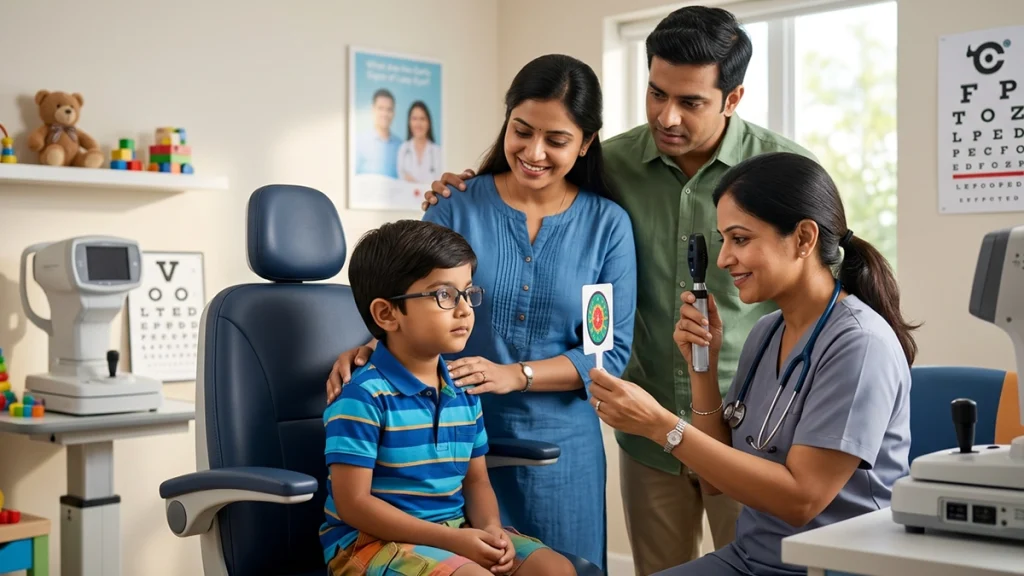
Lazy eye which is also known as amblyopia is a vision issue that develops in childhood which has one eye that does not develop as well as the other. In some cases both eyes are affected. The eye may look fine but the brain begins to use the image from the stronger eye. This change in the brain happens as vision is still developing which is why early diagnosis and lazy eye treatment is important for the long term health of the eyes.
The issue is that it is easy to overlook because kids do not always know which of their eyes is seeing differently. The better eye may correct for it which allows the child to play, read and move around without bringing it to attention. Early Lazy Eye Symptoms may present as changes in posture, coordination or visual behavior. By knowing Amblyopia Symptoms and the common Lazy Eye causes parents may arrange for an exam before the eye which is doing worse is completely ignored.
What Is Lazy Eye?
Amblyopia results from a miscommunication between the brain and an eye which at some point during the early growth of vision does not function as they should. If an image is blurred, misaligned or blocked the brain will favor the other eye. Over time the connection between the brain and the weaker eye does not fully form. Thus in Lazy Eye Treatment we do not just focus on the health of the eye but also on methods to get the brain to use the weaker eye more which in turn stimulates its development.
Lazy eye and strabismus although are distinct they are related. Strabismus that the eye goes in, out, up or down. Amblyopia in which vision does not develop properly. A child may also present with amblyopia while the apparent alignment of the eyes is within normal range, especially in cases when prescription between the eyes is very different. A full scale exam is important before starting on Lazy Eye Treatment.
Early Signs Parents May Notice
The range of Early Lazy Eye Symptoms is very individual. May be that one eye will turn out or in which may be a constant issue or only present when the child is tired. A child may cover one eye while watching TV, reading, or looking out into the distance. Also may tilt head or turn face to use the stronger eye.
As for a large set of Amblyopia Symptoms related to depth perception. May have issues judging steps, bump into things, reach in an inaccurate manner or do poorly in ball games. This may look like typical clumsiness but repeated trouble with tasks which require the use of both eyes should be checked out.
Some kids sit very near to screens, lose their place while reading, avoid color or detail work, or have trouble copying from a board. These may be Lazy Eye Symptoms but do not in fact prove amblyopia which in any case may present with a number of vision and learning issues that produce the same behaviors. They do however indicate the need for separate eye testing.
Teachers may be the first to notice Lazy Eye Symptoms during reading or sports. Because Amblyopia Symptoms may be subtle, repeated observations across different settings are worth sharing with the doctor.
Parents also report that which eye is covered brings out very strong reactions. If the child’s response is very poor when the better eye is patched, the weaker eye may in fact have a defect. This is a tell tale Amblyopia Symptoms but is not a do it at home or dismiss to patching without a medical evaluation. I am using it to fill in for the repeat which is a parent break and also to separate points I made.
Early Signs and Everyday Clues
| Possible sign | What may be noticed | Why assessment matters |
| Eye turning or drifting | One eye points in a different direction | Alignment and vision in each eye can be checked |
| Closing one eye | The child shuts one eye while reading, watching screens or looking in bright light | It may indicate unequal clarity or coordination |
| Head tilt or face turn | The child repeatedly changes head position to look | The posture may compensate for a visual problem |
| Poor depth judgement | Difficulty with stairs, catching a ball or reaching for objects | Binocular vision can be assessed |
| Avoiding close tasks | Reduced interest in reading, drawing or puzzles | Refraction may reveal unequal focusing power |
| Distress when one eye is covered | The child strongly objects when the better eye is blocked | It may suggest reduced vision in the uncovered eye |
Some children show none of these signs. Government health sources note that the affected eye can look normal and that poor vision in one eye may be the main finding. Screening helps identify children who need a comprehensive eye examination.
Common Lazy Eye Causes
One of the primary Lazy Eye causes is strabismus. When the eyes do not aim at the same object the brain may ignore the image from the misaligned eye which in turn causes double vision. If this goes on into early childhood the brain may learn to suppress that eye’s vision.
Unequal refractive error is also a very present issue. In some cases one eye may be much more affected by long sightedness, short sightedness or astigmatism than the other. The brain will go to the better focused image, at which point the other may appear lazy even when in fact both eyes are aligned. These lazy eye causes may go undetected until an eye exam measures the power of the focus and the vision in each eye.
Deprivation amblyopia is when something obstructs a clear image from going to the retina. In childhood we see cataracts, a very low hanging eyelid or a cloudy cornea which all play a role in development. These less common Lazy Eye causes require prompt attention as the issue itself must be resolved. A white pupil or an eyelid that covers the pupil should not be waited out at home for weeks.
High refractive error which is uncorrected in both eyes also plays a role in visual development. Family history, premature birth and some developmental conditions may contribute to risk but a risk factor by itself does not confirm amblyopia. The goal of the evaluation is to determine the exact problem and implement the appropriate Lazy Eye Treatment.
Types of Amblyopia and Treatment Direction
| Type | Main problem | General treatment direction |
| Strabismic amblyopia | The eyes are not consistently aligned | Correct vision, encourage use of the weaker eye and manage the eye turn when required |
| Refractive amblyopia | One eye has a substantially different prescription | Prescribed glasses, followed by additional therapy if vision remains unequal |
| Deprivation amblyopia | A cataract, eyelid droop or another obstruction blocks the image | Prompt treatment of the obstruction and visual rehabilitation |
| Bilateral refractive amblyopia | Both eyes receive persistently blurred images | Accurate optical correction and regular monitoring |
How Is Lazy Eye Diagnosed?
Amblyopia is not a diagnosis that can be made by appearance alone. For diagnosis we use age appropriate visual acuity tests for each eye, determination of refractive error, evaluation of eye alignment and movement, and study of the eye’s structures. Also we use pictures, matching methods and observation of fixation in which a child may not yet be able to read letters to test some kids. Normal photographs do not exclude Lazy Eye Symptoms, and subtle Amblyopia Symptoms can otherwise be missed. These steps help distinguish Amblyopia Symptoms from other causes of reduced vision.
A screening test is a tool to identify risk but does not instead of a full exam. When screening is abnormal or parents report persistent Lazy Eye Symptoms the child should be referred to an eye care professional. The doctor will determine the Lazy Eye cause which in turn may be a result of unequal focus, eye misalignment and visual obstruction which require different Lazy Eye treatments.
What Does Lazy Eye Treatment Involve?
The initial step in Lazy Eye treatment is to correct the issue that is causing poor vision. Many times we will start with prescription glasses. As the weaker eye begins to see better the doctor may put off further intervention and see how the patient does.
When there is a significant difference which remains, Lazy Eye Treatment may include the use of a patch over the strong eye for a set number of hours. This in turn forces the brain to use the weaker eye. Each person’s care plan is unique, also overuse of patches beyond what is recommended does not mean better results. Follow up is necessary for evaluation of both eyes.
Atropine drops also are a proven Lazy Eye treatment in some children. The medicine causes temporary blurring of near vision in the strong eye which in turn forces use of the weak eye. It should only be used as prescribed with direction on dose and side effects. Government health authorities report that glasses, patching and atropine are recognized treatments which they choose based on what is best for the child.
If there is a cataract, a severe eyelid droop or some other obstruction present, corrective surgery may be required in order to open up the field of vision. For some types of eye turn which we call “eye turns” we may recommend surgery as a treatment option also however an “unturned” eye can still present with poor vision. Also, at times Lazy Eye treatment will proceed prior to a procedure, or as a follow up after one.
Consistency is key which is why we see that children do not care for treatments which temporarily affect the vision they use the most. A set routine and involved activities will support their cooperation, but the treatment plan should be designed by the health care team. For Effective Lazy Eye Treatment we see that it is adjusted to the age, severity, cause and response of the child.
Why Early Treatment Matters
Visual development is at its most flexible stage in childhood. The National Eye Institute and NHS push for early intervention but it should be noted that older children are not to be written off. Research done by the National Eye Institute reports that some kids and teens may still see improvement, although results are very much a mixed bag.
Untreated amblyopia may persist into adulthood. According to the CDC in the case of around 2 to 3 out of each 100 kids this condition may also become chronic if it is not treated properly. Early intervention in Lazy Eye Treatment is focused on the improvement of useful vision as the visual system’s responsiveness at this stage is better which is the key for effective treatment.
When Should Parents Seek Treatment?
Arrange for an eye exam when a child is reported to be closing one eye repeatedly, tilting the head, having issues with 3D tasks, sitting very close to reading materials or which has a recurring eye turn. Also if there is a failed school or pediatric screening go in for a follow up evaluation even when there are no apparent Amblyopia Symptoms. Some causes of amblyopia which are silent like unequal refractive error may not present with obvious symptoms and thus should not be ruled out simply because the eyes appear to be normal.
Seek prompt medical attention for a white pupil, a sudden or constant new eye turn, an eyelid blocking the pupil, an eye injury, sudden loss of vision, significant pain or redness with reduced vision. These findings are not all typical Lazy Eye Symptoms, but they may indicate conditions requiring faster care and possibly urgent Lazy Eye Treatment.
Parents don’t have to wait until a child is reading. Eye care professionals can evaluate infants, toddlers and preschool children using age appropriate techniques. The CDC reports that it is recommended to have at least one vision screening between the ages of 3 and 5 to identify amblyopia or it’s risk factors.
Frequently Asked Questions
1. What are the earliest lazy eye symptoms?
Early Lazy Eye Symptoms may present as an eye that turns out, a child which covers one eye, which tilts his head, has poor depth perception, away from detailed tasks or has distress when one eye is covered. Some kids do not show any visible symptom.
2. Are amblyopia symptoms always visible?
No. Amblyopia Symptoms may go unnoticed when both eyes are used at the same time but one has a very different corrective lens prescription. The strong eye does the compensating which is why a child may not see that there is a problem.
3. What are the main lazy eye causes?
The main Lazy Eye Causes are eye misalignment, unequal refractive error and obstruction of the visual pathway by conditions such as childhood cataract or a severe drooping eyelid.
4. Can glasses alone provide lazy eye treatment?
For certain children the Lazy Eye Treatment which we may begin with the use of glasses and what we see is that vision improves greatly as the image comes into focus. We may also add in patching, drops or treatment of an issue which is at the root of the problem.
5. How long does lazy eye treatment take?
The duration of Lazy Eye Treatment is a variable which at play is age, severity, cause and response. Care may go on for months in which time we have exams that will adjust the plan and also monitor the health of both eyes.
6. Can lazy eye return?
Vision can sometimes worsen after therapy is reduced or stopped. The ophthalmologist may taper Lazy Eye Treatment and continue follow-up to detect regression.
7. Is surgery always necessary?
No. Many children are treated with glasses, patching or drops. For Lazy Eye causes which include a cataract, large scale eyelid obstruction or a strabismus requiring operative correction, surgery is considered.
8. Can an older child still receive treatment?
Yes. Earlier treatment is preferred which is true, but also attention should be given to the care of older children. Some may respond to Lazy Eye Treatment and also a diagnosis of other correctable vision issues is made.