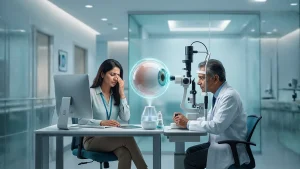
Dry eyes can present as a gritty sensation at the end of the day, also they may interfere with reading, driving, or screen time. This is a result of the eyes producing too few tears which in turn causes the tear film to evaporate or become unstable at a rapid rate. We present this information on Dry Eye Causes to support you in seeking early Dry Eye Treatment which in turn may prevent persistent irritation.
Occasional dryness may be a thing that improves with rest but if you have Recurring Dry Eye Symptoms don’t write it off as normal for screen use or as a part of the aging process. If symptoms persist for weeks you may have Chronic Dry Eye which will require an eye exam.
What Is a Dry Eye?
Each time we blink our tear film is spread across the eye. Oily, watery and mucus elements of which it consists of protect the cornea’s smooth surface, support clear vision and also reduce friction. Dry eye results from insufficient tear production, rapid evaporation or unstable tears.
Because several mechanisms create similar discomfort, Dry Eye Treatment should address the underlying problem. A weak protective oil layer may cause dryness even when tear volume seems adequate, while age, medicines or health conditions can reduce production. These Dry Eye Causes which is why the same drop does not work for each patient the same.
Common Dry Eye Symptoms
The condition also does not present as just simple dryness. Common dry eye Symptoms are burning, stinging, itching, redness, a sandy or gritty sensation, sensitivity to light, and blurred vision that resolves when one blinks. Also some patients report that they have the sensation of a lash or grain of sand in the eye.
Wat tear production may also be a result of surface irritation which in turn triggers reflex tearing. These tears may present in excess of what is required and do not form a stable protective layer. Also included in Dry Eye Symptoms are reports of tired eyes, discomfort which contact lens wearers experience, stringy mucus and fluctuating vision which may present itself in air conditioned settings, dust, and later in the day.
Choosing which Dry Eye treatment to use starts with recognizing the pattern of symptoms. We have included a table which details how common symptoms present and what they may indicate. This is not to be used for diagnosis as infections, allergies, corneal injuries and other eye issues may present with similar signs.
| Symptom | How it may feel | Why an examination may help |
| Burning or stinging | A hot, irritated or raw sensation | Helps distinguish dryness from allergy or infection |
| Grittiness | Sand, dust or a foreign-body feeling | May reflect an unstable tear film or eyelid-gland problem |
| Intermittent blur | Vision clears after blinking, then becomes hazy again | Can indicate that the tear layer is breaking up too quickly |
| Redness | Visible blood vessels or general irritation | Persistent redness needs assessment to exclude other causes |
| Watering | Tears overflow despite a dry or scratchy feeling | May be reflex tearing caused by surface irritation |
| Contact-lens discomfort | Lenses feel dry, tight or difficult to wear | May require a lens review and targeted surface care |
What Are the Main Dry Eye Causes?
One of the primary causes of Dry Eye is reduced tear production. As we age our tear production may decline and it may also be affected by health conditions which include the immune system, thyroid or metabolic issues. Hormones play a role in the tear film which is why dryness may present itself more at certain points in life.
Rapid tear break up is also a large issue. Along the edge of the eyelids are small meibomian glands which produce oil that in turn slows break up. When these glands become blocked or do not produce the right kind of oil, tears may leave the surface too quickly. Also at this time Eyelid inflammation which is also known as blepharitis may present and it does play a role in Chronic Dry Eye.
Modern work culture has introduced dryness. We see that people are not blinking as much and may be only partially blinking while they are into their phone, laptop or desktop tasks. Extended periods of low blink rate causes the tear film to break up which in turn brings forward the onset of Dry Eye Symptoms even when the tear glands are still at it’s [which is still] full capacity.
Environmental factors play a role. Wind, smoke, pollution, low humidity, fans and direct air conditioning may cause tear evaporation or irritate the eye surface. These environmental Dry Eye Causes also account for why symptoms may present at some times and be worse in certain rooms, seasons or work places. Contact lenses, past eye surgery and some medicines used for allergies, colds, depression or blood pressure also play a role. Do not cease prescribed medication without medical advice; bring it up during the eye consultation.
Who Is More Likely to Develop Chronic Dry Eye?
Sure is that any person may have temporary dryness but Chronic Dry Eye is more prone with age, extended use of screens, wearing contact lenses, in dry indoor air, from eyelid gland dysfunction or as a result of some health conditions. Autoimmune disease, diabetes and thyroid issues may also play a role. A full history is used by the ophthalmologist to tailor Dry Eye Treatment.
Risk assessment also guides Dry Eye Treatment. The table below connects common risk factors with practical questions that patients can discuss during an appointment.
| Risk factor | How it may affect the eyes | Useful point to discuss |
| Increasing age | Tear production or tear-film quality may decline | When symptoms started and whether they are becoming more frequent |
| Heavy screen use | Blink rate and blink completeness may decrease | Daily screen hours, breaks and workstation airflow |
| Contact lenses | Lenses may alter tear stability and increase discomfort | Lens type, wearing duration and hygiene routine |
| Eyelid-gland dysfunction | Oil deficiency allows tears to evaporate faster | Crusting, lid swelling or symptoms on waking |
| Medicines | Some medicines may reduce tear production | A complete list of prescription and non-prescription products |
| Health conditions | Immune, thyroid or metabolic problems may affect tears | Existing diagnoses, dry mouth, joint symptoms or recent health changes |
How Is Dry Eye Diagnosed?
An ophthalmologist will ask what brings the issue to your attention, what makes it better or worse, how much time you spend on screen use, if you use contact lenses and what medications you are on. The exam may include evaluation of the eyelids, blink quality, tear volume, tear stability and the corneal surface. At times special dyes or tear tests are used. A slit-lamp exam allows the doctor to see the tear film, eyelids and eye surface in great detail. A Schirmer test is used to measure tear production and a break up time of tears is done to see how well the tear film does after a blink. The exact tests done are based on the patient’s symptoms and what is seen in the exam.
This matters as we see Dry Eye Treatment from a causal perspective. Evaporative dryness which is a result of issues with the eyelid glands may require a different approach from low tear production. Allergy, infection and corneal disease may present in the same way, also over the counter redness relief or steroid drops may in fact be delaying diagnosis.
Dry Eye Treatment Options
In mild cases of dry eye treatment may start with the use of lubricating drops, gels or ointments. What works best depends on the severity, contact lens use and dosing frequency. Preservative free options may be preferred when drops are required often.
Artificial tears supplement the natural tear film and reduce friction across the eye surface. They can provide useful relief, but they do not correct every underlying problem. Someone with blocked eyelid glands, inflammation or reduced tear production may need additional care rather than simply changing between different lubricating products.
When blockage of the eyelid glands or blepharitis is a Dry Eye Causes we may include in treatment a regimen of professional guidance for warm compresses and eyelid hygiene. Also we see deliberate blinking, screen breaks, redirecting of air vents, use of a humidifier in dry environments and reduction of smoke exposure as supportive measures in Dry Eye Treatment.
Moderate to severe Chronic Dry Eye may require prescription anti-inflammatory eye drops or other therapies as determined by an ophthalmologist. In some patients we see benefit from punctal plugs which in turn reduce tear drainage and cause tears to stay on the eye longer. Also included may be the treatment of related eyelid issues, allergy, or some other health issue.
Punctal plugs are small devices that are put in the tear drain passages at the inner eye lid corner. They slow the drainage which in turn allows natural tears and tear drops to stay on the eye surface longer. They do not go in every case and should be put in only after a proper evaluation.
Severe and complex cases of Chronic Dry Eye may require a more long term approach which includes a combination of treatments instead of just one product. In the Dry Eye treatment we go beyond the goal of providing only temporary relief; we also work to improve the stability of the tear film, reduce inflammation, protect the eye surface and to achieve more consistent vision.
Everyday Habits That Can Reduce Discomfort
During screen time do perform frequent complete blinks, take frequent vision breaks, position the monitor just below eye level and keep the fans or air conditioners away from your face. Also adhere to the provided eye drop and lid care regimen very regularly. If you are a contact lens wearer do not persist with use through large scale irritation, also do not use redness relief or prescription drops without professional advice. These are the measures that support Dry Eye Treatment which is in addition to seeing a health care provider when symptoms last.
People in air conditioned offices may see that symptoms worsen as the day goes on. Try moving your work station away from that draft, take a break from your computer at regular intervals and be aware of fully completing each blink. For outdoor work use protective glasses in windy or dusty settings. Consistency is the key. Using eye drops only when very uncomfortable may not give the same results as a regime put forth by the ophthalmologist. Also the warm compresses should be very warm not hot and the lid cleaning should be gentle.
When Should You Seek Treatment?
Book in for an eye exam when you have Dry Eye Symptoms which don’t improve with basic treatments, come back often, interfere with your reading or work, or cause your contact lenses to be an issue, or which cause repeated episodes of blurred vision. Persistent Dry Eye Symptoms are a reason for assessment as this condition may progress to a more difficult to manage state when inflammation and surface irritation are left untreated.
Seek medical attention early when you have dry eyes which also include pain, light sensitivity which is a marked issue, a sudden or continuous vision change, an eye injury, chemical exposure, thick discharge from the eye, very red eyes or the sensation that there is something in your eye. These may be signs of a more serious issue other than just dryness and should not be treated only with artificial tears.
People with an existing autoimmune issue, recent ophthalmic surgery or symptoms like dry mouth should bring that to the doctor’s attention at your visit. Early assessment will determine if it is Chronic Dry Eye which in turn will help the doctor choose suitable Dry Eye Treatment before discomfort begins to affect daily activities.
Why Timely Care Matters
Dryness is often manageable, but delay can allow tear-film instability and surface inflammation to reinforce each other. Timely Dry Eye Treatment may reduce discomfort and protect the eye surface. Severe untreated dryness can occasionally damage the cornea, which is the clear front surface of the eye.
At ASG Eye Hospital our ophthalmologists evaluate the tear film and eyelids, determine what Dry Eye Causes you and we will recommend which among lubrication, eyelid care, environmental modifications or prescription therapy will be right for you. We may perform tear film analysis, a slit lamp exam, Schirmer test and evaluation of the oil producing glands of the eyelids.
Frequently Asked Questions
1. Can dry eye cause blurred vision?
Yes. An unstable tear film which in turn may cause variable vision which may present during activities like reading, driving, and screen time. If vision is which has suddenly appeared, is persistent, painful or different in each eye see an eye care professional instead of attributing it to dryness. Appropriate for dry eye treatment can improve clarity when tear film instability is the cause.
2. Why do my eyes water when they feel dry?
Surface irritation may cause reflex tearing in which the secretion may spill over but will lack the balance of oil, water and mucus for sufficient lubrication. So a person can produce lots of tears at the same time they also have dry eye symptoms.
3. Can too much screen time cause dry eye?
Screen time may cause dryness which is a result of decreased blink rate when we are engrossed in what we are seeing. It is a put forth issue but not the only one. Also, persistent issues may be a symptom of other Dry Eye Causes like eyelid gland issues, medication use or an underlying health problem.
4. Is chronic dry eye permanent?
Chronic Dry Eye may last for a while, but it’s symptoms can also be controlled with proper care. The prognosis is based in the cause and how severe it is and also if blepharitis or some other health issue is present. Also a Custom Dry Eye Treatment plan is usually better results than at home remedies.
5. Are artificial tears safe to use every day?
Punctal plugs are small devices that are put in the tear drain passages at the inner eye lid corner. They slow the drainage which in turn allows natural tears and tear drops to stay on the eye surface longer. They do not go in every case and should be put in only after a Dry Eye Treatment.
6. Can dry eye damage the eyes?
Persistent dryness which is severe and constant may cause inflammation or damage to the eye surface. Also this is more likely in cases where symptoms are ignored or when an underlying issue goes untreated. It is recommended that patients with chronic Dry Eye Symptoms see an ophthalmologist for a full eye exam.
7. How can I tell the difference between a dry eye and an eye infection?
Both can cause redness and irritation but infection may also present with discharge, eyelid swelling, pain or recent contagious exposure. In that which presents similarly, an eye exam is the safe bet to rule out infection as a cause of Chronic Dry Eye.
8. When should I visit ASG Eye Hospital for dry eyes?
Arrange a consultation when symptoms persist, frequently return, affect vision or daily work, or do not improve with basic measures. Prompt care is particularly important when there is pain, light sensitivity, injury or a sudden change in vision. An ophthalmologist can evaluate the likely Dry Eye Causes and recommend suitable Dry Eye Treatment.