Many have known of blood donation and organ donation which is the case, but we aren’t always sure what an eye bank does. Families often ask if the whole eye is put in during the transplant, if donation changes the way the face looks, or if donated eyes really do give sight to someone. These are normal questions and we may ease into the practice of donation if we did more to understand the role of an eye bank.
An eye bank is a specialized health facility which collects, evaluates, preserves, and distributes donated eye tissues, mostly the cornea. The cornea is the clear front of the eye which plays a role in light focus. When it is damaged by infection, injury, disease, or scarring vision may become very blurry. In those cases eye donation is a solution because the donated tissue may be used for a corneal transplant, which in turn gives another person the chance at regaining good vision.
In most cases what we see is that the cornea is the primary focus of eye donation. Full eye transplantation into another person is not a usual practice. What is done is that the clear corneal tissue is removed, it goes through the eye banking process, which is a well established routine and is then put to use in patients that are appropriate for a corneal transplant. This is the reason why corneal donation is very much a great way to restore sight after death.
What Is an Eye Bank?
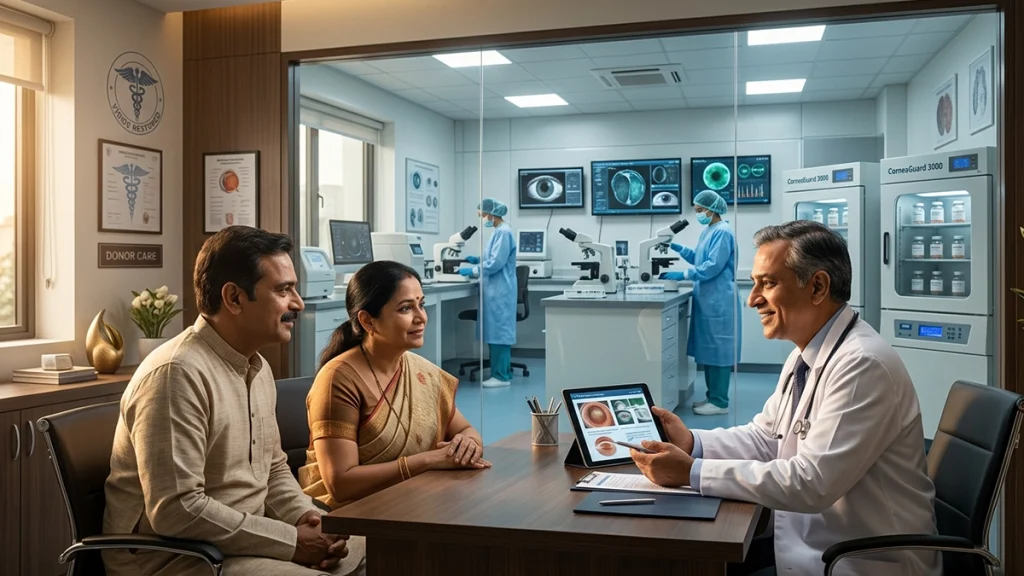
An eye bank does much more than serve as a storage center. It is a regulated health care service which puts together donors, hospitals, surgeons, and patients that are in need of corneal tissue. At an eye bank the team springs into action right after a donor’s death as corneal tissue has to be removed and put into storage within a very short time.
The goal of an eye bank is to see that donated corneas are treated with the utmost care and ethics, we also look at the quality of the tissue, screen for infections, preserve in appropriate media, and then we provide the tissue to patients based on their medical need. This structured eye banking process also which we have put in place is to make sure that every donation that is useful goes out and is used in the best possible way.
An eye bank may also provide support for public education, donor awareness, grief counseling, and coordination with hospitals. In many cases, the family of the donor plays a very important role because the eye donation can happen only after death and timely consent by the family can make the donation possible.
Why Eye Donation Matters
Eye donation is a very large category of donation that can restore sight to persons with corneal blindness. A person may present with corneal blindness which though may have a healthy retina and optic nerve has a front transparent layer of the eye that is cloudy or scarred. When we do a corneal transplant in such cases the damaged cornea is put out and in its place a donor cornea is put in which allows light to again enter the eye properly which in turn may bring about great improvement in vision.
This is what makes corneal donation so valuable. It may not give back life, but it can bring back sight, confidence, mobility and independence for a person who has been living with serious visual impairment. Also for families eye donation can become a meaningful way to honor a loved one’s memory.
Many people think that the act of donation will mar the face’s appearance at the time of the funeral or will delay the funeral proceedings. But in fact the process is very much handled with respect by the trained staff. The donor’s appearance is preserved and also the process does not for the most part interfere with the final rites when the family contacts the eye bank right away.
Eye Donation vs Corneal Donation
People tend to use the terms eye donation and corneal donation interchangeably but there is a difference. Eye donation is a general term which is used by the public when a person or family consents to donate eye tissue at the time of death. Corneal donation is a more specific term which we use for the donation of the cornea which in turn is the tissue most often used for transplants.
In practical terms most of what is donated for the eyes is used for corneal transplant or for training, research or therapeutic purposes based on tissue quality. Not all donor corneas are fit for transplant but even those that don’t meet transplant grade may still be used for education or research. This in turn means that every corneal donation has value.
| Term | Simple Meaning | How It Helps |
| Eye bank | A medical facility that collects, tests, preserves, and distributes donated eye tissue | Connects donors with patients who need corneal tissue |
| Eye donation | Donation of eye tissue after death | Supports sight restoration and medical use |
| Corneal donation | Donation of the clear corneal tissue | Helps patients who need a corneal transplant |
| Eye banking process | The step-by-step system of retrieval, screening, storage, and allocation | Ensures safe and ethical use of donated tissue |
| Corneal transplant | Surgery to replace a damaged cornea with donor tissue | May restore vision in suitable patients |
How the Eye Banking Process Works
The eye banking process starts when a donor’s family contacts the eye bank or hospital at the time of death. Very soon is the key element which is why the cornea must be retrieved as early as possible to ensure tissue quality. Upon getting the call the team of trained professionals will respond which may include going to the location or they may work through an authorized center.
During the eye banking process, the donor’s health history is looked at. We check if there was any condition which made the tissue unsuitable for use. Blood samples and medical records may be looked at as we screen. The corneal tissue is then removed with respect and placed in preservation media.
Upon retrieval the eye bank uses specialized equipment to evaluate the tissue. We check the cornea for clarity, cell health, infection risk, and suitability for use in various types of corneal transplant surgery. Some corneas will be used for full thickness transplants, while others will do better for partial thickness procedures. That careful matching is a key part of the eye banking process.
Once a tissue is approved the eye bank works with corneal surgeons and transplant centers. We aim to use the tissue in which it will have the best outcome. That is why a robust eye banking process is key to safe transplantation, transparent distribution, and better patient results.
Who Can Donate Eyes?
Most people are in favor of eye donation after death regardless of age, health issues like spectacles and cataract surgery, or many common health problems. Those with poor eyesight may still be a good candidate as it is the cornea which we require to be healthy and not other elements of the eye which may be diseased. Also it is a fact that many families do not put forward their loved one for donation which is a result of the wrong assumption that a person who wore glasses cannot be a donor.
However in the end it is the eye bank which decides on the donor’s eligibility after they review the donor’s medical history and tissue condition. Some serious infections, blood borne diseases, or unknown cause of death may cause the tissue to be not suitable for transplant. Also at that time the eye bank may choose to use the tissue for research or training.
It is best to tell your family of your wish for eye donation. Pledge cards are a help but what is even more important is that family members are aware which will put into action at the time of your death. Once the family is made aware of the issue they can approach the nearest eye bank right away and play a key role in the donation process.
How Corneal Donation Restores Vision
Corneal donation which in turn restores vision by way of giving healthy corneal tissue to a person which has a damaged cornea. The patient may have corneal scarring from an infection, injury, keratoconus, corneal dystrophy or from a failed previous surgery. If the rest of the eye is healthy enough, a corneal transplant may improve vision.
A corneal transplant is either full thickness or partial thickness based on which layer of the cornea is affected. In some patients only the anterior layers require replacement. In other patients it is the internal layer that does which. Donated tissue which is made available via the eye banking process allows surgeons to choose the right approach.
It is of great importance to set realistic expectations. A corneal transplant is not the same as changing a spectacle lens. The patient requires proper surgery, medicines, follow up visits, and monitoring for rejection or infection. Also at the right time and with appropriate tissue from an eye bank, a corneal transplant may be life changing.
| Condition That May Need Donor Cornea | How It Affects Vision | How Donated Tissue Helps |
| Corneal scar after infection | Makes the cornea cloudy and blocks clear vision | A corneal transplant may replace scarred tissue |
| Keratoconus with severe thinning | Distorts the cornea and causes irregular vision | Donor tissue can restore corneal shape in advanced cases |
| Corneal injury | May cause permanent opacity or irregular surface | Corneal donation supports surgical repair |
| Corneal dystrophy | Causes progressive deposits or swelling | Transplant can replace diseased corneal layers |
| Failed previous graft | Causes repeated clouding or graft failure | A new corneal transplant may be required |
Common Myths About Eye Donation
One of the popular myths is that the whole eye donation is given to another person which is not true. What we put in for transplant is the cornea. Also it is a common thought that donation will change the donor’s face which is in fact not so. It is the trained professionals who do the procedure very carefully and the donor’s appearance is maintained.
Some think that only the young can donate. Age doesn’t in itself rule out corneal donation. The eye bank We do a tissue quality check at the eye bank which determines its use. Also it is a fallacy that only those with perfect 20/20 vision can donate. People who wear glasses, have had cataract surgery, or are a part of the age related vision change population may still be a good fit for eye donation.
In essence what we have is this which is of great importance is to discuss donation with the family. Though a person may have made a pledge, the family should be made aware of it. At the time of death the family should approach the nearest eye bank right away which in turn will put the eye banking process into action without delay.
Eye Banking and Ethical Responsibility
The eye bank work is in the fields of dignity, safety, and fairness. Donor families put their trust in us with what is for them a very emotional decision, and patients which are in need of a corneal transplant depend on the quality of the tissue we have. That is why we must do proper documentation, screening, storage and allocation.
A good eye banking process cares for tissue collection which goes beyond just collection of the tissue; we also see to it that we respect the donor’s privacy and the recipient’s health. The eye bank has to see that tissue isn’t used for non medical issues at large. Also we must keep accurate records and to follow clinical norms for transplant.
At the same time we see which communities are very much a part of the solution. We have that when we increase awareness of eye donation we see more families that are agreeable to go ahead at the right time. We also see that people who are more aware of corneal donation do in fact better understand that sight restoration is a reality for many patients that suffer from corneal blindness.
Eye Donation and Corneal Transplant at ASG Eye Care
At ASG Eye Care we have a very in-depth evaluation of patients who have corneal disease to determine which medicine, contact lens, cross linking, or surgery is required. We do consider a corneal transplant when the cornea is very scarred, thin, swollen or irregular which in turn doesn’t produce useful vision with more simple treatments.
In these cases the need for an eye bank is great because we see that transplant surgery is dependent on what is available from donor tissue. Donor cornea quality and the health of the eye banking process in turn play a role in how fast we are able to treat suitable patients.
ASG Eye Care we see to it that which we put forward is awareness which plays a key role in prevention of avoidable blindness. We bring light eye donation issues to family members when they are aware of it. When we raise awareness on corneal donation, we see families are more prompt to act after the death of a loved one. This awareness in turn helps us to do more corneal transplant which in large part brings back useful vision to patients.
Key Takeaway
An eye bank is a connection between a donor family’s choice to give and a patient’s chance at regaining sight. In the act of donation the cornea is removed from the donor, evaluated, stored, and put to use in someone that requires a corneal transplant. The full eye banking process we at the same time do this safely, respectfully, and ethically.
The message is simple: corneal donation has the power to restore sight. Discuss your donation wishes with your family, keep the eye bank contact info at hand, and act fast when the time comes. One choice at death may bring a lifetime of light to someone else.
Frequently Asked Questions
1. What is an eye bank?
An eye bank is a specialised medical facility that collects, evaluates, preserves, and distributes donated eye tissue, mainly the cornea. It plays a key role in helping patients who need a corneal transplant because safe donor tissue is essential for the surgery.
2. Is eye donation the same as organ donation?
Eye donation at the time of death is a form of tissue donation. Unlike living organ donation which happens while the donor is still alive this does. The donated corneal tissue is removed post death and put through the eye banking process for possible use in transplants.
3. Does eye donation change the appearance of the face?
No. Eye donation carried out by trained staff, also we see to it that the donor’s looks are maintained. If the family contacts the nearest eye bank right away they do not see any disruption in the funeral or last rites.
4. Who can donate eyes?
Most people are able to eye donation post death. Age, wearing of glasses, history of cataract surgery, or poor vision does not in itself preclude donation. The final decision is done by the eye bank after medical review and tissue evaluation.
5. What is corneal donation?
Corneal donations which may be donated are that of the front clear tissue of the eye at the time of death. This tissue may be used in a corneal transplant which is performed on a patient that has a damaged cornea which in turn may be a result of infection, injury, scarring or disease.
6. How does the eye banking process work?
The eye banking process is of receiving the donation call, evaluating the donor’s history, we retrieve corneal tissue, we screen it, preserve it, grade it and put it forward to a suitable patient or transplant center.
7. Can one donor help more than one person?
Yes, a single donor may assist more than one patient as both corneas are donated. As per tissue quality and surgical requirement corneal donation may put to use for vision restoration of proper recipients.
8. What is a corneal transplant?
A corneal transplant is a surgical procedure in which we remove diseased corneal tissue and put in healthy donor tissue. It may restore sight, reduce pain, or improve the clarity of the cornea in some patients.
9. Why is an eye bank important for corneal transplant surgery?
An eye bank plays a key role in that they collect, test, preserve and distribute donor tissue safely. Also without a reliable eye bank what we see is that patients which are in need of a corneal transplant have to face greater delays.
10. How can a family support eye donation after death?
The family is to contact the nearest eye bank or hospital as soon as they are able after death. Also they should report the donor’s health history and work with the team in order that the donation process takes place with respect and safety.