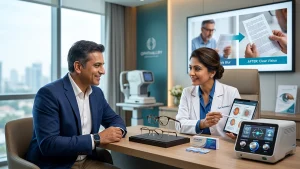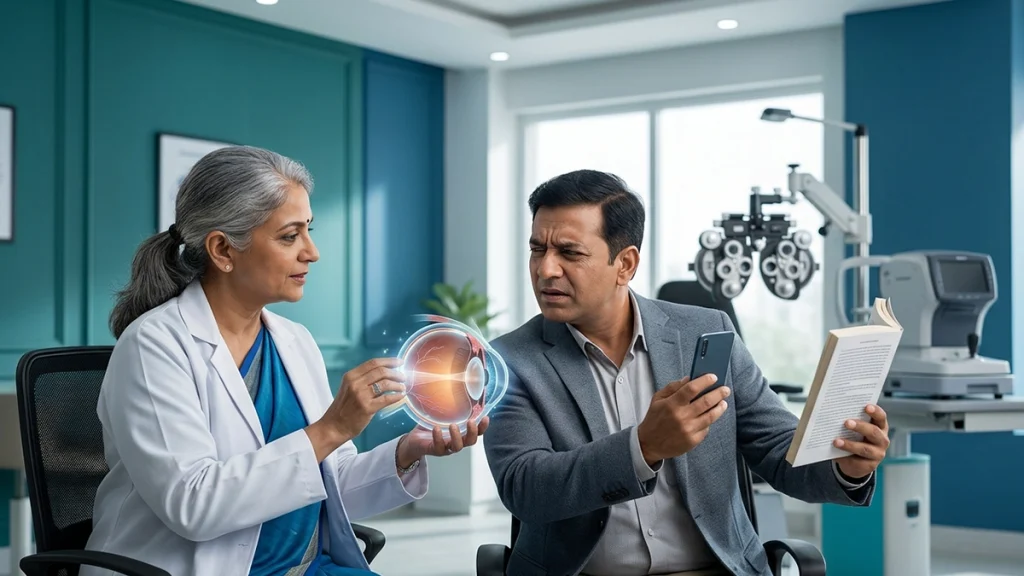
At the age of 40 many see gradual change in the look of restaurant menus, medicine labels and phone messages which we have trouble with at a normal distance. What many note first is that the words appear clearer when we put out arms out further or turn up the lights. This very common issue is called presbyopia. It is a result of the eye’s slow loss of some of its near focus. Also known as age related macular degeneration Presbyopia Treatment to improve close up vision for reading, computer use and daily tasks. By recognizing Presbyopia Symptoms early it is easier to get the right prescription.
Presbyopia is a natural process of aging which is not an infection or sudden weakness. Also it is caused by incorrect spectacle power, dry eye, cataract and a number of other conditions which may cause blurring of near vision hence an exam is important before we determine Presbyopia Treatment.
What Is Presbyopia?
The eye focuses light with the help of the cornea and the natural lens. In a younger eye, the lens changes shape when a person looks from a distant object to a nearby one. This focusing process is known as accommodation. As the years pass, the natural lens becomes less flexible and cannot change shape as efficiently. The result is gradually blurred close-up vision.
Presbyopia usually sets in between the early and mid forties. It is different from hyperopia which is mainly a result of the eye’s optical shape or power. A person may have presbyopia at the same time as myopia, hyperopia or astigmatism which means that Presbyopia Treatment must be part of a full prescription.
Common Presbyopia Symptoms
Early Presbyopia Symptoms are noted during reading or on screen. What is small print may present as blurry at the normal reading distance, but bringing the material or device out further improves that. Also a person may increase font size on a device, seek out a brighter light or stay away from in depth near work later in the day.
Other Presbyopia Symptoms include eye fatigue, headaches after reading and slow transition from looking at distant objects to near. They tend to develop gradually in both eyes though it is not uncommon for the correction in one eye to appear to be of a different power which in turn may cause one eye to appear blurrier.
| Vision change | How it may affect daily life |
| Blurred close vision | Menus, labels, books and phone text become unclear |
| Holding print farther away | Words look sharper when the arms are extended |
| Eye strain | The eyes feel tired after reading or computer work |
| Headache | Discomfort appears around the forehead or eyes after near tasks |
| Need for stronger light | Fine print is easier to read under brighter illumination |
| Slow refocusing | Vision takes a moment to adjust when looking from far to near |
Sudden loss of vision, severe pain, red eye with blurred vision, new flashes, many floaters, double vision or a dark curtain in the visual field is out of the question for presbyopia and requires immediate assessment. These warning signs should not be put down to Presbyopia Symptoms.
What Causes Presbyopia?
Age related changes in the natural lens and the structures which play key role in focus are the main Presbyopia Causes. The lens becomes harder and more rigid over time which in turn leaves the eye with little focusing power for close objects. These biological changes are what causes Presbyopia Causes. This is a natural process which ends up affecting almost all.
Age is the greatest of what we know in Presbyopia Causes, but at play also are present spectacle power, occupation, reading distance and lighting which by the time the issue becomes noticeable have great play. These factors play into when people notice the issue, not the root Presbyopia Causes.
Health issues and drug use may change your focus. Don’t assume that the Early onset or sudden change in Presbyopia Causes is due to presbyopia which is a normal age related condition, rather that it may be dry eye, cataract, refractive error or blood glucose changes which also present with the same symptoms.
Presbyopia is a process which we cannot prevent as the body’s natural lens ages which is not affected by eye exercise, supplements or the use of brighter light. While healthy choices may support overall eye health they do not in fact reverse the Presbyopia Causes. It is important to understand Presbyopia Causes in order to not have false hope in terms of which remedies will work. The aim of Presbyopia Treatment is to put right what can’t be reversed that is to improve out come at the distances you use most.
How Is Presbyopia Diagnosed?
Diagnosis usually takes place at a full eye exam. At the visit the health care provider will ask when the issue started, if it is in one or both eyes and what activities are difficult. Distance and near visual acuity is measured in addition to refraction which we do to determine the lens power for best correction.
The doctor will test eye coordination, eye pressure, the cornea, lens and retina. This helps to distinguish presbyopia from cataract, glaucoma and retinal disease which in turn will note if Presbyopia Treatment must also correct astigmatism or distance power.
Working distance is a factor which is true as we use different distances for a book as opposed to a desktop monitor. Precise measurement of this issue allows for better Presbyopia Treatment which in turn improves daily activities.
Presbyopia Treatment Options
There is no one size fits all solution. What works best for Presbyopia Treatment is based on the patient’s age, eye power, what they do for work, their hobbies, if they drive and their tear film quality and over all eye health. Spectacles are still the easy go to option but in some cases we may look at contact lenses, prescription eye drops and surgery.
Reading Glasses and Multifocal Spectacles
For large number of adults Reading Glasses for Presbyopia present a great and easy solution to see nearby objects. What we put into these Reading Glasses for Presbyopia is the proper power which in turn reduces strain in the eye during close work. Readies made readers do the job when what is seen in one eye is similar to what is seen in the other and there is little to no astigmatism. It is also because these spectacles use the same power in each lens which may not in fact provide equal clarity when the eyes’ prescriptions are different.
Prescribed Reading Glasses for Presbyopia are custom fitted for each eye and working distance. Also people who are in the use of distance spectacles may prefer bifocals or progressive lenses instead of getting a new pair. In this case Reading Glasses for Presbyopia may be included in a multifocal prescription.
Bifocals have distance and near zones, progressive lenses have a gradual transition from distance to near vision. Occupational lenses do well for desk work but may not be best for driving. For Reading Glasses for Presbyopia which should be chosen based on the tasks and distances which they will be used.
Contact Lenses
Multifocal contact lenses have different focal points and thus reduce the need for glasses. In monovision we correct one eye for distance and the other for near. The brain adap to use the better image for the required distance.
Results are a function of prescription, eye dominance, tear quality and what a person’s expectations are. Some users report reduced contrast and glare which is why a supervised trial is recommended. Contact lenses are a great option for Presbyopia Treatment, but good hygiene and follow up is key.
Prescription Eye Drops
Certain prescription eye drops which reduce the size of the pupil at the present time improve close up vision for some adults. They do not return the natural lens’ youthfulness nor is the effect permanent. Also what is right for you may not be the same as what is available to others.
Possible results are that of headache, redness or night vision issues. We recommend an ophthalmologist evaluation of retinal health, glaucoma status and night driving needs. Drops are a option for Presbyopia Treatment, not a replacement for exam.
Surgical and Lens-Based Procedures
Procedures to reduce spectacle dependence. Corneal laser procedures which produce monovision or extended range of focus and lens surgery which puts in a chosen intraocular lens.
No procedure is a sure thing for all distances. Some patients do in fact report seeing halos, experiencing glare, reduced color definition and in some cases the need for glasses for fine print. Also there is the risk of complications from any operation which takes place inside the eye. For surgical Presbyopia Treatment we perform a very in depth assessment of the cornea, lens, retina, optic nerve, pupil, tear film and what is important to the patient visually.
| Option | Main benefit | Important consideration |
| Near-only spectacles | Clear vision for close tasks | Must be removed or changed for distance |
| Bifocal or progressive spectacles | Cover several viewing distances | Accurate fitting and adaptation are important |
| Multifocal contact lenses | Reduce spectacle dependence | Contrast or night vision may be affected |
| Monovision contact lenses | One eye supports distance and the other near | Not every patient adapts comfortably |
| Prescription eye drops | Temporary near-vision improvement for selected adults | Effects are limited and suitability must be checked |
| Corneal or lens procedure | May reduce reliance on spectacles | Trade-offs and surgical risks require counselling |
Choosing the Right Treatment
A teacher, accountant, driver and tailor have varying visual needs. What each of these professions does for a living should play a role in which Presbyopia Treatment proves to be the most useful.
Over the counter glasses are a no go in case of persistent headaches or different vision in the eyes. Prior to surgery a contact lens monovision trial will show the expected visual result.
The invariable element of Presbyopia Treatment is that total freedom from glasses is not achieved. What we aim for is safety, comfort and what is appropriate for the patient’s daily routine. Counseling which is open and honest helps set real expectations and also to avoid disappointment.
Living Comfortably With Presbyopia
Good lighting, proper working distance and large text size improve comfort which in turn does not Presbyopia Causes.
An incorrect power can cause discomfort which also does not speed up the progress of presbyopia. With properly prescribed Reading Glasses for Presbyopia you support comfortable near work. Also have your eyes checked again when near work becomes difficult or one eye doesn’t see as clearly.
Regular checkups also identify if new Presbyopia Symptoms are due to a change in prescription or another eye issue. Any atypical Presbyopia Symptoms should be looked at by a professional.
When Should You See an Eye Doctor?
Book in an exam if you notice that blur is interfering with your daily life, comes up very early, is quick to worsen or is present in only one eye. These are key Presbyopia Symptoms to bring up at your visit, also especially if you have diabetes or a history of eye surgery.
At ASG Eye Hospital we see to it that during an eye assessment we put out what is causing near vision issues and also we present to our patients the options of spectacles, contact lenses and procedures. Personalized Presbyopia Treatment plans should be developed based on the results of the exam and the patient’s visual needs which is in contrast to self diagnosis.
Frequently Asked Questions
1. Is presbyopia the same as farsightedness?
No. Farsightedness is out of the question mainly for the eye’s optical power, as presbyopia is caused by reduced lens flexibility. To that may be added that a person can have both so an exam is key to Presbyopia Treatment.
2. At what age do Presbyopia Symptoms begin?
Most adults recognise Presbyopia Symptoms in their early or mid-forties, although timing varies. The change usually develops gradually.
3. Can presbyopia be prevented?
Presbyopia is a condition which you can’t really prevent. Also it has been found that eye exercises don’t improve lens flexibility which is what presbyopia is related to, thus we focus instead on methods of Presbyopia Treatment.
4. Are ready-made reading glasses safe?
Ready made Reading Glasses for Presbyopia which are for occasional use when the same power is required in both eyes. For unequal powers, astigmatism or persistent headaches prescription lenses are preferable.
5. Do reading glasses weaken the eyes?
No. Reading Glasses for Presbyopia which is a result of reduced focusing ability; they do not weak out the eyes. As it is a progressive condition Presbyopia will see an increase in the prescription over time.
6. Can contact lenses correct presbyopia?
Yes. Multifocal and monovision lenses are for appropriate patients. For Presbyopia Treatment tear quality, prescription and adaptation are issues.
7. Is surgery a permanent cure?
Surgery may decrease spectacle use but doesn’t guarantee perfect results at all distances. Assessment is a must prior to Presbyopia Treatment.
8. Can presbyopia cause headaches?
Yes, work related issues may cause headaches, but chronic pain should not automatically be attributed to Presbyopia Causes.
9. How often should reading power be checked?
Review at the first sign of print blurring, headachy sensations, or if one eye appears less clear. Go in to have your Reading Glasses for Presbyopia and to check the overall state of your eye health.