
Glasses help, but they can feel limiting in daily life. This is why patients often ask which eye surgery for glasses removal is best. The answer is that it depends on eye power, corneal thickness, age, tear film, lifestyle, and eye health. At ASG Eye Care the goal of eye surgery for glasses removal is for safe and stable vision.
Understanding the treatment
Refractive surgery is a term which includes procedures that correct focusing issues of myopia, hyperopia and astigmatism. Glasses correct vision from the outside of the eye, while eye surgery for glasses removal corrects the focusing system more directly. In most types of laser vision correction we use a laser to reshape the cornea which in turn causes light to focus properly. In some cases we may use an implantable lens instead of doing corneal laser treatment.
When patients look at LASIK vs SMILE they are typically looking at comfort, recovery, safety, and long term results. Both are advanced options but what type of eye surgery for glasses removal is best is determined by in depth scans. A good result of refractive surgery is had by what is put forward as the best procedure for the patient’s eye.
Main options for glasses removal
| Procedure | How it works | Best suited for |
| LASIK / Femto LASIK | A flap is created and the cornea is reshaped. | Stable power and suitable corneal thickness. |
| SMILE | A lenticule is removed through a tiny incision. | Myopia and astigmatism patients wanting flap-free laser vision correction. |
| PRK | The corneal surface is treated without a flap. | Thinner corneas or flap-related concerns. |
| Contoura Vision | A topography-guided customized procedure. | Selected patients needing advanced correction. |
| ICL | A lens is placed inside the eye. | High power or patients unsuitable for corneal refractive surgery. |
LASIK is a very common eye surgery for glasses removal in suitable patients which is also true because of fast recovery. SMILE has gained in popularity for its minimal invasiveness and no flap use. PRK is an option we turn to when flaps are not the best choice and ICL does a great job for very high powers. The safest eye surgery for glasses removal is the one that your eye structure will support.
LASIK vs SMILE: Which is better?
The issue of which between LASIK vs SMILE is best does not have a universal answer. LASIK has the advantage of experience and fast recovery. SMILE which has a smaller incision may be a better choice for patients that want flap free laser vision correction. Also do not think of LASIK vs SMILE as competitors.
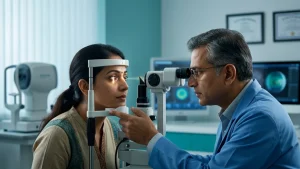
A patient may have a better fit for LASIK over SMILE which we also see the other way around. This is why at the time of corneal topography, tomography, pachymetry, dry eye testing, pupil size and retinal evaluation we present the LASIK vs SMILE option to you. At ASG Eye Care we put this in terms which are easy for the patient to understand which in turn they can use to make an informed decision on which eye surgery for glasses removal is right for them.
| Factor | LASIK | SMILE |
| Flap | Requires a corneal flap. | Flap-free. |
| Recovery | Usually fast. | Usually fast, sometimes gradual. |
| Dry eye | Temporary dryness may occur. | May have less nerve impact in selected cases. |
| Customization | Can use customized platforms. | Best for selected myopia and astigmatism. |
| Suitability | Depends on thickness and shape. | Depends on power range and measurements. |
Who is a good candidate?
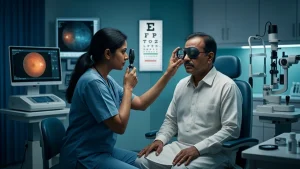
A good choice of patient for eye surgery for glasses removal is one that has a stable prescription, healthy cornea, enough thickness, healthy retina, and no uncontrolled dry eye. Most patients are at the age of adulthood at the time of evaluation which also includes a one year mark of stable glasses number.
Some eye conditions do not do well with the typical laser vision correction. In which case the doctor will treat the eye condition first, put the laser procedure on hold, or bring up another refractive surgery option like ICL. This screening makes eye surgery for glasses removal safer.
What happens during treatment?
During laser vision correction anesthetizing drops are used. In LASIK a flap is created and the cornea is reshaped. In PRK the laser works on the corneal surface. Most procedures take a few minutes per eye.
After laser vision correction you may have mild watering, dryness, glare, or light sensitivity which is only for a short time. Also at this time we see that use of the prescribed drops and follow up care improves these symptoms. A patient choosing eye surgery for glasses removal should know that post operative care is a part of the result.
Recovery and expectations
Most patients see an improvement in vision within a day or few days of laser vision correction. For LASIK recovery is usually very quick, PRK may take longer. SMILE recovery is there which is also very comfortable but you may see improved sharpness gradually. These differences are what to note when comparing LASIK vs SMILE.
The goal of eye surgery for glasses removal is to decrease the use of them in most daily tasks. It does not eliminate the need for reading glasses after the age of 40 and it also doesn’t put a stop to other eye diseases. With proper screening refractive surgery may provide long term visual freedom, but regular eye checkups are still recommended.
ASG Eye Care approach
At ASG Eye Hospital, we do not recommend eye surgery for glasses removal based only on eye power. We look at the corneal shape, thickness, retina, tear film, age, lifestyle, what you expect out of the procedure and we also look at safety issues. Our doctors go over the choices between LASIK vs SMILE, PRK, Contoura Vision, ICL and other refractive surgery options which in turn gives patients a full picture of what is available to them.
For a given patient the best eye surgery for glasses removal may be LASIK. For another it may be SMILE, PRK, or ICL. The right choice is always personal because safe laser vision correction begins with a complete eye evaluation.
FAQs
1 Which eye surgery for glasses removal is best?
There is not a one size fits all solution. LASIK, SMILE, PRK, Contoura Vision, and ICL all have what works for some. The best eye surgery for glasses removal depends on corneal thickness, power, tear film, age, lifestyle, and retinal health.
2 Which is better in LASIK vs SMILE?
The choice of LASIK vs SMILE is based on your eye measurements. For some patients LASIK does well because of the wide range of what it offers and degree of customizability, while for other patients which may be free of the flap issue,
3 Is refractive surgery safe?
While in most cases it is very safe for those that are properly selected as patients, there are risks with refractive surgery that include dryness, glare, halos, under correction, or over correction. In depth screening is a key element that helps to reduce these risks.
4 Is laser vision correction permanent?
Laser vision correction does in fact reshape the cornea forever, yet there is still the issue of age related changes which can occur naturally. At a later age reading glasses may still be required.
5 Can high power be treated with eye surgery for glasses removal?
In some cases yes, but not always with the use of corneal laser. Some high power patients may do better with ICL or other refractive surgery options. For these patients eye surgery for glasses removal is a more complex issue and must be very well planned out.