
ASG Eye Hospital

Blade vs Bladeless LASIK: Which is Better Blade or Bladeless Lasik

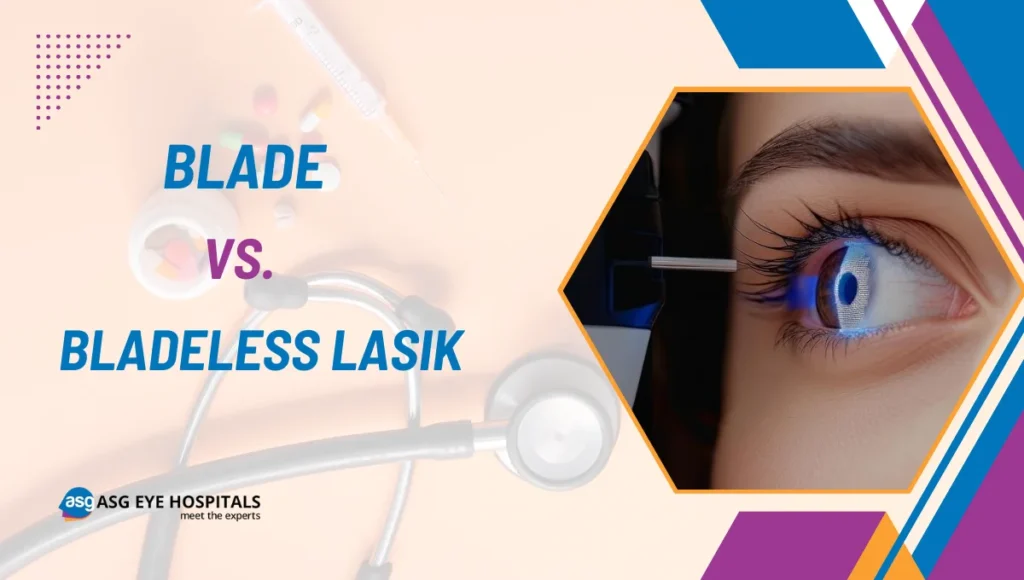
In the world of vision correction, LASIK eye surgery has become a groundbreaking procedure, freeing many people from the need for glasses and contact lenses. But, a debate continues in the LASIK world: should you choose surgery with a blade or bladeless? Both promise better vision, but for making an informed decision it’s important to understand the difference between blade and bladeless LASIK. In this blog we will discuss which is better blade or bladeless lasik.


The Traditional Approach: Blade LASIK

Blade LASIK, also known as microkeratome LASIK, has been the trust of vision correction for decades. This technique involves a microkeratome, a precise surgical instrument that looks like a small razor blade, to create a thin flap in the cornea. Once the flap is created, a laser is used to reshape the underlying corneal tissue, correcting refractive errors such as myopia, hyperopia, and astigmatism. Finally, the flap is repositioned, acting as a natural bandage for the eye.


Supporters of blade LASIK highlight its established track record and lower cost compared to bladeless alternatives. Moreover, some argue that the flap created by the microkeratome heals faster, resulting in quicker visual recovery for patients. Additionally, since blade LASIK has been in practice for a significant period, surgeons are often highly experienced in its execution, further ensuring successful outcomes.


The Innovation: Bladeless LASIK

In contrast, bladeless LASIK represents the evolution of traditional LASIK, integrating advanced technology to improve precision and safety. Instead of a microkeratome, bladeless LASIK employs a femtosecond laser to create the corneal flap with unparalleled accuracy. This laser emits rapid pulses of light, allowing surgeons to create a customized flap tailored to each patient’s unique eye anatomy.


Supporters of bladeless LASIK praise its superior precision and reduced risk of complications. Since the femtosecond laser operates at a microscopic level, it can create a thinner and more uniform flap, minimizing the likelihood of irregularities and enhancing visual outcomes. Furthermore, the bladeless approach eliminates the mechanical microkeratome, reducing the potential for human error and improving overall safety.


Comparing the Two: Efficacy, Safety, and Comfort

When weighing the pros and cons of blade versus bladeless LASIK, several factors come into play:


  • Precision and Customization: Bladeless LASIK holds a distinct advantage in precision and customization. The femtosecond laser allows for the creation of a flap with micron-level accuracy, tailored to each patient’s unique corneal architecture. This precision contributes to better visual outcomes and reduced risk of post-operative complications such as irregular astigmatism.


  • Safety Profile: While both procedures are generally safe, bladeless LASIK offers a marginally lower risk of certain complications associated with the use of a mechanical microkeratome, such as flap irregularities and epithelial defects. However, it’s essential to note that the skill and experience of the surgeon play a significant role in mitigating risks for either technique.


  • Visual Recovery and Comfort: Some patients report faster visual recovery and less discomfort with blade LASIK due to the quicker healing of the corneal flap. However, advancements in bladeless LASIK technology have narrowed this gap, with many patients experiencing comparable or even faster recovery times with the femtosecond laser approach.


  • Cost Considerations: In terms of cost, blade LASIK typically has a slight edge over bladeless LASIK due to the higher initial investment required for femtosecond laser technology. However, the long-term benefits of enhanced precision and reduced risk of complications may justify the slightly higher price tag for bladeless LASIK in the eyes of many patients.


Conclusion:

There is no one-size-fits-all answer in the debate between blade and bladeless LASIK. Both techniques have their merits and are capable of delivering excellent visual outcomes when performed by skilled surgeons. Ultimately, the choice between the blade and bladeless LASIK should be made in consultation with a qualified LASIK eye surgeon, taking into account individual factors such as corneal thickness, refractive error, and personal preferences.


As technology continues to advance, the difference between blade and bladeless LASIK may become less pronounced, with both approaches converging toward optimal precision, safety, and patient satisfaction. Whether opting for the established reliability of blade LASIK or the cutting-edge innovation of bladeless LASIK, the goal remains the same: to achieve clear, crisp vision and enhance quality of life for those seeking freedom from corrective eyewear.
Overview

Job Title: Consultant Ophthalmologist

Location: Pan India
Job Category: Medical Healthcare

Work Employment:  Full time

What you work:

  • Diagnose and treat patients with a focus on Ophthalmologist.
  • Collaborate with senior doctors and multidisciplinary teams.
  • Ensure patient-centric care and follow clinical protocols.
  • Contribute to research, training, or hospital initiatives (if applicable).

Mandatory skills:

  • Relevant medical degree / certification.
  • Strong knowledge of ophthalmology practices / healthcare protocols.
  • Excellent communication and patient-handling skills.
  • Ability to work in fast-paced healthcare environments.

Preferred Qualifications:

  • Experience: 3 to 6 years of experience
  • Prior experience in eye care / multi-speciality hospitals.
  • Fellowship or advanced training in Ophthalmologist.
  • Familiarity with advanced diagnostic tools and surgical techniques.
  • Passion for innovation, patient care, and continuous learning.

Apply For This Positions

This will close in 0 seconds

Overview

Job Title: Optometrist

Location: Amritsar, Punjab 

Job Category: Optometry

Work Employment:  Full time

What you work:

  • Conduct comprehensive eye examinations and vision assessments for patients of all ages.
  • Prescribe and fit spectacles, contact lenses, and low-vision aids.
  • Perform diagnostic tests including refraction, tonometry, perimetry, and OCT imaging.
  • Support consultant ophthalmologists in pre-operative and post-operative patient workups.
  • Counsel patients on eye care, lens hygiene, and follow-up schedules.
  • Maintain accurate clinical records and adhere to hospital protocols.

Mandatory skills:

  • Bachelor’s or Master’s degree in Optometry (B.Optom / M.Optom) from a recognised institution.
  • Valid registration with the relevant state or national optometry council.
  • Proficiency in refraction, slit-lamp examination, and contact lens fitting.
  • Working knowledge of autorefractors, tonometers, fundus cameras, and OCT equipment.
  • Strong communication skills in English, Hindi, and Punjabi.
  • Ability to manage high patient volumes in a fast-paced clinical setting.

Preferred Qualifications:

  • Experience: 1 to 5 years of clinical optometry experience.
  • Prior experience in an eye care or multi-speciality hospital in Punjab.
  • Exposure to paediatric optometry, binocular vision, or low-vision rehabilitation.
  • Familiarity with advanced diagnostic imaging and dry-eye management.
  • Passion for patient care, community eye-health camps, and continuous learning.

Apply For This Positions

This will close in 0 seconds

Overview

Job Title: Optical In-charge 

Location: Panjim, Goa / Mumbai-Worli (Lower Parel) 

Job Category: Optical

Work Employment:  Full time

What you work:

  • Manage day-to-day operations of the optical outlet, including sales, dispensing, and inventory.
  • Guide customers on frame selection, lens options, and coatings based on their prescription and lifestyle.
  • Take accurate frame measurements and ensure precise fitting, adjustments, and after-sales service.
  • Drive optical sales targets and monitor daily, weekly, and monthly business performance.
  • Maintain optimum stock levels, coordinate with vendors, and control shrinkage through periodic audits.
  • Supervise and train optical staff on product knowledge, dispensing standards, and customer service.
  • Coordinate with optometrists and consultants to ensure smooth prescription-to-delivery flow.
  • Ensure visual merchandising, display hygiene, and adherence to brand and hospital standards.

Mandatory skills:

  • Diploma or Bachelor’s degree in Optometry (D.Optom / B.Optom) or equivalent optical dispensing qualification.
  • Minimum 3 years of experience in optical supervisory or in-charge role.
  • Sound knowledge of lens types, coatings, frame materials, and dispensing principles.
  • Hands-on experience with edging, fitting, and basic optical workshop equipment.
  • Proven ability to achieve sales targets and manage inventory and billing systems.
  • Strong communication and interpersonal skills in English, Hindi, and Konkani or Marathi.
  • Working knowledge of POS / retail software and MS Office.

Preferred Qualifications:

  • Experience: 3 to 7 years in optical retail or an eye care hospital optical division.
  • Prior experience managing an optical outlet in Goa or the western region.
  • Exposure to premium and progressive lens brands and specialty eyewear.
  • Familiarity with contact lens dispensing and after-care support.
  • Team leadership, customer relationship management, and continuous learning mindset.

Apply For This Positions

This will close in 0 seconds

Overview

Job Title: Optometrist

Location: Pan India 


Job Category: Optometry

Work Employment:  Full time

What you work:

  • Conduct comprehensive eye examinations and vision assessments for patients of all ages.
  • Prescribe and fit spectacles, contact lenses, and low-vision aids.
  • Perform diagnostic tests including refraction, tonometry, perimetry, and OCT imaging.
  • Support consultant ophthalmologists in pre-operative and post-operative patient workups.
  • Counsel patients on eye care, lens hygiene, and follow-up schedules.
  • Maintain accurate clinical records and adhere to hospital protocols.

Mandatory skills:

  • Diploma / Bachelor’s or Master’s degree in Optometry (D.Optom / B.Optom / M.Optom) from a recognised institution.
  • Valid registration with the relevant state or national optometry council.
  • Proficiency in refraction, slit-lamp examination, and contact lens fitting.
  • Working knowledge of autorefractors, tonometers, fundus cameras, and OCT equipment.
  • Ability to manage high patient volumes in a fast-paced clinical setting.

Preferred Qualifications:

  • Experience: 1 to 5 years of clinical optometry experience.
  • Exposure to paediatric optometry, binocular vision, or low-vision rehabilitation.
  • Passion for patient care, community eye-health camps, and continuous learning.

Apply For This Positions

This will close in 20 seconds