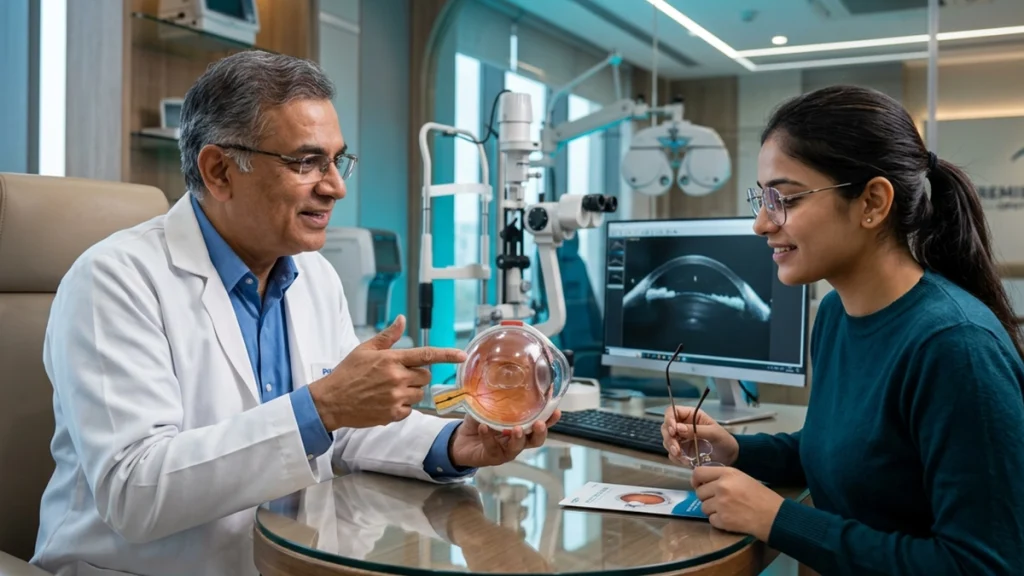
A lot of people want to see well without glasses or contacts but not everyone is fit for LASIK. Some patients have a thin cornea, very high number, issues of dry eye, or a shape of the cornea that doesn’t do so well with laser correction. For such patients, we may talk about ICL Surgery as advanced vision correction. It’s a procedure where you place a special lens inside the eye while the natural lens stays untouched.
One of the most common questions that patients ask at ASG Eye Care is, Who Is a Good Candidate for ICL Surgery? And the answer is not determined by the power of the glasses alone. The cornea, eye pressure, and retina, as well as the anterior chamber depth and pupil size, will have to be checked. Also, the clarity of the natural lens will have to be ascertained, and the overall health of the eye will have to be evaluated. When all these factors are suitable, the procedure can help an individual become less dependent on glasses and contact lenses.
What Is the Procedure?
ICL Surgery stands for implantable collamer lens surgery. A soft artificial lens is placed inside the eye, generally behind the iris and in front of the natural lens. It acts as an internal contact lens but does not rest on the surface of the eye and does not require daily removal.
The Implantable Collamer Lens works by focusing light on the retina, thus making distant objects clear. The corneal shape is not altered, unlike in LASIK. This is why ICL Surgery may be beneficial to a person for whom the cornea is too thin for laser procedures or when the spectacle power is too high for the safe removal of corneal tissue.
This is not similar to cataract surgery. In cataract surgery, the natural lens is removed because it has become cloudy. In this procedure, the natural lens stays in place. This difference is important because most candidates are younger adults with clear natural lenses who want refractive correction.
Why Doctors Consider This Option
ICL Surgery is considered by doctors when the patient desires long-term vision correction and the structure of the eye is appropriate. It is particularly beneficial for selected patients with moderate to high myopia, contact lens intolerance, or unsuitable corneal thickness for LASIK. However, it should never be recommended casually. Proper measurement and detailed discussion on benefits and risks are necessary.
Corneal preservation is one of the main ICL Surgery Benefits. Since no corneal tissue is removed, the procedure can be of use to certain patients who may not be suitable for LASIK or SMILE. The other benefit is that the lens can usually be removed or replaced if medically required in the future. This does not mean it should be treated as a temporary procedure, but it does offer flexibility.
Patients also like that the lens is not visible from the outside and does not require the daily maintenance of contact lenses. In suitable cases, vision improves significantly after healing, but patients should still understand that perfection in every lighting condition cannot be guaranteed.
| Factor checked before treatment | Why it matters |
| Stable prescription | Helps ensure predictable long-term vision correction |
| Corneal shape and thickness | Helps decide which refractive procedure is safer |
| Anterior chamber depth | Confirms whether there is enough space inside the eye |
| Eye pressure | Helps rule out glaucoma-related risk |
| Retina examination | Important for people with high myopia |
| Natural lens clarity | Cataract or lens opacity may make the procedure unsuitable |
| Pupil size | Helps assess night glare and halo risk |
Who Can Consider the Procedure?
Normally, a good candidate is considered to be an adult with a stable refractive error for glasses, a healthy retina, clear crystalline lens, normal intraocular pressure, and adequate anterior chamber depth for safe lens implantation. Patients with high myopia, thin corneas, or contact lens intolerance can be considered after thorough evaluation.
This lens-based option is often discussed if the doctor feels that corneal laser correction is not the best choice. The patient may also be suitable if they have realistic expectations, understand the follow-up schedule, and are willing to follow post-operative instructions carefully.
Online information can help patients understand the option, but a detailed eye examination will confirm whether the eye is safe for the procedure or not.
Understanding Eligibility
ICL Surgery Eligibility is determined through a thorough pre-operative checkup. Refraction, corneal mapping, anterior segment measurements, pupil size, retina health, eye pressure, and the condition of the natural lens are usually confirmed by a doctor prior to the operation. All these tests help in the selection of the correct lens power and size.
Patients should usually be on a stable prescription for at least a year. If the power is changing, the doctor may advise waiting. The eye should also have adequate internal space. A too-shallow anterior chamber makes the procedure unsafe since the lens would sit too close to important structures in the eye.
Uncontrolled glaucoma, active eye infection, uveitis, cataract, severe retinal disease, or major corneal problems would affect eligibility for ICL Surgery. In this scenario, the doctor may recommend treating the underlying condition first or choosing a different vision correction method.
| More suitable candidates | Patients who may need another option |
| Stable glasses power | Frequently changing prescription |
| Moderate to high myopia | Very shallow anterior chamber |
| Thin cornea but otherwise healthy eye | Uncontrolled glaucoma or high eye pressure |
| Contact lens intolerance | Active eye infection or inflammation |
| Healthy retina and clear natural lens | Cataract or significant lens opacity |
| Realistic expectations | Expectation of perfect vision in every situation |
Who Should Avoid It?
ICL Surgery is not for every patient seeking freedom from glasses. Those with uncontrolled glaucoma, active eye inflammation, severe infection, cataract, unstable prescription, or untreated retinal weakness may need to avoid or postpone the procedure. What matters most is safety, not speed.
Women who are pregnant or nursing are typically advised to hold off since hormonal changes can affect vision measurements temporarily. Patients with unrealistic expectations should also be counselled carefully. The goal is to reduce dependence on glasses or contact lenses, not to promise flawless vision in every possible situation.
may be more suited to , SMILE, refractive lens exchange, or cataract-based treatment depending on their age and condition of their eyes. Any will lay out all the options before pushing you to have ICL Surgery.
Key Benefits
The most talked-about ICL Surgery Benefits are clear vision, reduced dependence on thick glasses, preservation of corneal tissue, and suitability for many patients with high myopia. For people who have struggled with contact lenses for years, this can be a big lifestyle upgrade. In cases of people who do not want to wear glasses due to aesthetic reasons, ICLs are the right solution.
Visual quality is another advantage in properly selected patients. Since the cornea is not reshaped, some patients who are unsuitable for laser correction may still achieve good results. The procedure is also usually quick and recovery is often smooth when the patient follows the prescribed eye drops and precautions.
However, ICL Surgery is not without risk. Potential problems include glare, halos, raised eye pressure, inflammation, infection, cataract formation, lens rotation, and the need for lens repositioning. These are the risks that make pre-operative testing and follow-up visits crucial.
What Happens During and After the Procedure?
In ICL Surgery, the lens power and size get calculated from detailed eye measurements. On the day of the procedure, numbing drops are used for keeping the eye comfortable. A tiny opening is made, the lens is inserted in a folded form, and it unfolds inside the eye; the surgeon then positions it carefully behind the iris.
Most patients are discharged on the same day. Vision may clear immediately but mild blurring, watering, glare, or discomfort may be present in the early recovery period. Eye drops are prescribed for the prevention of infection and to control inflammation. Follow-up visits help the doctor to check the pressure in the eye, position of the lens, and healing.
Patients are generally advised against rubbing their eyes, swimming, using eye makeup, or exposing their eyes to dust in the early days of recovery. Most of the regular activities can be resumed within a short period, but the exact timeline will depend on how quickly the patient heals as well as the advice of the surgeon.
Treatment Planning at ASG Eye Care
At ASG Eye Care, patients who wish to undergo ICL Surgery are subjected to a detailed refractive evaluation to determine the suitability of the procedure. Spectacle power, corneal scans, anterior chamber depth, eye pressure, the health of the retina, and the condition of the natural lens are evaluated by the team to draw a final conclusion on whether the procedure can be offered as a genuinely suitable and safe one.
The options are also discussed, including glasses, contact lenses, LASIK, SMILE, and other refractive procedures. Some patients are great candidates while others may get safer results with another treatment. Often, the best choice is not the most advanced procedure but the one that better fits the patient’s eyes.
Key Takeaway
ICL Surgery can be a good alternative for selected patients who seek freedom from glasses but are not ideal candidates for corneal laser procedures. It helps many people with high myopia, thin corneas, or contact lens intolerance.
The decision should be based on medical testing, not convenience. Once the doctor confirms suitability, patients can clearly understand the expected outcome, recovery process, benefits, risks, and long-term care before choosing treatment.
Frequently Asked Questions
1. Who can consider this procedure?
An ideal candidate is an adult with stable glasses power, healthy eyes, a clear natural lens, normal eye pressure, and adequate space within the eye. Individuals with high myopia or thin corneas will also be considered following thorough testing.
2. Is it better than LASIK?
It depends on the corneal tissue. LASIK restructures the cornea ICL Surgery puts a lens inside the eye without removing corneal tissue. For patients with thin corneas or very high myopia, the doctor may prefer this option; other patients may do better with LASIK or SMILE.
3. What is this lens?
An Implantable Collamer Lens is an artificial lens that is placed inside the eye for the correction of refractive errors. It is somewhat similar to an internal contact lens, which is positioned without removing the natural lens.
4. What are the main benefits?
Major advantages are lessened reliance on glasses, preservation of the corneal tissue, applicability to selected high-myopia cases, and the option for lens removal if medically required. These benefits are best realized when a very careful patient selection is undertaken.
5. Who should avoid the procedure?
Uncontrolled glaucoma, active eye infection, cataract, unstable prescription, severe inflammation, untreated retinal disease, and inadequate eye space are conditions that might require the patient to avoid or delay ICL Surgery. A comprehensive eye examination should be the basis for the final decision in all cases.