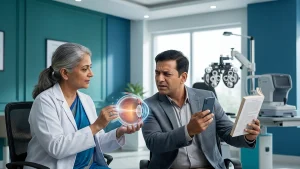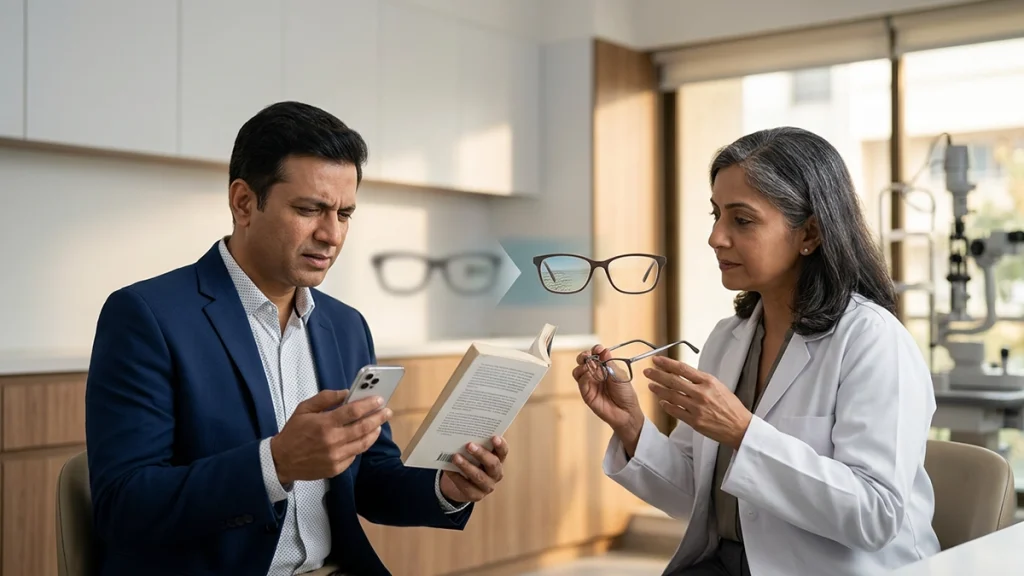
If you are finding that you have to hold your phone at a greater distance, increase the size of the font, or that you require more light to read, you may be developing presbyopia. Many people are confused when this happens as at the same time their distance vision may still be sharp. This is the most typical age-related vision change and it usually becomes noticeable in the early to mid-40s.
Presbyopia is not an eye disease. What it is is a natural issue with focus which develops as the lens within the eye loses its flexibility over time. With age, close work becomes more difficult. Which is why it is common for people who did not previously require glasses to now need reading glasses for near tasks.
What Is Presbyopia?
Presbyopia is an age related issue which is the slow loss of the eye’s ability to focus on near objects. What happens is that the natural lens becomes more rigid and less flexible as we age. This in turn causes light from close objects to not focus properly on the retina which in turn results in blurry near vision.
Also unlike myopia or hyperopia which are mostly related to the eye’s shape, presbyopia is a product of the aging process of the lens. It also may develop in a person which had perfect vision their whole life.
Common Symptoms
The earliest presbyopia symptoms are often subtle. You may push books, bills, or your phone farther away to see better. Headaches and eye strain after close work are also common.
| Symptom | How It Feels in Daily Life |
| Difficulty reading small print | Menus, bills, medicine labels, and phone text become harder to see clearly |
| Need for brighter light | Reading feels easier under strong light but difficult in dim rooms |
| Holding objects farther away | You stretch your arm to bring text into focus |
| Eye strain or headache | Long reading, stitching, screen work, or close work becomes tiring |
| Fluctuating near focus | Vision feels clear for a short time, then blurs again |
These presbyopia symptoms tend to present slowly. Many people put them off at first and think that they are just tired or spending too much time on screens. But if near work is becoming a struggle, an eye examination is better than trying to determine the cause.
Why Does Presbyopia Happen With Age?
The primary presbyopia cause is the natural process of aging which affects the lens. Over time the lens’ flexibility decreases. These age-related vision changes will affect almost all at some point. Also presbyopia does not mean your eyes are weak and it does not lead to total blindness.
Some individuals report issues at an early stage which is a result of greater near vision demand in their case. Reading, computer work, accounting, stitching, mobile use, or working long hours in an office setting may bring these issues to light. A full eye test is useful in distinguishing between simple near sightedness and cataracts, glaucoma, retinal disease or screen related eye strain.
How Is Presbyopia Diagnosed?
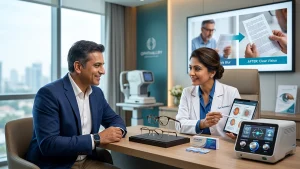
Diagnosis of presbyopia is a simple and painless process. We check your distance vision, near vision, refraction, eye pressure, and overall eye health. Also we look out for other eye conditions.
At ASG Eye Hospital we carefully evaluate patients with reports of blurry near vision because not all such reports are due to presbyopia. Dry eyes, early cataract, uncorrected power and screen related strain may present with similar symptoms. A proper diagnosis is what we use to determine the best correction.
Treatment Options for Near Vision
The positive news is we have good options for presbyopia. As it stands the easiest is reading glasses which we recommend for people who do distance vision fine but have issues with near. If you are a glasses wearer already we may suggest bifocals, progressives, or occupational lenses based on what you require for your day to day activities.
| Treatment Option | Best Suited For | What to Expect |
| Near-vision spectacles | Clear distance vision with near-only difficulty | Simple, safe, and useful for reading and mobile use |
| Bifocal glasses | Distance and near correction in one pair | Two separate zones for distance and reading |
| Progressive lenses | Smooth focus at multiple distances | Useful for office, driving, and daily activities |
| Multifocal contact lenses | Selected patients comfortable with lenses | May reduce dependence on spectacles |
| Surgical options | Selected cases after detailed evaluation | Considered only after discussing benefits, limits, and suitability |
Many patients put out that they think reading glasses will cause their eyes to weaken. That isn’t the case. They do what they should to improve focus at close range. If you ignore the care your eyes require you may see an increase in strain, headaches, and reading fatigue.
Can It Be Prevented?
There is no proven prevention for this issue which is a natural part of aging. We can improve the health of our eyes through some practices. Healthy eye routines will improve your experience with near work. Get adequate lighting, take breaks from the screen, maintain proper working distance, control diabetes, and get regular eye exams which in turn will support better visual health. Also do not go out and get a new pair of glasses at every sale. Over the counter glasses may work for some but may not be the best fit for everyone.
Eye Care at ASG Eye Care
At ASG Eye Care we include presbyopia in full vision and eye health assessment. Our specialists determine if what you’re experiencing is really presbyopia or if it’s a symptom of some other eye health issue. We base our recommendation on your lifestyle and eye health. Many patients come to us after trying to deal with it for months, strain reading that small print, looking at phone screens, work documents. If you are seeing issues with near vision we can do an early assessment for you to determine the cause and which solution is best.
Key Takeaway
Presbyopia which is very common and a natural issue related to near vision usually presents itself after the age of 40. We have reading glasses, bifocals, progressive lenses, contact lenses, or we can go over surgical options with you to choose from based on your needs. At ASG Eye Care we invite you in for a full eye exam which will put you back into clear and comfortable vision.
Frequently Asked Questions
1. What is the first sign?
The first thing which is noticed in presbyopia is difficulty in reading small print at the normal distance. Many people at this point begin to hold the phone or book at a greater distance out and also require more light to read comfortably.
2. Are glasses the only treatment?
No. Spectacles are the easiest and most common solution but also we have the option of bifocal glasses, progressive lenses, multifocal contacts and certain surgical options which may also be considered based on your eye health.
3. Can it cause permanent vision loss?
Presbyopia does not cause total loss of vision or permanent damage to it. What it does is affect near focus which we can correct. Any sudden change in vision should be checked out immediately.
4. When should I see an eye doctor?
You should go to an eye doctor if you have persistent near vision difficulty, headaches while reading, eye strain, or sudden changes in vision. An eye test helps out with determining if the issue is presbyopia or another condition.