
Seeing straight lines which instead bend, wave, dip, or break may be confusing and at times frightening that which in the medical field is reported as metamorphopsia. Also which some patients report while reading, looking at window grills, checking out floor tiles or noting the edge of a door frame. This visual change is what we know as metamorphopsia. It is not just a simple issue of the correction of glasses. In fact in many cases this is a symptom of a problem in the macula which is the central area of the retina responsible for fine detailed vision.
At ASG Eye Care what we find is that patients report this issue of distorted vision which in turn does not look right. What may present as a curve in a line, letters may appear too close together, a face may look a bit stretched out. Also because the issue of distorted vision may be related to retinal issues it is best not to ignore it and if it does come on suddenly or affects just one eye, you should bring it up with us.
What Is Metamorphopsia?
It is a visual issue in which what is straight appears distorted from lines, to objects, to letters, to shapes. The eye may still register light and note color but what is seen in the center of the field of vision is changed. At this point the retina which includes the macula is either swollen, pulled out of place, has developed scarring or is damaged.
The macula is like the fine focus in a camera. When it is in perfect health it allows you to read, recognize faces, drive, see small details. When the macula is affected by swelling, fluid, membrane growth, or degeneration the image quality goes down. This is the reason that with metamorphopsia straight lines may appear wavy instead of straight.
People think that is a result of tired eyes or from an out of date glasses prescription. But in fact we see that we term refractive errors which are very common and do not cause that sort of line distortion. What you may be seeing which is the waviness, twisting, or shape changes is what we see with retinal problems in which case you should have your retina checked.
Why Do Straight Lines Look Wavy?
Straight lines appear wavy when the retinal surface is no longer smooth or when the macula is affected by fluid, stretching, or tissue change. The brain processes the image from the retina, so if the retinal image is distorted the final visual picture also is.
This is which we see that retinal diseases which affect the macula are the common association for metamorphopsia to present. The issue may develop gradually as in age related macular degeneration or suddenly as in retinal swelling or fluid leakage. In some patients what early AMD signs present with is a slight change in reading vision or a small curving of lines on a grid.
Common Causes of Metamorphopsia
Some eye conditions present with this symptom which mostly affect the macula or retina. The exact cause of metamorphopsia is confirmed only after a detailed eye exam, retinal imaging, and sometimes OCT scan.
| Cause | How It Can Lead to Wavy Vision |
| Age-related macular degeneration | Damage or fluid changes in the macula can produce macular degeneration symptoms such as wavy lines, central blur, and difficulty reading. |
| Epiretinal membrane | A thin membrane can form over the macula and pull on it, causing image warping. |
| Diabetic macular edema | Fluid leakage from diabetic eye disease can swell the macula and trigger wavy central vision. |
| Macular hole | A small opening in the macula can affect central vision and cause missing or distorted areas. |
| Central serous chorioretinopathy | Fluid under the retina can make objects look smaller, bent, or blurred. |
| Retinal vein occlusion | Blocked retinal blood flow can cause swelling and visual distortion. |
In this group Age related macular degeneration is the main issue we see particularly in individuals over 50. macular degeneration symptoms at first may just be slight, but early diagnosis will help preserve usable vision.
Macular Degeneration Symptoms and Wavy Lines
Age related macular degeneration affects the macula which in turn may cause loss of sharp central vision. It is a fact that in the early stages of macular degeneration symptoms we see straight lines as bent, crooked or wavy. Also some report a dark or blurred spot in the center of vision, trouble with reading, reduced color intensity, or difficulty in recognizing faces.
Not all cases of metamorphopsia are from macular degeneration symptoms but that which it does cause should be taken seriously as the wet form of the disease progresses fast. If you have wavy vision which is new to you, get your retina checked out early that may make a large difference.
Patients report to us that they worry about going blind with macular degeneration. In most cases we see that the disease affects central vision which is a part of total vision. Peripheral vision may still be present but what we are seeing is that activities like reading, driving, and recognizing faces may become an issue. That is to say this is an early warning sign which must not be ignored.
How Retinal Diseases Affect the Macula
The retina is a complex neural tissue at the back of the eye. It receives light and transmits signals to the brain. Many retinal diseases which affect the macula, blood vessels, or supportive tissues around the retina do in fact occur. In which case we see patients that report visual distortion, blurred central vision, flashes, floaters, or reduced night vision.
The retina is a complex neural tissue at the back of the eye. It receives light and transmits signals to the brain. Many retinal diseases which affect the macula, blood vessels, or supportive tissues around the retina do in fact occur. In which case we see patients that report visual distortion, blurred central vision, flashes, floaters, or reduced night vision.
Because there is often no pain associated with retinal diseases they may progress silently which is why it is important for people with diabetes, high blood pressure, a family history of macular disease, or sudden visual changes to have regular eye exams.
Symptoms You Should Not Ignore
The onset of metamorphopsia is sometimes gradual. A patient may first note that words in a sentence don’t align right, a tile pattern appears crooked, or what one eye sees is different from the other. Also some people only notice it when they cover one eye at a time and test each out.
| Symptom | What It May Suggest |
| Straight lines appear wavy | Possible macular distortion from retinal change. |
| Words look crowded or broken | Possible macular swelling, pucker, or early macular degeneration symptoms. |
| A central dark or blurred spot | Possible macular disease requiring urgent evaluation. |
| Objects look smaller or larger in one eye | Possible retinal fluid or macular distortion. |
| Sudden distorted vision | Needs prompt retinal examination. |
If these symptoms appear suddenly, especially in one eye, do not wait for the next routine visit. Sudden visual distortion can sometimes indicate active leakage, swelling, or another retinal problem that needs treatment.
How Doctors Diagnose Wavy Vision
Diagnosis starts with a thorough history. Your doctor will ask at what point the wave like vision began, if it is in one or both eyes, and if it is related to blur, floaters, flashes, diabetes, or past eye disease. A vision test and retinal dilation are usually done.
One easy screening tool is the Amsler grid. It is a square grid which has straight lines. If the lines appear wavy, missing or broken it may indicate metamorphopsia. But the Amsler grid is not a replacement for a retina exam.
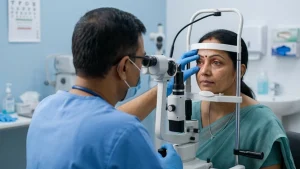
At ASG Eye Care we use advanced imaging tools like optical coherence tomography which peels back layers of the macula to see what is going on. This in turn helps us to detect retinal diseases like macular edema, epiretinal membrane, macular hole and changes related to macular degeneration. Also in some cases we may recommend retinal photos or angiography.
Treatment Depends on the Cause
There isn’t a universal treatment for metamorphopsia which is a symptom of an issue rather than a disease by itself. What we do have are treatments for the causes of the visual distortion. In the case of diabetes as a cause which brings about macular edema we may see a focus on blood sugar control, injections, laser therapy or other forms of retinal care. In the case of wet age related macular degeneration we may recommend anti-VEGF injections. Should an epiretinal membrane be the issue and is pulling on the macula surgery may be an option in chosen cases.
The key issue is that wavy line vision should not be put off to the care of eye drops at which point only we do not know what is causing it. Also many retinal diseases do require early diagnosis and specific treatment to preserve central vision. While full restoration of vision may not always be achieved early intervention does in many cases slow progress of the disease and improve quality of care.
Can Wavy Vision Be Prevented?
Not all cases of metamorphopsia are preventable, but that which many eye issues are about can be lessened. With diabetes it’s important for patients to keep sugar in hand at a steady state and to also have a regular retina checkup. For persons over 50 they should pay no mind to new symptoms especially those of wavy lines or central blur. What also increases the risk of some retinal issues is smoking, uncontrolled blood pressure, and putting off eye care.
A healthy diet, regular eye checks, UV protection, and early intervention in systemic issues is a key to retinal health. Also it is important for patients to test each eye separately at times as one eye may compensate for the other and mask visual changes until the issue is in an advanced stage.
Eye Care at ASG Eye Care
At ASG Eye Care we see patients who have metamorphopsia for in depth eye exams which focus on the macula and retina. We aim to determine the cause of the distorted vision, to explain the condition in full to the patient and then to put out a tailored treatment plan based on the exact diagnosis.
In the issue of macular degeneration, diabetic eye disease, epiretinal membrane, or any other retinal condition early assessment is key. Wavy lines may seem like a minor issue but they may in fact be the first sign that the central retina requires attention.
Key Takeaway
Metamorphopsia is a condition in which straight lines, letters, or objects present as wavy, bent, or out of shape. It is a common feature of macular issues and other retinal diseases. If you notice distorted vision in one eye in particular do not assume it is a result of your glasses or screen strain. Early diagnosis is key in identifying macular degeneration symptoms and other retinal problems which may lead to more severe vision loss.
Frequently Asked Questions
1. What is metamorphopsia?
It is a visual issue in which what is straight appears wavy, bent, stretched, or distorted. This is also a sign that there may be a problem in the macula, the central portion of the retina.
2. Is metamorphopsia serious?
It may be serious as these are also causes of its macular degeneration, diabetic macular edema, epiretinal membrane, and other retinal conditions. A retina exam is important to determine the cause.
3. Can glasses correct distorted vision?
Glasses may correct for blurry vision that is caused by refractive errors, which may include farsightedness, nearsightedness and astigmatism, however in the case of macular or retinal issues the true distorted vision does not improve fully with glasses.
4. Are wavy lines one of the macular degeneration symptoms?
Yes. Wavy and crooked straight lines are some of the early signs of macular degeneration symptoms, which in particular are seen in wet age related macular degeneration. An eye exam is recommended.
5. Can retinal diseases cause permanent vision loss?
Some retinal diseases will cause permanent central vision loss if not detected at an early stage and treated. Early diagnosis improves the chance of preserving usable vision.