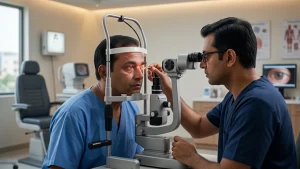

All the Ophthalmologists in India are experiencing a subtle revolution in the way patients look at their vision. There are more and more people finding that their eyesight is not the result of their genes and the thickness of their lenses. Rather, a blend of yogic exercises and systematic eye exercises provides a natural, non-pharmacologically-based route to visual comfort, without side effects.
The ancient wisdom of yoga for eyesight India which is embedded in yoga practices today, is now proving to be useful in modern clinics, where the yoga postures, breath and body movements are being prescribed together with the traditional treatment.
Can yoga improve eyesight naturally?
Yoga for eyesight India practices and eye exercises for better vision may help reduce digital eye strain, relax eye muscles, improve blinking habits, and support visual comfort naturally.
Why The Eye Muscles Deserve a Workout
A complex network of muscles is responsible for the human eye. It undergoes all its movements under the control of six extraocular muscles, and the very tiny ciliary muscles change the shape of the lens for near and distant vision. Like all other muscle groups, these tissues become taut, weak and tired when they are constantly used to remain in a single position.
The ciliary muscle contracts when the eye is focused on a screen, and over time, this causes it to go into spasm, which results in the familiar “blur” that happens when you look at a screen at night. This is where a trained eye specialist sees the logic behind eye exercises for better vision. Muscles can be retrained. Regular daily practice can get flexibility back in their lives that they have lost over the years to the screens.
Yoga for Eyesight India: A Living Tradition
In India, the vision, eyes are always considered as an extension of the mind and not a sense organ. Yoga for eyesight India is not about forcing change; it is about creating the conditions for healing. Eye Rotation, traditionally known as Netra Vyayam, is a foundational practice.
The six extraocular muscles are exercised through their full range by eye movement in a full circle, clockwise and then counterclockwise. By deliberate sweeps up and down and side-to-side. This motion helps to wash out the tissues. Relieve the “glass half full” effect of a fixed gaze and loosen the muscles involved in fine visual tracking.
If performed gently and without tension, it becomes a meditative experience which the nervous system really absorbs.
Eye Exercises for Better Vision: The Daily Toolkit
Typically, an eye doctor who prescribes eye exercises for better vision establishes a program based on three simple steps. The first is Eye Rotation, which is a simple, slow circular movement repeated several times in each direction. Without speed or pushing into pain. The second is the practice of Blinking (referred to in some yogic contexts as Sarvangasana for its whole-system benefit).
A person sits comfortably, and blinks his/her eyes for approximately thirty seconds, followed by closing the eyes and resting. This hurried flutter resets the blink reflex, a blink reflex that is suppressed by the screen. Diffuses the tear film over the cornea as well as carries the meibomian gland’s vital oils over the corneal surface. For anyone suffering from dry, gritty eyes, this is one of the most direct. Effective eye exercises for better vision available, requiring nothing more than a conscious pause.
The third Pillar is Palming or Hasta Mudra in the yogic language. The palms are rubbed quickly, in quick circles, until warm, and placed, without pressure on the lids, over the eyes. The heat loosen the orbicularis (eyebell) muscles which surround the eye. The complete darkness permits the retinal photoreceptors to rest and regenerate their light-sensitive pigments.
This practice also calms the visual system through deep. Slow breathing, which relaxes the entire body from state of ‘alert tension’ to state of ‘restoration’.
Eye Exercises and Their Benefits
| Eye Exercise | Main Benefit |
|---|---|
| Eye Rotation | Relaxes eye muscles |
| Blinking Exercise | Reduces dry eyes |
| Palming | Relieves eye fatigue |
| Bhramari Pranayama | Helps reduce stress |
| Alternate Nostril Breathing | Improves circulation |
| Child’s Pose | Supports relaxation |
Yoga for Digital Eye Strain: Beyond the Screen
Digital eye strain is the epidemic that brought these ancient tools back into mainstream focus. A software professional experiencing burning eyes. A tight brow will find the fastest, most sustainable relief not in another eye drop. But in a sequence of yoga for digital eye strain techniques. Pranayama is the basis of this method.
The hummingbee breath (bhramari) produces a subtle vibration inside the skull which massage the nerves around the eyes and forehead. Helps to relieve deeply held tension. Alternate nostril breathing (Anulom-Vilomi), also known as Nadi Shodhana or alternate nostril breathing. Is a practice that is useful for keeping the nervous system relaxed and on balance. Also helps to enhance circulation to the delicate capillaries of the retina.
FAQs
Can yoga improve eyesight naturally?
Yoga and eye exercises may help reduce eye strain, improve relaxation, and support healthy visual comfort naturally.
Which yoga is best for eye health?
Eye rotation exercises, palming, blinking exercises, Bhramari pranayama, and alternate nostril breathing are commonly recommended for eye relaxation.
Do eye exercises improve vision permanently?
Eye exercises mainly help relax eye muscles and reduce digital eye strain, but they usually do not permanently remove the need for glasses.
Is yoga useful for digital eye strain?
Yes. Yoga breathing techniques and eye relaxation exercises may help reduce screen-related eye fatigue, dryness, and stress.
How often should eye exercises be practiced?
Gentle eye exercises can usually be practiced daily for a few minutes to support eye comfort.
Can yoga reduce dry eyes?
Blinking exercises and relaxation techniques may help improve tear film stability and reduce dry eye symptoms.