Cataract disease stands as one of the most prevalent causes that leads to vision loss among people throughout the world, especially among elderly individuals. The condition results from the eye lens, which becomes opaque, causing patients to experience visual disturbances that include blurred sight, glare problems and decreased visual sharpness. The most effective treatment solution for cataracts occurs when they reach a point that disrupts essential activities like reading, driving and face recognition.
Modern ophthalmology offers multiple types of cataract surgery, which medical professionals use to extract the opaque eye lens and insert a transparent artificial intraocular lens (IOL). Ophthalmic technology advancements have created advanced surgical techniques that provide doctors with high-precision methods that create minimal patient disruption. Many patients ask this crucial question: Which cataract surgery is best for vision? because they want to know their best treatment choice.
Patients can make better treatment choices by learning about surgical methods and their medical applications, which doctors will explain to them.
What Is Cataract Surgery?
Cataract surgery is a safe and widely performed ophthalmic procedure in which the eye’s clouded natural lens is removed and replaced with an artificial intraocular lens. The surgical procedure aims to restore visual clarity while enhancing the complete visual capability of the patient.
The development of new surgical instruments, together with advanced imaging systems and improved intraocular lenses, has produced better surgical results. Today, several of the latest cataract surgery techniques allow ophthalmic surgeons to perform the procedure with high precision, minimal discomfort, and faster recovery times.
The Main Types of Cataract Surgery
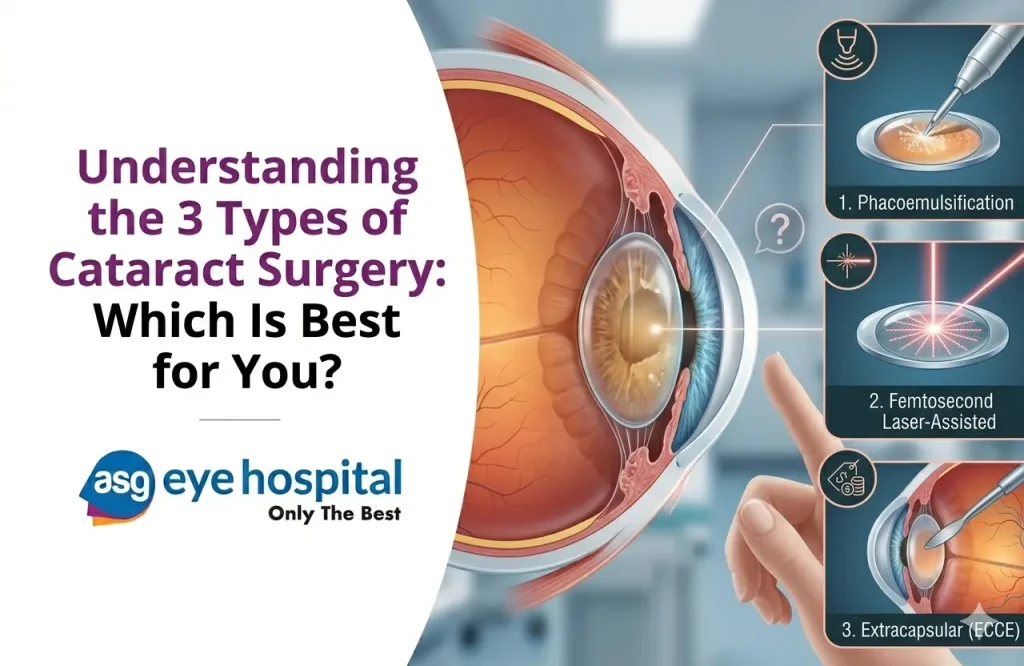
Modern ophthalmology uses three major surgical methods for cataract removal, which serve as its primary surgical options. The techniques employ different approaches to both disintegrate and extract the cataract material.
1. Phacoemulsification Cataract Surgery
The standard treatment for cataracts today uses phacoemulsification, which people commonly refer to as phaco surgery. The procedure uses ultrasound energy to perform cataract surgery by breaking the cloudy lens into smaller pieces.
Phacoemulsification surgery provides multiple benefits, which include the following:
- A surgical cut that requires very little space
- The procedure needs only a small number of stitches
- Patients experience their recovery process at an accelerated speed
- The procedure leads to less pain for patients after they finish their surgery
Doctors use phacoemulsification because it delivers accurate results and safe outcomes to answer patients who ask, ‘Which cataract surgery is best for vision?’ The technique is still used as the standard method for most normal procedures.
2. Laser-Assisted Cataract Surgery
The medical field now uses laser cataract surgery, which experts refer to as ‘femtosecond laser-assisted cataract surgery’ because of technological advancements. The procedure uses computer-controlled laser technology to complete multiple surgical steps with improved accuracy.
The surgeon in traditional cataract surgery uses his hands to create the corneal incision and open the lens capsule. The femtosecond laser technology in laser-assisted procedures enables surgeons to create precise and uniform incisions for these surgical steps.
The primary advantages of laser cataract surgery are the following:
- The operation achieves higher accuracy.
- The procedure enables doctors to create exact corneal incisions.
- The process requires less ultrasonic energy to break up the lens.
- The method enables better results in challenging cases.
Doctors consider the procedure to be one of the latest cataract surgery techniques, which they use particularly for patients who need exceptional visual accuracy or have particular corneal disorders.
The medical team decides between laser-assisted surgery and other options based on their assessment of the patient, the properties of the lens, and the patient’s qualifications.
3. Extracapsular Cataract Extraction (ECCE)
Doctors use extracapsular cataract extraction as a surgical method to treat patients who have developed advanced cataracts that have reached extreme cataract density. The procedure requires a larger incision, which allows the surgeon to extract the cloudy lens in its complete form instead of using the method of breaking the lens into smaller pieces.
The surgical technique ECCE has become less common in modern medicine because phacoemulsification and laser cataract surgery have developed into more advanced treatment methods, yet it remains a vital approach for treating patients with complex cataracts.
ECCE requires multiple stitches because its incision size exceeds standard surgical procedures, which leads to extended patient recovery time. The treatment option exists as an effective choice for particular medical situations.
The three procedures represent the most commonly used types of cataract surgery that doctors perform in present-day ophthalmology.
Difference Between Phaco and Laser Cataract Surgery
Patients frequently enquire about the difference between phaco and laser cataract surgery</mark>, as both procedures are commonly offered in modern eye care centres.
The primary difference lies in the technology used during the surgery.
Phacoemulsification relies on ultrasound energy and manual surgical steps performed by the ophthalmic surgeon. The surgeon creates the incision, opens the lens capsule, and breaks the cataract using an ultrasound probe.
In contrast, laser cataract surgery</mark> uses a femtosecond laser system to automate several steps, including corneal incisions, capsulotomy, and initial lens fragmentation.
Key distinctions include the following:
The laser-assisted surgical procedures use computer-controlled systems to achieve precise results for specific surgical steps. The laser technology enables doctors to perform surgeries with reduced need for ultrasound energy during the entire treatment. Patients who have astigmatism and complex cataracts will find advantages from laser-assisted surgery.
The difference between phaco and laser cataract surgery exists as a crucial factor that helps patients and surgeons select the best treatment path according to their specific eye conditions and surgical objectives.
Which Cataract Surgery Is Best for Vision?
Selecting the appropriate procedure depends on several clinical factors rather than a single universal solution. Therefore, determining which cataract surgery is best for vision requires careful ophthalmic evaluation.
Factors influencing the choice of surgery include:
- The degree of cataract development and its current stage of maturity
- The condition of the cornea and its respective curvature measurements
- The existence of astigmatism
- The complete anatomical makeup of the eye
- The patient’s daily activities and their expected visual results
Phacoemulsification remains the most commonly recommended procedure because of its safety and fast recovery times, together with its ability to produce excellent visual results. However, in certain cases, laser cataract surgery may provide extra benefits through its improved accuracy.
An experienced ophthalmologist evaluates these parameters to recommend the most appropriate procedure among the available types of cataract surgery.
Importance of Timely Cataract Treatment
Cataracts develop through a gradual process, which begins with symptoms that include blurred vision, light glare and night vision problems and colour vision loss. The treatment delay results in two main consequences, which include worsening vision loss and making surgical procedures more difficult to perform.
The combination of current ophthalmic technology and the latest cataract surgery techniques has transformed cataract surgery into one of the most secure and effective medical procedures available. Patients who consult early receive their diagnosis through timely methods, while their best surgical option gets determined through an assessment of individual requirements.
Conclusion
Cataract surgery has undergone major changes because of both new technologies and better surgical methods. Patients gain knowledge about their surgical options through their understanding of three surgical methods, which include phacoemulsification, laser-assisted surgery and extracapsular cataract extraction.
The selection process needs to determine the best treatment method according to the patient’s visual impairments, and the eye doctor needs to make their judgement. Patients who need to select between phaco and laser cataract surgery need to learn about the main distinctions between these two treatment methods.
Patients who show cataract symptoms must visit specialized eye hospitals for immediate medical assessment. ASG Eye Hospital provides full ophthalmology services across India in cities such as ASG Eye Hospital in Mumbai, ASG Eye Hospital in Delhi, ASG Eye Hospital in Srinagar, ASG Eye Hospital in Gujarat, ASG Eye Hospital in Indore and ASG Eye Hospital in Punjab. Early diagnosis combined with correct surgical methods, enables patients to achieve better vision results while maintaining their eye health over time.
Extracapsular cataract extraction is a surgical procedure that doctors use to treat patients with advanced cataracts when the cataract has reached an extreme level of density. The procedure requires a larger incision, which allows the surgeon to extract the cloudy lens in its complete form instead of using the method of breaking the lens into smaller pieces.
Frequently Asked Questions
1. On average, how long does a cataract operation last?
The average duration of cataract surgery is between 15 and 30 minutes per eye. Usually, local anaesthesia is used so patients are able to go home after surgery.
2. Can I expect any discomfort during a cataract procedure?
There is no discomfort involved in the surgery itself because of the numbing eye drop used along with the local anaesthesia for the surgery. You may feel slight pressure during the operation, but probably not any significant pain.
3. How quickly can I expect to see improved vision after my cataract operation?
In general, many people see a substantial improvement in their vision (especially for distance vision) immediately after the cataract procedure; however, it may take several weeks for the vision to completely stabilise due to healing.
4. Can I expect my cataracts to grow back after they’ve been removed?
After actual (primary) cataract surgery, patients don’t typically have cataracts grow back. They may, however, develop posterior capsule opacification (POC), which can be fixed with a laser.
5. How do I know if it’s time for me to consider cataract surgery?
If a person’s ability to carry out daily activities like reading, driving, or recognising people has been seriously compromised by their cataracts, they may want to think about having the surgery as well. The exact timing for when to seek treatment will be determined by an eye doctor based on the results of an eye examination performed on the individual.