Laser-Assisted In Situ Keratomileusis (LASIK) operates as a common surgical method which corrects vision through the process of corneal reshaping. The process of selecting patients stands as the most important factor which determines treatment success, while corneal thickness measurement emerges as the key element among all assessment factors. The process of determining candidate eligibility requires an understanding of how corneal structure impacts surgical safety.
Understanding Corneal Thickness
The cornea functions as the eye’s primary transparent dome, which helps to focus light. People need an intact corneal structure because it serves as the foundation for clear visual perception. The average corneal thickness ranges between 500 and 550 microns, although individual variations are common.
Corneal thickness assessment for LASIK procedures during refractive surgery determines whether enough stromal tissue will remain after the operation. LASIK requires the creation of a corneal flap, which needs specific tissue to be removed for corneal reshaping. Excessive tissue removal from a narrow cornea will lead to decreased structural integrity, which increases the likelihood of developing corneal ectasia and other complications.
Why Corneal Thickness Matters in LASIK
The importance of corneal thickness for LASIK lies in maintaining postoperative corneal strength. LASIK surgery involves the removal of corneal tissue through excimer laser ablation. The intact portion of the cornea, which remains after surgery, needs to have sufficient thickness to maintain its structural integrity.
Patients with thinner corneas may not have sufficient tissue to safely undergo LASIK. The removal of further tissue will result in progressive corneal thinning, which creates bulging as a result of ectasia that severely affects vision.
LASIK eligibility requires corneal thickness assessment through both the initial measurement and the required correction amount. Higher refractive errors require more tissue removal, making corneal thickness even more critical in such cases.
How Is Corneal Thickness Measured?
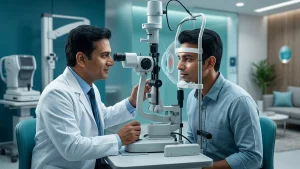
Accurate measurements of the corneas from pre-op testing are needed to provide guidelines for pre-op assessments of LASIK surgery. Information obtained from the measurements of the corneal thickness is an important part of providing accuracy to the LASIK surgery procedure and developing an appropriate surgical plan.
There are three commonly used diagnostic tools for measuring corneal thickness:
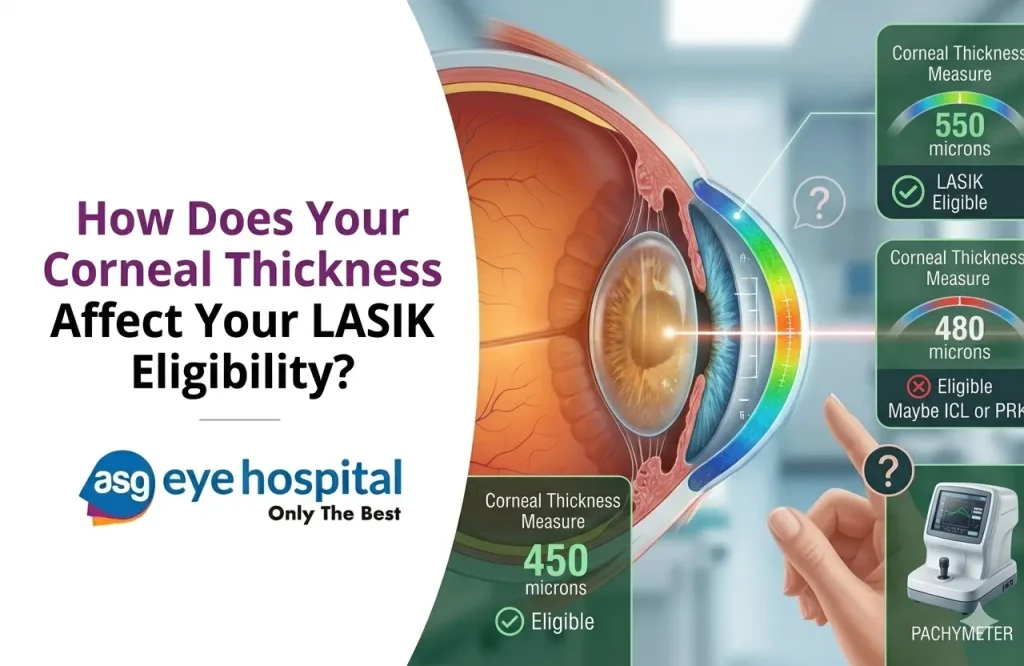
- Pachymetry is the standard method used by physicians for measuring corneal thickness, using both ultrasonic and optical methods.
- Optical Coherence Tomography (OCT) uses imaging technology to provide a nearly complete individual cross-section of the cornea.
- Topography and Tomography of the Cornea use different imaging methods to accurately measure the thickness and curvature of the cornea, enabling the diagnosis of keratoconus and other corneal abnormalities.
These three devices measure the corneal thickness as part of determining LASIK candidacy, as well as other factors, including corneal curvature and overall eye health.
Minimum Corneal Thickness Requirements
There is no absolute cutoff for the thinner cornea necessary for all LASIK patients; however, the range for a corneal thickness required for refractive surgery by most ophthalmologists is 480-500 µm or more. In addition, it is required that the residual stromal bed is at least 250-300 µm after the surgery.
Corneal thickness tolerance is also determined based on the following parameters that vary from patient to patient:
- Degree of refractive error
- Corneal shape and symmetry
- Age and overall health of the eyes
- Vision stability
The corneal thickness for LASIK should be determined after taking many other factors into consideration with regard to the safety of the procedure.
Can Thin Cornea Have LASIK?
The common question people ask is whether people with thin corneas can undergo LASIK surgery. The medical community considers standard LASIK to be unsafe for patients who have extremely thin corneas because their risk of complications becomes higher.
The evaluation process permits assessment of borderline situations. The advanced diagnostic imaging system enables assessment of corneal strength through its ability to detect more than just corneal thickness dimensions. The medical field sees ophthalmologists using a conservative treatment method which they apply to all situations.
The human eye suffers from permanent vision problems when LASIK surgery is performed on a cornea that does not meet proper criteria.
LASIK for Thin Cornea Options
Patients deemed unsuitable for LASIK due to insufficient corneal thickness still have alternative treatment options. Understanding LASIK for thin cornea options ensures that patients can pursue safe and effective vision correction.
Common alternatives include:
Photorefractive Keratectomy (PRK)
PRK is a surface ablation technique that does not involve creating a corneal flap. Since less corneal tissue is removed, it is often recommended for patients with thinner corneas.
SMILE (Small Incision Lenticule Extraction)
SMILE is a minimally invasive procedure that preserves more corneal integrity compared to LASIK. It may be considered in select cases depending on corneal parameters.
Implantable Collamer Lens (ICL)
For patients with high refractive errors and thin corneas, ICL offers a non-laser alternative. A lens is implanted inside the eye without altering the corneal structure.
Advanced Surface Ablation Techniques
Customized procedures using wavefront-guided or topography-guided approaches may optimize outcomes while preserving tissue.
These LASIK for thin cornea options provide safe alternatives when traditional LASIK is not advisable.
Comprehensive Evaluation for LASIK Eligibility
The process of establishing LASIK eligibility requires an assessment of corneal thickness through medical procedures that need to be conducted in a specific manner. This includes:
- Measurement of corneal thickness
- Corneal mapping and curvature analysis
- Assessment of tear film and ocular surface
- Evaluation for conditions such as keratoconus
- Stability of refractive error
The procedure aims to achieve two goals, which include enhancing vision capacity while protecting corneal health throughout the patient’s life.
Patients require assessment at an eye care center which provides high-level diagnostic equipment and access to skilled ophthalmologists.
Risks of Ignoring Corneal Thickness
Surgeons who perform LASIK surgery need to measure corneal thickness because insufficient corneal thickness assessment will result in hazardous complications that include:
- Corneal ectasia
- Visual distortions, which include glare and halos
- Reduced visual acuity
- Need for additional corrective procedures
The clinical guidelines, together with a proper patient selection process, require strict compliance because these practices protect against potential dangers.
Conclusion
Corneal thickness remains one of the most critical determinants in assessing suitability for LASIK surgery. The procedure achieves its safety and effectiveness through accurate measurement, which scientists perform together with their complete ocular assessment work. Patients with thinner corneas should not be considered unsuitable for vision correction altogether, as several alternative treatments are available.
The patient needs to see an ophthalmologist who holds proper qualifications because this step will help them assess their condition while receiving expert advice. The advanced diagnostic evaluation process at ASG Eye Hospital in Parel, Dadar, Jaipur, Jodhpur, Ahmedabad and Udaipur enables medical professionals to determine patient eligibility and choose the most suitable treatment method.
The first assessment, followed by correct decision-making, leads to the best visual results and the preservation of eye health throughout the patient’s life.
Frequently Asked Questions
What is the corneal thickness that is appropriate for LASIK?
Most patients seeking LASIK eye surgery require a minimum corneal thickness of 500µm, in addition to having adequate residual stromal bed after LASIK.
How do you obtain the corneal thickness measurement pre-LASIK?
Before having LASIK, you will have multiple different tests performed, including pachymetry (to measure corneal thickness) and other corneal imaging, such as topo-whatever and optical coherence tomography.
Can you safely have LASIK with a thin cornea?
The answer to whether someone can have LASIK with a thin cornea is determined on the basis of many individual factors. However, patients with corneas that are exceedingly thin are typically not candidates for conventional LASIK.
What is the significance of the corneal thickness in regard to LASIK eligibility?
Corneal thickness is important in determining a patient’s eligibility for LASIK surgery since the amount of corneal tissue reshaped must allow sufficient amounts of corneal tissue to remain after surgery to provide adequate structural integrity.
What if the corneal thickness is low? What are the alternatives?
Patients with a low corneal thickness and are clinically found to be suitable candidates for LASIK may seriously consider LASIK alternatives; these include PRK, SMILE or Implantable Contact Lenses.