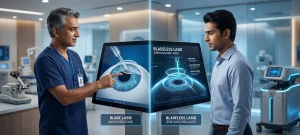
Vision issues impact how we go about our day. From waking up and setting the alarm to that first stretch of the morning, to the course of the work day, to the gym, to better vision improves quality of life. For many appropriate adults, laser vision correction is a great solution to break free of glasses or contacts and into a more active lifestyle.
Laser vision correction is a kind of refractive surgery which changes the cornea, the clear outer layer of the eye, to improve how light hits the retina. We use it for most refractive errors like myopia, hyperopia, and astigmatism. While the aim is for better vision correction, also included is greater convenience, confidence, and freedom in day to day life.
At ASG Eye Hospital we see each patient in depth before we put forth any treatment plan. Laser vision correction does not fit the same for all, we base our decision on corneal thickness, prescription stability, eye surface health, age, lifestyle, and what the patient is expecting. We do an in depth consultation to determine if lasik eye surgery is the right choice for you, or if it’s better to go with another type of laser eye surgery or a different refractive surgery option.
What Is Laser Vision Correction?
Laser vision correction is where we use lasers for the treatment of refractive errors. In other words it changes the cornea’s shape which in turn properly aligns the focus of incoming light. When the focus error is fixed the person may see better and rely less on glasses or contact lenses.
The most prevalent type of laser vision correction is LASIK which is what the majority is familiar with but we also have PRK, SMILE, and also custom treatments that may be put forward in certain cases. Each of these approaches has different procedures, recovery time, and best use. This is why a full eye exam is very important before choosing a vision correction treatment.
Laser vision correction is a choice which we present to adults that have had the same prescription for some time and who do not have health issues with their eyes. This is not a trivial cosmetic issue. It is a medical procedure in which we do very careful patient selection, and also we go over the benefits and risks in great detail.
Common Laser Vision Correction Options
| Procedure Type | Basic Idea | Commonly Considered For |
| LASIK | A corneal flap is created, and a laser reshapes the underlying corneal tissue. | Many patients with suitable corneal thickness and stable prescription. |
| PRK | The surface layer is gently removed, and the laser reshapes the cornea without creating a flap. | Patients with thinner corneas or those advised against flap-based surgery. |
| SMILE | A small lenticule is created inside the cornea and removed through a tiny incision. | Selected patients with myopia and suitable eye measurements. |
| Customised Laser Treatment | Treatment planning may be guided by detailed corneal or wavefront measurements. | Patients who may benefit from more personalised optical correction. |
Benefit 1: Reduced Dependence on Glasses and Contact Lenses
One of the primary reasons that people choose laser vision correction is because they want to reduce their dependence on glasses and contacts. For a person who has worn specs for years even the smallest of daily tasks may see an improvement after the procedure. Early morning reading of the phone, in–person meetings, going to the gym, and travel may become less of a hassle.
This sort of vision correction is very useful for people who find contact lenses uncomfortable or who deal with dryness, irritation, or frequent lens care. Also some patients may still require glasses for certain tasks as we age which is to say that after the age of 40 you may still use reading glasses, but laser vision correction does greatly reduce the need for distance glasses in right candidates.
Benefit 2: Better Comfort During Sports and Outdoor Activities
People that play sports, go to the gym, run, swim, trek, or travel report that they have issues with glasses which either fog up, fall off, break or just get in the way. Also contact lenses may become uncomfortable in dry, dusty and windy environments. With laser vision correction we are able to remove many of these issues thus making for a much more active lifestyle.
For athletes and fitness enthusiasts which is your primary audience we see that vision correction gives a more natural visual experience while in motion. Frame adjustment, carrying lens solution, or losing contact lenses during play are a thing of the past. This is the sort of life time benefit which patients report to value the most post laser vision correction.
Benefit 3: Clearer Vision for Work and Digital Life
Modern day life is filled with long hours at the computer, in meetings, commuting, reading, and multitasking. If your glasses are scratched, smudged, or just don’t suit you, work may leave you feeling tired. Laser vision correction may put a better outcome for suitable patients in terms of clear distance vision which in turn may improve the flow of your work and of your daily routine.
This does not mean the eyes become immune to digital strain. After vision correction procedures also, it is important to practice healthy screen habits. Patients still require regular blinking, proper lighting, breaks during long screen use, and treatment for dry eye if present. Also for many people what we do is that laser vision correction reduces the daily bother of switching between glasses, contact lenses, and screen work.
Benefit 4: More Confidence in Social and Professional Settings
Vision is a bigger issue of confidence than we think. Some patients feel self aware with thick glasses. Also they are restricted at social events, presenting to groups, in front of cameras, or at social meetings. Laser vision correction may improve day to day confidence for patients which in turn reduces dependence on external visual aid
This benefit goes beyond what meets the eye. It also includes comfort and ease. When a person is able to pass through social and professional settings free of issues with glasses or contact lenses the results are very natural. For many appropriate adults this is the most valuable result of vision correction.
Benefit 5: Long-Term Convenience and Practical Value
Glasses and contacts include in your budget repeat purchases and care. Frames break in style, lenses in the scratch category, contact supplies are a must, and also your prescription may require annual updates.Laser vision correction is a one-time medical procedure for suitable candidates, and the results can be long-lasting when the prescription is stable and the eyes are healthy.
That which is said, laser vision correction does not prevent the process of natural eye aging. You may still require reading glasses at a later stage due to presbyopia, and also cataracts may develop as we get older. Also it is true that many patients report a practical benefit of reduced daily use of glasses or contacts.
Benefit 6: Fast Procedure and Gradual Return to Routine
That being said, laser vision correction does not prevent the process of natural eye aging. You may still require reading glasses at a later stage due to presbyopia, and also cataracts may develop as we get older. Also it is true that many patients report a practical benefit of reduced daily use of glasses or contacts.
Recovery time is different for each person. We see some patients report better vision right away, while others have dry eyes, glare, tearing, or which may fluctuate during the healing process. That is why we stress the importance of follow up care. Safe results from this treatment don’t only depend on the treatment itself but also on proper at home care, use of prescribed eye drops, and to avoid rubbing the eyes during the recovery which also plays a key role.
Benefit 7: Personalised Treatment Planning for Better Outcomes
Today we have that with the aid of advanced diagnostic tools which look at the cornea, prescription, pupil size, tear film, and overall eye health. We use these results to determine if the patient is a good candidate and which procedure will best balance safety and clarity.
Personalization in care is key which is to say that two patients presenting with the same spectacle power may not in fact have the same eye structure. Some may do better with LASIK, others may be put forward to PRK, and still others may not be good candidates for laser eye surgery at all. The goal of the consult is to determine the safest method of vision correction which may also take the longest to recover from, not the quickest.
Lifestyle Benefits and Practical Impact
| Benefit | How It Helps in Daily Life |
| Less dependence on glasses | Easier morning routine, travel, work, and daily movement. |
| More comfort during sports | No slipping frames or contact lens discomfort during activity. |
| Better convenience at work | Fewer interruptions caused by glasses, lens care, or visual aids. |
| Improved confidence | A more natural experience in social and professional situations. |
| Long-term practicality | Reduced repeated dependence on frames, lenses, and lens supplies. |
| Quick procedure experience | Many patients return to routine activities after a short recovery period. |
| Personalised planning | Treatment can be selected based on eye health, corneal shape, and lifestyle needs. |
Who Is a Good Candidate for the Procedure?
A large group of patients which do well with this treatment are adults that have stable prescriptions, healthy corneas, and realistic expectations. We see best results in patients that don’t have uncontrolled dry eye, active eye infection, unstable power, severe corneal weakness, or certain health conditions which affect healing. Also pregnant and breastfeeding women may see changes in their prescription which is why we must pay attention to the timing.
Before you begin with vision correction the ophthalmologist will do a screening which includes evaluation of corneal thickness, corneal shape, tear film quality, pupil size, eye pressure, retina health, and the exact refractive error. This is important as sometimes the safe play is to delay treatment or go with a different option. The treatment does work best when the eyes are a good candidate and the patient is aware of what to expect.
What to Expect Before, During, and After the Procedure
Before the procedure we do in depth testing and counseling. Contact lens users may be asked to go without their lenses for a while before the scans as the lenses may affect corneal measurements. Also the doctor goes over the procedure, recovery, side effects and what to watch out for.
During the procedure patients are given numbing eye drops which will leave them comfortable. The process of the procedure is quick which means the patient will be awake the whole time. After the treatment it is common for patients to report some watering of the eye, mild irritation, light sensitivity, or blurry vision. With use of eye drops, rest and return visits the eye will heal properly.
After treatment patients should steer clear of eye rub and report in to all medication directions. Vision may improve right away, but healing is a process which takes time. The final result is a product of the type of procedure, eye health, degree of prescription, and the individual healing response.
Laser Eye Treatment at ASG Eye Hospital
ASG Eye Hospital is dedicated to safe screening, precise diagnosis, and personalized treatment planning. We evaluate each patient’s eye health in great detail before we put forth any recommendation. We aim for more than just glasses free vision we aim for safe, stable, and comfortable vision in day to day life.
The team goes over what we have to offer in terms of refractive surgery which includes lasik eye surgery and other types of laser eye surgery based on what is best for each patient. For some it is the best choice. For others we may recommend a different approach which is safer. We take a patient first approach which in turn helps us plan for the best possible outcome and clear results.
Key Takeaway
The process is to present benefits for some patients which may include reduced use of glasses and contact lenses, improved comfort at work and play, and increased daily life confidence. But it must also begin with a full eye exam and a very clear picture of what is suitable, what the recovery time is, and what results to expect.
The best results come when the procedure is chosen carefully, performed by trained specialists, and supported by proper follow-up care. Anyone considering vision correction should consult an experienced eye specialist to understand which option is safest for their eyes.
Frequently Asked Questions
1. What is the procedure?
The field of this treatment is that of eye procedures which use laser technology to reshape the cornea and correct refractive errors which include myopia, hyperopia, and astigmatism. It is to reduce dependence on glasses or contact lenses in suitable patients.
2. Is the procedure safe?
The procedure is in general very safe for those that are proper candidates, but it is still a medical procedure which may present issues like dryness, glare, halos, or under correction. A very in depth pre op eye exam is required to determine suitability.
3. Are the results permanent?
During laser treatment corneal reshaping is a permanent change. But for some people natural age related changes like presbyopia or cataract will still take place at a later date. Some patients may thus require reading glasses or other eye care in the future.
4. How is LASIK eye surgery different from other refractive surgery options?
Lasik eye surgery usually involves creating a flap in the cornea before reshaping the tissue underneath. Other refractive surgery options, such as PRK or SMILE, use different techniques. The best choice depends on corneal thickness, prescription, eye health, and the doctor’s assessment.