
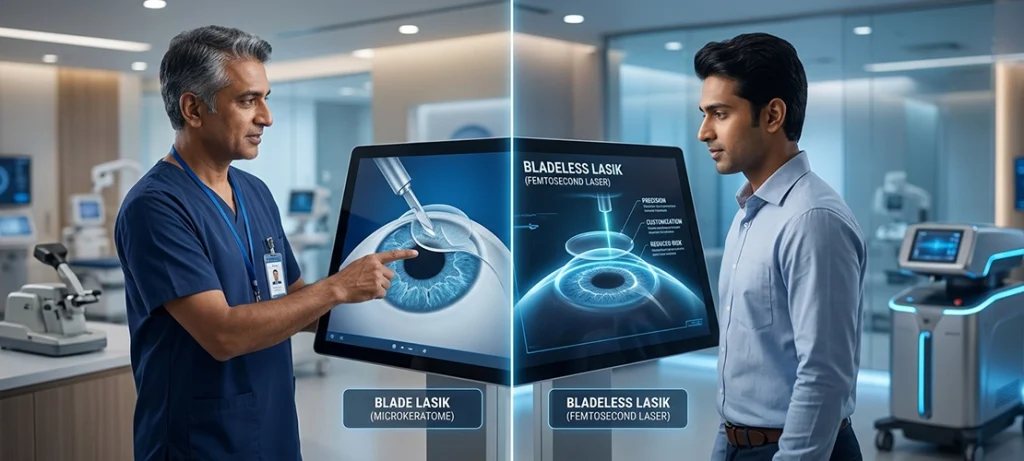
If you are considering freedom from glasses, one of the most common questions you may come across is whether to choose traditional blade LASIK or a newer laser-based approach. Patients often arrive with a simple concern: if both procedures improve vision, why does one use a blade while the other does not?
The issue of bladeless lasik vs blade lasik has come to the fore as laser vision correction in general has evolved. Today’s LASIK is not just about removing your dependence on glasses; we also see in terms of precision, safety, recovery and how well the treatment suits your individual eye structure.
The fact is that we have had these two procedures for refractive surgery and they have both produced great results world wide. What we really look at is not which is the better of the two, but which will work best for your cornea, prescription, lifestyle, and long term expectations.
What Is LASIK and How Does It Work?
LASIK (Laser Based In Situ Keratomileusis) we have a type of lasik eye surgery which corrects refractive errors such as myopia, hyperopia, and astigmatism. It is a 2 stage process. First a thin flap is made in the corneal surface. Second an excimer laser is used to reshape the inner layer of the cornea which in turn improves the focus of light on the retina.
This first step is where the discussion of bladeless lasik vs blade lasik begins.
Traditional blade LASIK which uses a microkeratome for a mechanical purpose to make the flap. Also we see in bladeless LASIK surgery that the femtosecond laser is used to create the flap instead of a blade. This laser which delivers very fast pulses is what allows for great control in the process of creation.
Blade LASIK vs Bladeless LASIK: What Is the Real Difference?
When we discuss bladeless lasik vs blade lasik patients think the full scope of the procedure changes which is not the case the corneal reshaping is the same in both. The main difference is in how the flap is created.
Table 1: Blade LASIK vs Bladeless LASIK Comparison
| Parameter | Blade LASIK | Bladeless LASIK |
| Flap creation | Mechanical microkeratome | Femtosecond laser |
| Precision | High | Very high |
| Flap consistency | Slight variation possible | More predictable |
| Recovery | Fast | Fast |
| Corneal customization | Moderate | Greater customization |
| Suitability for thinner corneas | Limited | Often better |
| Cost | Lower | Higher |
This comparison explains why many people researching bladeless lasik vs blade lasik focus heavily on safety and long-term predictability.
What Happens During Bladeless LASIK Surgery?
Before recommending bladeless lasik surgery, a complete eye assessment is performed.
Your surgeon usually evaluates:
- Corneal thickness
- Corneal topography
- Tear film quality
- Pupil size
- Prescription stability
- General eye health
In Bladeless LASIK Surgery the femtosecond laser produces a very thin corneal flap. The flap is gently pushed aside and an excimer laser is used to reshape the tissue beneath.
The flap is repositioned without stitches.
For many patients, actual laser treatment takes only a few minutes.
Is Bladeless LASIK Safer Than Blade LASIK?
Safety issues are what often come up in the bladeless lasik vs blade lasik debate. What we see is that the laser created flaps are more uniform which in turn may reduce certain flap related complications. At the same time it is of great importance that the surgery plan out and which patient is selected for the procedure.
FDA reports that at present there is no one flap method which is put forth as clearly better and that which method to use depends on the surgeon’s preference, recovery expectations, complication profile, and which patient is the right candidate.
That means bladeless lasik surgery may offer advantages in some patients, while traditional blade LASIK continues to remain highly successful for many others.
Recovery After LASIK: Is There a Difference?
One of the biggest concerns patients have while comparing bladeless lasik vs blade lasik is recovery.
The positive news is that recovery from both of these procedures is usually very quick. Within a day or two most people are back to their regular activities and we see gradual improvement in the following weeks. That said, recovery experience does present a little difference between patients. Many that have had bladeless lasik surgery report very smooth visual recovery and great comfort in the first few days post op which is a common report though we do see large variation between patients.
Typical recovery expectations include:
Table 2: Recovery Timeline After LASIK
| Timeline | What Patients Commonly Experience |
| First 24 Hours | Mild watering, light sensitivity, hazy vision |
| Days 2–3 | Improved clarity and reduced irritation |
| Week 1 | Return to most daily activities |
| Weeks 2–4 | Vision continues stabilizing |
| Months 1–3 | Final visual refinement |
When evaluating bladeless lasik vs blade lasik, it is important to understand that healing depends not only on technology but also on eye health, tear quality, prescription strength, and post-operative care.
Who Is a Good Candidate for LASIK?
Not everyone who wants LASIK is automatically a candidate.
A proper eye evaluation determines whether bladeless lasik surgery or another vision correction procedure may be more appropriate.
Good candidates generally include people who:
- Are over 18 years old
- Have stable spectacle power
- Have healthy corneas
- Do not have uncontrolled dry eye
- Do not have progressive keratoconus
- Have realistic expectations
Patients who present with thin corneas are often encouraged to have a more in depth discussion of bladeless lasik vs blade lasik as flap precision plays a greater role. Also in some cases other options to LASIK may be put forth.
Can Bladeless LASIK Reduce Complications?
Many patients think that what’s new is what is also better. This is not true in every case. In bladeless LASIK vs blade LASIK which is performed by modern femtosecond technology there is a reduction in some flap related complications because of the consistent flap thickness achieved.
However, long-term success depends more on:
- Proper screening
- Experienced surgeons
- Accurate measurements
- Good postoperative care
Common temporary side effects after either procedure may include:
- Dryness
- Halos
- Mild glare
- Light sensitivity
- Temporary fluctuations in vision
For suitable patients, bladeless lasik surgery may improve flap predictability, but both approaches remain established treatment methods.
LASIK Surgery Cost: Does Technology Affect Price?
Patients comparing bladeless lasik vs blade lasik often notice cost differences.
The overall lasik surgery cost varies depending on:
- Technology used
- City
- Hospital infrastructure
- Surgeon experience
- Number of follow-ups
- Diagnostic testing
In India traditional LASIK is at a lower price point than bladeless LASIK which is a trend to note although prices do vary. As for in depth personalization which is made available by Contoura Vision or top of the line laser platforms that will pass the cost along to the patient. As you look at price do think in terms of what you are getting for your money which is value, not just which has the lower price.
Is Bladeless LASIK Better for Everyone?
The answer is no. In many cases what is put forth in bladeless lasik vs blade lasik is misinterpreted. Some patients do well from laser flap creation. Also it is true that some may do equally well with traditional LASIK.
Your surgeon may consider:
- Corneal thickness
- Eye dryness
- Prescription
- Lifestyle
- Occupation
- Healing expectations
The goal is not to choose the newest procedure.
The goal is to choose the safest and most predictable procedure for your eyes.
LASIK Care at ASG Eye Hospital
At our ASG Eye Hospital we have implemented a policy of in-depth initial patient evaluation at every LASIK consult which we conduct. We have seen an increase in patients that are coming in to compare bladeless lasik vs blade lasik and for that we have developed a very extensive panel of tests which includes corneal mapping, tear film analysis and personal treatment plans. Based on the results of what we find we may recommend bladeless lasik surgery, advanced refractive surgery or other vision correction options. We put safety of the procedure, stable post op results and long term visual quality at the forefront of what we do as opposed to pushing any one technology for all patients.
Key Takeaways
When patients look at the choice bladeless lasik vs blade lasik the decision shouldn’t be based only on the issue of the blade. Traditional LASIK and bladeless lasik surgery procedures are still very much at the top of their game in terms of results and also in terms of safety and we see that out to very long term. The main difference is in how the flaps are created. In the case of traditional lasik eye surgery we use a microkeratome blade, but for bladeless lasik surgery we use a femtosecond laser which in turn produces a more precise and predictable result.
For a number of patients which includes those with thin corneas or which have certain anatomic issues the choice between bladeless lasik vs blade lasik comes into greater focus. Tech is a factor but in the mix of what you should be looking at also comes in pre op screening, surgeon’s skill and setting realistic expectations. Choosing the right refractive surgery procedure means selecting what fits your eyes rather than following trends.
Also Read :
Blade vs Bladeless LASIK: Which is Better Blade or Bladeless Lasik
Frequently Asked Questions
1. Which is better: blade LASIK or bladeless LASIK?
There isn’t a one size fits all answer. What we see in terms of bladeless lasik vs blade lasik is that it really does depend on your corneal thickness, your prescription, the state of your eye’s surface and what your surgeon recommends. For many appropriate candidates we see that bladeless lasik surgery does in fact present with greater precision and better predictability. At the same time though traditional LASIK still does very well in terms of visual results.
2. Is bladeless LASIK surgery completely blade-free?
Yes. During bladeless lasik surgery flap creation is performed with a femtosecond laser as a substitute for a mechanical blade. Also the reshaping stage still uses an excimer laser which is the same as in traditional LASIK.
3. Is recovery faster with bladeless LASIK?
Recovery is quick for both approaches. In some patients we see that bladeless lasik surgery reports better early healing and more comfort, but overall recovery depends on eye health, healing response, and post op care. When we look at bladeless lasik vs blade lasik both methods generally allow for return to normal activities within a short time.
4. Is bladeless LASIK more expensive?
Usually, in most cases. What we see is that for bladeless lasik surgery which has at its core advanced laser platforms, surgery cost of the procedure may be greater than what is seen in traditional LASIK. But price should not be the only thing which determines your choice.
5. Is bladeless LASIK safer?
Many patients when looking at bladeless lasik vs blade lasik ask this question first. What laser created flaps do is improve consistency and also reduce some flap related risks, that said safety in the end does in large part depend on patient selection, surgeon skill, and proper follow up.
6. Can I undergo LASIK if I have thin corneas?
Possibly. Patients who have thin corneas are usually evaluated in great detail during bladeless lasik vs blade lasik decision process. Also based on these results bladeless lasik surgery or some other refractive surgery option may be put forth.