
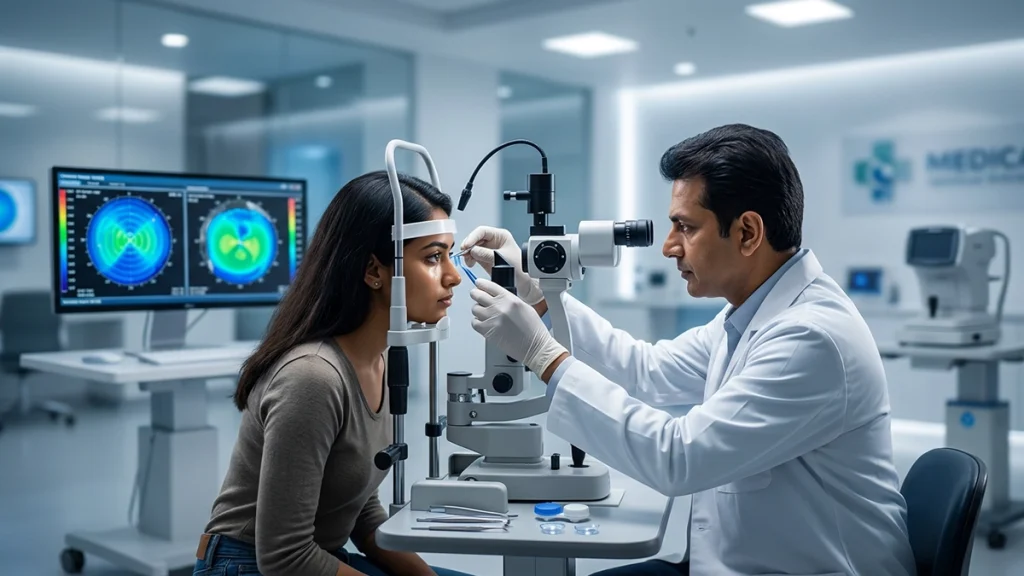
For a great many patients the issue after a keratoconus diagnosis is which glasses to get by with or which special contact lenses for keratoconus to use. Keratoconus causes the cornea to change in shape, to become thinner, steeper and more irregular. Due to this irregular shape which also may vary over time, common glasses may not always correct vision fully.
The best contact lenses for keratoconus are based on the stage of the disease, corneal shape, comfort, and improvement in vision each lens type provides. In the early stages some patients do well with soft lenses, but others may require RGP lenses, hybrid lenses, or scleral lenses for better and more stable vision.
Understanding Keratoconus and Why Special Lenses Are Needed
In a normal eye the cornea has a regular dome shaped structure which also helps to clearly focus light on the retina. In Keratoconus the cornea slowly transforms into a conical shape. This causes irregular astigmatism, distorted vision, glare, ghost images and frequent changes in glasses prescription.
This is where we see that contact lenses for keratoconus are of a different design from regular contact lenses. We see that they are made to create a smoother optical surface over the irregular cornea. The lens does not cure the disease but what it does do is improve the way light enters the eye and in that which it does it also helps the patient see more clearly. In early stages we may see that contact lenses for keratoconus include soft toric or custom soft lenses.
As the condition advances, doctors often consider keratoconus lenses such as RGP lenses or scleral lenses, depending on the shape of the cornea and the patient’s comfort.
Types of Contact Lenses Used for Keratoconus
The choice of contact lenses for keratoconus is determined by in depth corneal evaluation. There isn’t one type of lens that works best for each patient. The doctor will look at corneal topography, visual quality, lens movement, dryness, comfort, and also if the patient can do well with the lens.
| Lens Type | Best Suited For | Key Benefit |
| Soft or custom soft lenses | Early keratoconus with mild irregularity | Better comfort and easy adaptation |
| RGP lenses | Mild to moderate keratoconus | Sharp vision by creating a smooth front surface |
| Hybrid lenses | Patients needing clear vision with better comfort | Rigid center with soft outer skirt |
| Scleral lenses | Advanced keratoconus, dry eyes, or poor RGP tolerance | Vault over the cornea and provide stable vision |
| Piggyback lenses | Patients who need RGP clarity but more comfort | Soft lens below and RGP lens above |
In the early stages soft contact lenses for keratoconus may be enough if vision is still correct and the cornea is only very slightly irregular. Also when vision is still an issue after use of glasses or soft lenses RGP lenses are an option.
RGP Lenses for Keratoconus
RGP lenses which are rigid and gas permeable sit on the cornea and produce a smooth surface for light to pass through. They are used in mild to contact lenses for keratoconus cases as they provide sharper vision than glasses or soft lenses.
For many patients RGP lenses are the first type of contact lenses tried for keratoconus because they are very effective, durable and also allow oxygen to the cornea. Some patients do experience initial discomfort from the firm lens which rests directly on the corneal surface. With proper fit and wear time many patients do adapt.
If RGP lenses fit poorly, cause discomfort, or do not sit well on a steep or irregular cornea the doctor may recommend other types of keratoconus lenses which include hybrid or scleral designs.
Scleral Lenses for Keratoconus
Scleral lenses which are larger in size sit on the white of the eye instead of the cornea. They cover the irregular corneal surface and maintain a fluid chamber between the lens and the eye. This makes scleral lenses great for patients with advanced keratoconus, dry eyes, corneal scarring, or rejection of smaller rigid lenses.
In many advanced cases we find that contact lenses for keratoconus work best when the lens does not touch the most delicate and irregular part of the cornea. This is what scleral lenses do well. Also they report stable vision, better comfort and less movement of the lens during blinking.
Although it may take more time to get used to and a proper care routine is required, scleral lenses are a solution which some of our struggling patients find very life changing.
How Doctors Choose the Right Lens
The best contact lenses for keratoconus are determined by a thorough fitting process. The doctor doesn’t just write out a number as a prescription which they would for glasses. Instead the cornea is mapped out, trial lenses are put in and the fit is evaluated under magnification. We check vision, comfort, tear exchange, and corneal health before we finalize the lens.
| Patient Situation | Lens Usually Considered |
| Mild keratoconus with good comfort | Soft or custom soft lenses |
| Moderate keratoconus needing sharper vision | RGP lenses |
| RGP discomfort but good visual potential | Hybrid or piggyback lenses |
| Advanced keratoconus or dry eye | Scleral lenses |
| Poor vision despite lenses or scarring | Surgical keratoconus treatment may be discussed |
Proper fit of contact lenses for keratoconus may take more than one visit. That is normal as the corneal shape is irregular and each eye does present differently. We aim for not only clear vision but also comfort, long term safety, and good corneal health.
Are Contact Lenses a Treatment for Keratoconus?
It is a fact that contact lenses for keratoconus do improve vision but they do not put a stop to disease progress. Should the cornea be still in a state of change your doctor may bring up other keratoconus treatment options like corneal collagen cross linking. Cross linking which serves to strengthen the cornea may in fact slow or even stop progression of the disease while lenses will do the job of improving vision.
In some patients, keratoconus treatment may include cross-linking first and lens fitting later. As to more advanced cases which have scarring in the tissue or very poor lens tolerance we may look at intracorneal ring segments or corneal transplant. But also it is not at all atypical that many patients do well for years with their fitted keratoconus lenses.
Care Tips for Keratoconus Lens Users
Using contact lenses for keratoconus safely requires regular hygiene and follow-up. Only the solution that your eye care team provides should be used to clean the lenses. Also do not sleep in them unless your eye care provider says it is OK. Any of the following redness, pain, sudden blurring, discharge, or light sensitivity should be brought to your health care provider’s attention right away.
Follow up is key in that keratoconus does change over time. Even if your contact lenses for keratoconus feel fine, it is recommended that you get your cornea and lens fit checked at regular intervals. A lens which fit well in the past may require adjustment as the cornea changes.
Contact Lens Care at ASG Eye Care
At our practice at ASG Eye Care we perform in depth corneal mapping, refraction, slit-lamp examination and lens trial fitting on patients with keratoconus. We aim to select contact lenses for keratoconus which will give our patients clear vision without at the same time damaging corneal safety.
Our professionals determine what type of contact lens is best for each patient RGP lenses, hybrid lenses, scleral lenses or some other custom option. Also in the case of progressive disease we may talk to patients about keratoconus treatments like corneal collagen cross linking which we may do before or in addition to lens rehabilitation.
It is important that patients do not purchase contact lenses for keratoconus from non specialist providers. These are medical devices and an improper fit may cause discomfort, poor vision, corneal staining or to make your eye irritation worse.
Key Takeaway
The best contact lenses for keratoconus are those that fit the patient’s cornea shape, stage of disease, comfort level, and visual needs. RGP lenses do well in mild to moderate cases, but scleral lenses are very much the choice for advanced or sensitive eyes. With proper fit, follow up and timely keratoconus treatment many patients report stable and functional vision.
Frequently Asked Questions
1 Which contact lenses are best for keratoconus?
The best contact lenses for keratoconus based on which phase it is in. Soft or custom soft lenses are best for mild cases, RGP lenses for moderate, and scleral lenses for very advanced or sensitive eyes.
2 Are scleral lenses better than RGP lenses for keratoconus?
Scleral lenses are the better choice for patients which the smaller rigid lenses do not work for or that have advanced corneal irregularity. But RGP lenses still do very well in many cases of mild to moderate issues. The best option is what fits and is tolerated by the patient.
3 Can contact lenses stop keratoconus from progressing?
No. Contact lenses for keratoconus which do improve vision but do not stop the progression of the disease. If the disease is progressing your doctor may put you into a keratoconus treatment which includes corneal collagen cross linking.
4 Are keratoconus lenses uncomfortable?
Some keratoconus contacts, especially the rigid ones, may at first be an issue. With proper fit and adaptation many patients do end up being comfortable. If the discomfort persists your doctor may look at hybrid or scleral lenses.
5 How often should keratoconus patients have follow-ups?
Patients who use contact lenses for keratoconus should have regular follow ups as recommended by their ophthalmologist. Follow up to assess corneal health, lens fit, vision changes, and if further keratoconus treatment is required also is a must.