Myopia which is also known as nearsightedness is a growing issue in school going children. Parents note this when a child begins to sit very near the TV, has trouble with the writing on the blackboard, or reports head pain after a short time reading. We have glasses which help with the blurred vision at a distance but what is more of a health issue is the early onset of myopia progression.
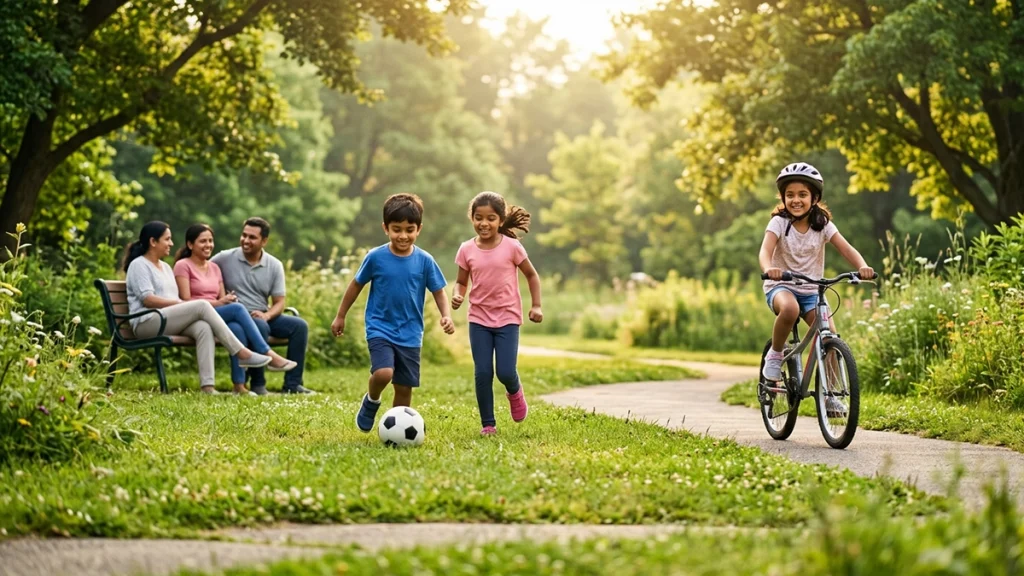
One easy practice which may prevent Myopia in Children is getting your kids to spend more time outside. While we don’t trade in the regular eye exams, it is noted that children who spend greater time out in the sun are less at risk for nearsightedness. At ASG Eye Care we put forth the idea that outdoor play is a key element in your child eye development which is right there with good nutrition, quality sleep, and school readiness.
Why Outdoor Activities Matter for Children’s Eyes
In order to prevent myopia in children it is key to see how a child’s eyes develop. During childhood the eye is still in the growth phase. If the eye grows too long from front to back the light focuses in front of the retina rather than right on it at which point distant objects become blurry which is what we know as myopia.
The outdoor environment seems to play a protective role in eye development. Also when at play children look at a variety of distant objects which gives the eyes a break from the continuous close work of reading, mobile phone use, tablets and homework. This is why outdoor time for eyes is now considered an important part of nearsightedness prevention.
Parents that wish to Prevent Myopia in Children should put in place a balanced daily routine. We are not talking of doing away with study or screen time totally, but to reduce long uninterrupted near work and to increase natural light which may be achieved through supervised outdoor play.
How Much Outdoor Time Is Helpful?
There isn’t a universal amount of time that will work for all children, but many eye care experts do recommend a daily total of 90 minutes to 2 hours of outdoor activity if at all possible. That time may be broken up into morning play, school recess, sports, cycling, walking, or evening games. What is important is consistency over time rather than a large block of outdoor time at once.
Regular outdoor time for eyes is very useful for kids that have a family past of myopia, spend lots of time with books or screens, or are already showing early signs of poor distance vision. If parents are trying to prevent Myopia in Children, outdoor play should be a daily affair rather than a weekend thing.
| Outdoor Habit | How It Supports Eye Health |
| Playing outside in natural daylight | Supports healthy eye growth and may reduce myopia risk |
| Looking at faraway objects | Gives the focusing system a break from close work |
| Running, cycling, or sports | Encourages distance viewing and physical activity |
| Taking outdoor breaks after study | Helps reduce eye strain from continuous near work |
| Limiting long indoor screen sessions | Supports better balance between near and distance vision |
Best Outdoor Activities to Prevent Myopia in Children
The best which are free and simple and which you can easily repeat. Kids don’t need to be in costly sports programs to see results. Free play in a safe outdoor setting will support child eye development and also reduce the time they spend inside on screens.
Outdoor sports like cricket, football, badminton, running, skipping, cycling, walking, and play in the playground are a great set of options. These activities get children to pay attention to moving targets, judge distances, and change focus between close in and out objects. That is in part what makes outdoor play a great tool in nearsightedness prevention.
To prevent myopia in children parents also may encourage them to go for a walk to the nearby places, to play in the park after school, or to spend some of the weekend outdoors. Also simple practices like looking at trees, buildings, clouds, and distant objects which break the routine of near work are recommended.
Screen Time, Study Time, and Myopia Risk
Today’s children spend more time indoors than past generations. They are in front of screens for online classes, mobile phones, games, and they are also studying for longer periods. While near work is a factor in myopia that is true, it isn’t the only cause that also plays a role is the lack of break from that close up focus which in turn may play a role in the myopia progression.
To prevent myopia in children, parents should push for breaks during study and screen time. A good practice is to get the child to step away from books or screens every 20 minutes and to look at distant objects. This doesn’t reverse myopia but what it does is give the eye a rest which in turn reduces visual fatigue. Also important is to increase the child’s outdoor time for eyes which in turn balances out the visual demand of the day. Instead of just cutting down on screen time the focus should be to trade in some indoor activities for healthy outdoor ones.
Signs Parents Should Not Ignore
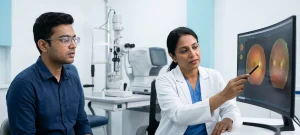
Outdoor play is a good idea but do not rely on it as a substitute for an eye exam. See a professional if your child is a frequent squinter, sits very close to the TV, holds books up very close, reports headaches, avoids outdoor sports, or has trouble copying from the board in class. Early diagnosis helps to prevent Myopia in Children from getting worse without notice.
If your child already has myopia an ophthalmologist can recommend the right glasses and also go over what you can do to either slow the progress down or at least monitor it.Managing myopia progression early is important because high myopia later in life may increase the risk of retinal problems, glaucoma, and other eye conditions.
| Warning Sign | What It May Indicate |
| Squinting to see far objects | Possible distance vision problem |
| Sitting close to screens | Blurred distance vision or eye strain |
| Headaches after reading | Uncorrected vision error or focusing strain |
| Poor school board visibility | Possible myopia |
| Frequent eye rubbing | Eye strain, allergy, or dryness |
| Avoiding outdoor play | Vision discomfort or poor distance clarity |
Outdoor Safety Tips for Children
While safety is a priority, outdoor activity is a must. It is advised that children not look directly at the sun. In very bright sun, wearing a cap and sunglasses is a good idea which is especially true for the afternoon peak. Also parents should pick out safe play areas and see to it that the child is drinking enough. We are after making outdoor activity a pleasure and a habit.
A child who has fun playing is more likely to do it often. This is also one of the best ways to prevent myopia in children without putting the child under pressure.
Can Outdoor Time Reverse Myopia?
Outdoor physical activity is a way to reduce the risk of myopia development, but by the time myopia has presented itself it is usually too late to reverse it. If a child is already wearing glasses, outdoor play is still a good idea, but also they require proper correction and follow up.
What we should tell parents is that outdoor time for eyes is a preventive and supportive measure which is not a substitute for treatment. For kids which do have myopia, doctors may recommend glasses, lifestyle changes and in some cases special myopia control options. The goal is to slow myopia progression and protect long term vision.
ASG Eye Care Approach to Children’s Myopia
At ASG Eye Care what we do is focus on early diagnosis, accurate prescription, regular monitoring, and parent education. Our doctors look at the child’s age, family history, screen time, outdoor activity levels, and rate of prescription change before we put together a care plan.
To Prevent Myopia in Children we tell parents to combine routine eye exams with health lifestyle changes. This includes more time spent outside, controlled screen use, proper study postures, good lighting, and prompt correction with glasses as needed. A total approach works better than relying on one habit alone.
Key Takeaway
The best way to prevent Myopia in children is to instill eye friendly habits at a young age. More time spent in outdoor play, breaks from close work, routine eye checkups, and reduction in excessive screen use support healthy vision. Though we can’t promise total prevention with outdoor activity, it does play a very important role in nearsightedness prevention and in the long term child eye development.
Parents should not delay until a child’s vision is very impaired. At the first notice of distance vision issues a pediatric eye exam is the best step. Early intervention gives us the best chance to prevent Myopia in Children from worsening silently.
Also Read : 10 Best Juices for Eye Health That Support Better Vision Naturally.
Best Vegetables for Eye Health: Improve Eyesight Naturally.
Best Foods for Kids’ Eye Development.
Frequently Asked Questions
1. Can outdoor activities really Prevent Myopia in Children?
Outdoor activities may decrease a child’s chance for myopia, also it’s particularly true when these are regular. We can not say that this will completely prevent myopia in each child but we do recommend that parents get their kids out there as part of a healthy eye care routine.
2. How much outdoor time is good for children’s eyes?
Many eye doctors will put forward that which is ideal is about 90 minutes to 2 hours of outdoor action daily if at all possible. This can be achieved through a number of activities like school break times, sporting events, walking, cycling or just free play in natural light
3. Does screen time increase myopia risk?
Long term exposure to near work which includes screen use is a factor which may cause eye strain and is associated with myopia risk. Also important for kids’ eye health are balanced screen habits, regular breaks, and time spent in outdoor play
4. Can myopia be reversed naturally?
Usually myopia does not reverse once it has developed. What we can do is diagnose early, use proper glasses, encourage outdoor activity and myopia control methods which will in turn help manage the condition and slow its progression.
5. When should I take my child for an eye check-up?
Take your child in for an eye exam if they are squinting, are sitting very close to screens, report headaches, having trouble seeing the classroom board, or are reporting frequent changes in vision. Also it is important to have regular exams even if symptoms are mild.