Many people assume that nearsightedness is a matter of wearing stronger glasses. But high myopia is far more than one may think. It is a health issue which requires close watch as it may cause very serious eye issues down the road.
At ASG Eye Hospital, one of the most common questions specialists hear is: What is high myopia and how does it differ from what we think of as regular myopia? In terms of degree of refractive error and long term impact on eye health that is where the difference is. Also by identifying high myopia early we empower patients to better protect their vision and to seek out the appropriate treatment at the right time.
What Is High Myopia?
To get a hold of what high myopia is you first must understand myopia which is a whole other issue. Myopia, also known as nearsightedness, happens when the eye grows longer than it is supposed to or the cornea is too rounded. This in turn causes light to focus in front of the retina instead of right on it which in turn causes distant objects to appear blurry. The National Eye Institute reports that myopia is developed due to the eye’s shape which in turn causes light to focus improperly on the retina. High myopia is usually a refractive error of -6.00 diopters or greater. In people with high myopia the eye is much longer than average which in turn increases the risk of retinal and other eye problems. Also to put it simply if you are asking what high myopia is it is a serious form of nearsightedness which goes beyond just blurred distance vision and may affect long term eye health.
How Common Is High Myopia?
High myopia is on the rise globally. In terms of our youth we see a consistent growth in cases of it. Also reporting from the National Eye Institute’s research which has noted a world wide increase in myopia which in turn is causing a large-scale increase in high myopia that has a high risk of retinal detachment, glaucoma and other sight which is threatening. Also because of this we are seeing an increased importance in what high myopia is for patients and parents.
Symptoms of High Myopia
The symptoms of high myopia can vary depending on the severity of the condition.
Common symptoms include:
- Blurred distance vision
- Frequent squinting
- Eye strain
- Headaches
- Difficulty recognizing faces from a distance
- Trouble reading road signs
- Increased dependence on glasses or contact lenses
Many people report that their myopia prescription is variable which in particular is an issue during growth years of childhood and adolescence.
If you have put forth the question what is high myopia, a consistent issue of blurred distance vision despite use of glasses may present the first symptom.
Why Is High Myopia More Serious Than Regular Myopia?
The issue with high myopia is not that patients require stronger glasses, it is that they have an increased risk of complications.
As the eye grows longer the retina and other internal structures become stretched out and thin. This makes people with high myopia more prone to develop permanent vision robbing eye diseases. High myopia is also a refractive and structural eye condition which means it affects not only the way light is focused but also the structure of the eye.
Complications of High Myopia
Patients with high myopia have a higher likelihood of developing certain eye problems compared to those with mild or moderate myopia.
Common Complications
| Complication | How It Affects Vision |
| Retinal Detachment | Can cause sudden vision loss if untreated |
| Myopic Macular Degeneration | Damages central vision |
| Glaucoma | May cause gradual vision loss |
| Early Cataracts | Can affect clarity of vision |
| Retinal Tears | Can lead to retinal detachment |
Studies report that high myopia is a great risk factor for retinal detachment, glaucoma, cataracts and also other vision threatening conditions. This is the reason why patients that are diagnosed with high myopia must never skip their regular eye exams.
Who Is at Risk of High Myopia?
Also which elements may increase the chance of developing high myopia.
Risk Factors
| Risk Factor | Impact |
| Family History | Higher genetic risk |
| Early-Onset Myopia | Greater chance of progression |
| Excessive Near Work | May contribute to progression |
| Limited Outdoor Time | Associated with higher rates of myopia |
| Rapid Prescription Changes | Requires monitoring |
Parents often ask about what is high myopia and also the issue of inheritance in children. Genes play a large role although environment also has a factor.
How Is High Myopia Diagnosed?
Diagnosing high myopia involves a comprehensive eye examination.
Your ophthalmologist may perform:
- Visual acuity testing
- Refraction testing
- Dilated retinal examination
- Eye pressure measurement
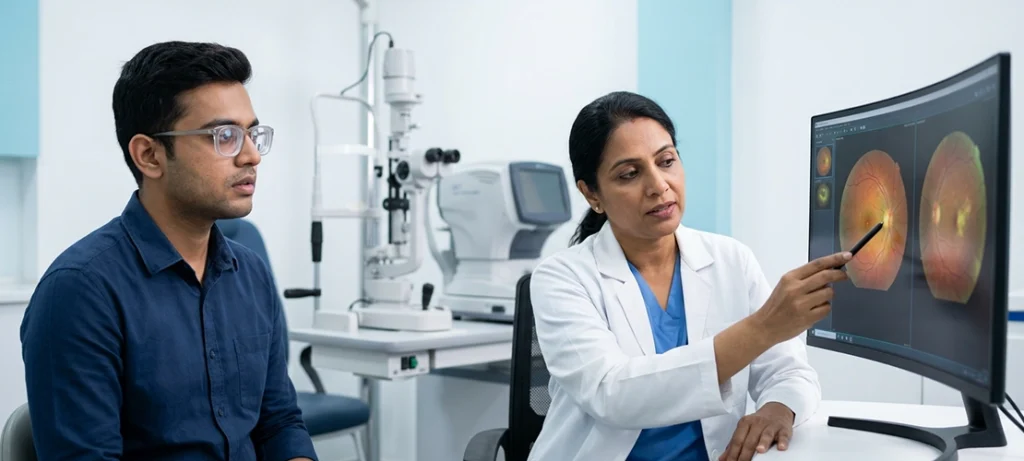
- Retinal imaging
- Axial length measurement
Because in high myopia which affects more than just vision clarity we evaluate retinal health which is a critical part of diagnosis. When patients ask what is high myopia we report that diagnosis which includes measurement of prescription power and assessment of the overall health of the eye.
Can High Myopia Be Treated?
Though high myopia may not be reversed it does have several treatment options which do improve vision and reduce dependence on glasses.
Treatment Options
| Treatment | Suitable For |
| Glasses | Most patients |
| Contact Lenses | Moderate to severe myopia |
| Orthokeratology | Selected cases |
| Myopia Control Treatments | Children and teenagers |
| Refractive Surgery | Eligible adults |
| Lens-Based Procedures | Very high prescriptions |
The right treatment depends on age, eye health, prescription stability, and lifestyle.
Is Refractive Surgery an Option?
Many adults with high myopia turn to refractive surgery to reduce their use of glasses. Today we see that modern refractive surgery techniques do very well for those that are right for the procedure. But also it is important to note that not all high myopia patients are good candidates for surgery.
Factors considered include:
- Corneal thickness
- Eye prescription
- Retinal health
- Dry eye status
- Overall eye condition
A detailed evaluation is essential before recommending any form of refractive surgery.
Can LASIK Eye Surgery Treat High Myopia?
Many of our patients ask if we do in fact perform LASIK for high myopia. What we find is that it depends on the degree of my vision which is impaired and the health of the cornea. In the case of LASIK we use a laser to reshape the cornea which in turn causes light to focus properly on the retina. Also according to the National Eye Institute we are among the providers of laser treatment options for adult myopia. While we may do LASIK for high myopia in some cases we also see better results in other patients who try out the implantable collamer lenses (ICL) or other lens based solutions. A full consultation is the best way to determine if in fact LASIK is the best and safest option for you.
Can High Myopia Cause Blindness?
This is a very frequent issue we see in our patients. High myopia comes into play in a large number of cases but that doesn’t mean that a person will go blind. That said, if left untreated these myopic complications may cause severe visual impairment. The key is in early detection and regular retinal check ups. If you know what high myopia is and are aware of its risks you greatly improve your long term results.
When Should You See an Eye Specialist?
Schedule an eye examination if you experience:
- Sudden flashes of light
- New floaters
- A curtain-like shadow in vision
- Rapid prescription changes
- Distorted central vision
- Difficulty seeing despite updated glasses
People with high myopia should undergo routine retinal evaluations even when no symptoms are present.
High Myopia Care at ASG Eye Hospital
At our ASG Eye Hospital we have specialists which provide in depth evaluation and management for high myopia. We go beyond just treating blurred vision to include the assessment of retinal health, prevention of complications, and we present the best treatment options for each patient. If a patient is a candidate for glasses, contact lenses, refractive surgery or is looking into LASIK we tailor our treatment plans to that individual’s needs.
Key Takeaways
- High myopia is a very severe form of nearsightedness which usually is at a level of over –6.00 diopters.
- It is important to understand what high myopia is as it brings in more than just the issue of blurry vision.
- What we see in high myopia is an increased risk of retinal detachment, glaucoma and myopic macular degeneration.
- Very important are regular eye exams which play a key role in the early detection of complications.
- We also see that refractive surgery and LASIK are options for some patients post in depth evaluation.
- Early diagnosis and ongoing care plays a key role in preserving vision and quality of life.
Frequently Asked Questions
1. What is high myopia?
It is a very severe form of nearsightedness which at the -6.00 diopter mark or above is classified as such. Also it increases the risk of retinal and other eye complications.
2. Is high myopia dangerous?
Yes. While in many cases high myopia does not cause issues with vision correction, this condition does increase the risk of retinal detachment, glaucoma, cataracts, and myopic macular degeneration.
3. Can high myopia be cured?
There is at present no permanent solution to high myopia, but vision can often be corrected with the use of glasses, contact lenses, refractive surgery, or other advanced procedures.
4. Is LASIK eye surgery suitable for high myopia?
Some patients that have high myopia may be good candidates for LASIK eye surgery, also many may do well with other vision correction options. A full eye exam is required to see what will work best.
5. At what prescription is myopia considered high?
Generally what eye specialists do is consider high myopia to be a refractive error of -6.00 diopters or greater.
References
- National Eye Institute – Nearsightedness (Myopia) https://www.nei.nih.gov/learn-about-eye-health/eye-conditions-and-diseases/nearsightedness-myopia
- National Eye Institute – Myopia Research & High Myopia Risks https://www.nei.nih.gov/about/news-and-events/news/myopia-close-look-efforts-turn-back-growing-problem?utm_source=chatgpt.com