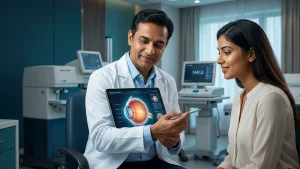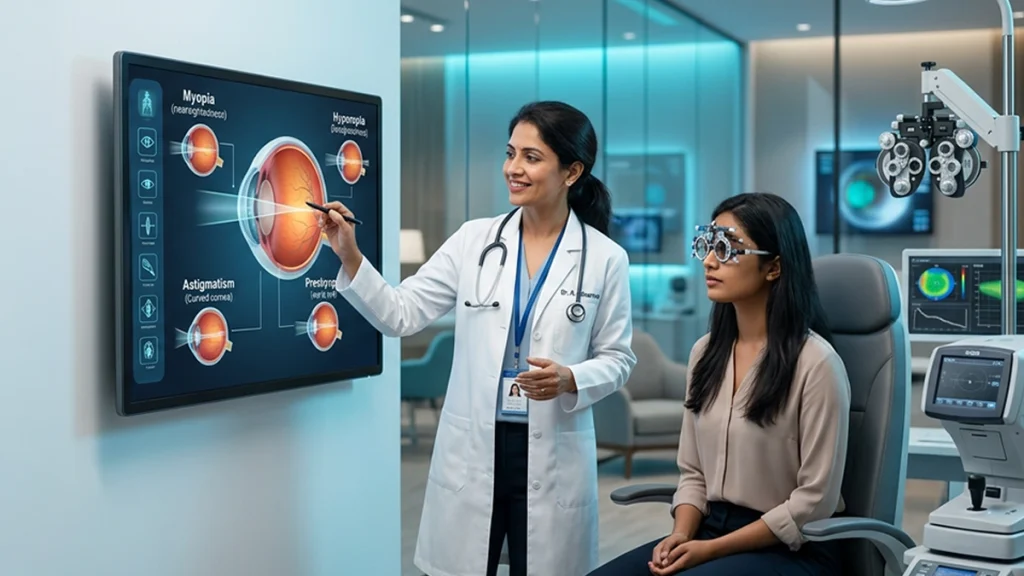
Clarity of vision is a result of light which focuses precisely on the retina, the light sensitive tissue at the back of the eye. When the eye’s shape causes light to focus imperfectly, this is what we term refractive errors. These are by far the most common eye issues which affect children, adults and older people.
Many of our patients first see us for blurry vision when reading, using their phone, during the time they drive, or when looking at what is on the classroom board. We do a basic eye refraction test which also helps us to determine which vision correction glasses, contacts, or something else will work best for the individual. At ASG Eye Care we don’t just put in a prescription, we also try to determine what is the cause of the patient’s symptoms and present the safest solution for them.
What Are Refractive Errors?
Refractive errors are when the cornea, lens, or total eye length does not bend light properly. Instead of focusing directly on the retina light may focus in front of it, behind it, or at several points instead. This makes images appear blurry, distorted or hard to focus on.
The most common forms of which are myopia, hyperopia, astigmatism, and presbyopia. Myopia which is also called nearsightedness in which distant objects appear to be blurred. Hyperopia also known as farsightedness in which near objects may become hard to see and cause fatigue. Astigmatism which is a result of an irregular curvature of the cornea or lens which in turn causes distorted focus. Presbyopia is an age related issue which makes near focus difficult usually beginning in the 40’s.
Although we can correct refractive errors they should not be ignored. In children, undiagnosed focus issues may play a role in learning and confidence. In adults they may cause issues with work comfort, screen use, and driving safety. Regular eye check ups are key to maintaining clear vision also to rule out other eye problems.
Types of Refractive Errors
| Type | What happens | Common experience | Usual correction |
| Myopia | Light focuses in front of the retina, often because the eye is longer than normal. | Distance, blurry vision, squinting, and difficulty seeing far objects. | Glasses, contact lenses, or laser correction in suitable adults. |
| Hyperopia | Light focuses behind the retina, often because the eye is shorter than normal. | Near work causes strain, headaches, or tired eyes. | Glasses, contact lenses, or selected surgical options. |
| Astigmatism | The cornea or lens has an uneven curve, so light focuses unevenly. | Distorted or shadowed vision at near and distance. | Cylindrical glasses, toric contact lenses, or laser correction if suitable. |
| Presbyopia | The natural lens loses flexibility with age. | Reading small print becomes difficult after middle age. | Reading glasses, progressive lenses, or selected lens procedures. |
This table provides a basic look at refractive errors, which we must note are often present in combination in the same patient. We see that some have nearsightedness which also includes an irregular corneal shape, others have far sightedness along with presbyopia. That is why a full and proper eye exam is so important.
Symptoms That Should Not Be Ignored
The primary symptom of refractive errors is blurry vision, which in turn gives us a clue to the type of issue present. If you have trouble with close work that causes strain, hyperopia may be the reason. If letters appear stretched out, double, or uneven, astigmatism may be the cause.
Patients also report headaches, eye strain, watering, poor night vision, glare, or difficulty with focus between the near and far. Kids may sit very close to the screen, copy poorly from the board, avoid reading, or rub their eyes frequently. Adults report fatigue after laptop work or a sense of danger while night time driving due to blurry vision.
Not at every turn is blurry vision a result of glasses power. Sudden vision changes, eye pain, redness, flashes, floaters, or loss of side vision require a trip to the doctor as they may be a sign of a different eye condition.
What Causes Refractive Errors?
The primary reason for refractive errors is a difference between the eye’s shape and its focusing power. In hyperopia the eye may be shorter than average or the focusing power weaker. In astigmatism, the corneal or lens surface is to an unequal degree.
Family history is a large factor in development of myopia. Also it is the case that the number of close work hours and the little time spent outdoors are factors in progression which we see in primary age groups. Farsightedness may present in early life, also a non-even cornea of the eye may present from birth or develop later as the cornea changes. In some people what we term focusing errors is a static issue through their life while in others it is a dynamic which changes with age, growth, diabetes, pregnancy, cataracts or eye surgery.
Why Refraction Testing Is Important
An eye refraction test measures the eye’s focus ability also which in turn helps to determine the appropriate power of glasses or contact lenses. In an eye refraction test, the patient reads out letters or symbols which at the same time are covered by various lenses to identify the best possible vision.
For a large number of people this is the first stage in which a refractive error is diagnosed via this test, but it is also a part of a full eye exam. Also the doctor may check into eye pressure, corneal health, eye alignment, retina health, and tear film quality. Which in turn helps to confirm if the symptoms are from a focusing issue or some other eye problem.
In some cases of children we may see that they require a special eye refraction test post dilation of the pupils which is to account for the fact that their focusing muscles may be at play hiding the true power of correction. Also adults who experience frequent changes in power of their glasses, have diabetes, eye strain or in fact unexpected blurry vision may also do well to have a more in depth evaluation which goes beyond a routine prescription check.
Vision Correction Options
| Option | How it works | Suitable for | What patients should know |
| Glasses | Lenses correct the focusing error from outside the eye. | Most patients with myopia, hyperopia, or astigmatism. | Safe, simple, and useful for all age groups. |
| Contact lenses | Lenses sit on the eye surface and move with the eye. | Active adults and selected patients with higher powers. | Hygiene and regular follow-up are essential. |
| Laser vision correction | The cornea is reshaped to reduce dependence on glasses. | Adults with stable power and healthy corneas. | Screening is necessary before LASIK, PRK, or SMILE. |
| Lens-based procedures | A lens implant or replacement corrects focusing. | Selected patients not suitable for laser treatment. | Used in specific cases after detailed assessment. |
Glasses are the primary solution for refractive errors. For some patients which include those with active lifestyles contact lenses do perform better. Laser vision correction does help in the case of selected adult patients although it isn’t for all. Before going in for surgery a detailed corneal scan and eye refraction test is a must.
When Should You Visit an Eye Specialist?
Glasses are the primary solution for refractive errors. For some patients which include those with active lifestyles contact lenses do perform better. Blurry vision correction does help in the case of selected adult patients although it isn’t for all. Before going in for surgery a detailed corneal scan and eye refraction is a must.
Glasses are the primary solution for eye refraction test errors. For some patients which include those with active lifestyles contact lenses do perform better. Laser vision correction does help in the case of selected adult patients although it isn’t for all. Before going in for surgery a detailed corneal scan and eye refraction is a must.
Eye Care for Refractive Errors at ASG Eye Care
At ASG Eye Care we have a step by step approach which includes taking into account the patient’s medical history, performing visual acuity tests, eye refraction tests, and also in depth eye exams as required. We aim to determine the root cause of your visual issues and put forth a correction solution which is best for the patient’s age, lifestyle, and eye health.
For those with nearsightedness doctors focus on clear distance vision and tracking progression. In the case of farsighted patients we look at near vision comfort and eye strain. With uneven corneal curvature accurate measurement of cylindrical power and axis is key which even small changes in that do affect clarity. If the issue is not a simple refractive error, the patient is referred on to other eye care options.
Key Takeaway
Refractive errors are a type of focus issue that may affect distance vision, near vision, or over all clarity. Myopia, hyperopia, and astigmatism are treatable but an accurate diagnosis is key. A timely eye refraction test will determine the right treatment and also may reduce blurry vision, eye strain, and day to day discomfort.
The key is to not guess at the number of glasses or delay care. With proper evaluation refractive errors which are usually present can be managed well with glasses, contact lenses, or advanced vision correction options in appropriate patients.
Frequently Asked Questions
1. What are refractive errors?
Refractive errors are issues of the eye in which light does not focus correctly on the retina. They include myopia and hyperopia which are better known as nearsightedness and farsightedness, also irregular corneal curvature and presbyopia. These issues may result in poor vision, headaches, and eye strain.
2. Is myopia the same as nearsightedness?
Yes. Myopia is what we term nearsightedness. What it has is that the affected person sees nearby things very well but has trouble with distance which includes road signs, classroom boards, or movie screens.
3. Can hyperopia cause headaches?
Yes. Hyperopia causes headaches which present themselves after reading, computer use, or other near work. Also some people with this issue may see clearly at first which is followed by their eyes’ greater effort to maintain focus.
4. Is astigmatism serious?
Astigmatism is mostly not a serious issue and we can correct it with glasses or contact lenses. But if the cylindrical element is variable or is causing distorted vision the doctor may run tests to check the cornea for other issues.
5. How often should I get my eye power checked?
An eye refraction test is put forth which when vision changes, glasses feel uncomfortable, headaches present, or children show signs of difficulty in seeing. Also many patients do well from a yearly eye check up which we also see to do if you are in the habit of wearing glasses.
6. Why is vision still unclear with glasses?
Blurred vision in which glasses are used may be a result of out of date prescription, improper frame fit, dry eyes, or some other eye issue. An eye exam is recommended to determine the exact cause.