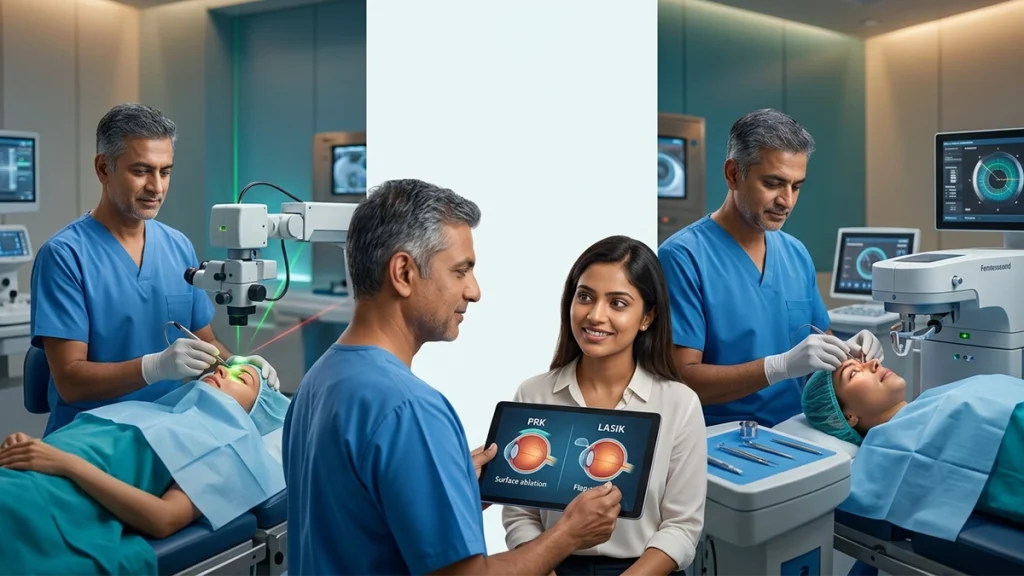
When at the eye care clinic ASG Eye Care which is a patient’s goal to reduce dependency on glasses or contacts they often ask about PRK vs LASIK. We perform both of these procedures which are for correction of refractive errors like nearsightedness, farsightedness and astigmatism. Though we use advanced lasers to reshape the cornea in both, we differ in the preparation of the cornea before the procedure.
This is that PRK vs LASIK isn’t a simple “which is better” issue. With LASIK surgery we make a thin flap in the cornea which then the laser acts on. In PRK eye surgery at first we remove the outer epithelial layer from the cornea surface, then do the laser work. Also both are forms of laser vision correction, also they fall into the category of refractive surgery, but what is right for you depends on your corneal thickness, eye surface health, lifestyle, profession and recovery expectations.
A patient that has healthy corneas and a very busy work schedule may be put forward as one option, while those who have a thin corneal tissue or are into active sports may be given different advice. At ASG Eye Care we focus not only on 20/20 vision but also on what is safe, comfortable, and what will suit each individual. There isn’t a one size fits all procedure which is why a thorough consultation is what really counts more than just going in for what is the most popular. The decision between PRK vs LASIK should always be a very personal one because safe refractive surgery is a result of a precise diagnosis, not a guess.
Understanding LASIK
In which a flap is created on the cornea is what is usually done in LASIK surgery Once the flap is lifted what follows is the use of an excimer laser which in turn reshapes the inner corneal tissue. The flap is put back in its place which it does so to stay without the use of stitches. This is also the reason many patients see improved vision right away.
In the issue of PRK vs LASIK, what we see is that faster recovery is the primary reason people bring up LASIK. Many patients are back to their routine activities in a short while though they still are to use eye drops as prescribed, wear eye protection, and come in for follow up visits. Also it may be that LASIK surgery is a good fit for adults with stable power, sufficient corneal thickness, and healthy corneal shape.
However, not everyone is a candidate for LASIK. Patients with very thin corneas, severe dry eye, abnormal corneal maps, or certain lifestyle related risks may do better with a different approach. A detailed evaluation is required before any decision is made.
Understanding PRK
PRK eye surgery which is short for Photorefractive Keratectomy is one of the first and most reliable types of laser vision correction We create a thin surface layer in the cornea instead of a flap like in other methods of which there are many in PRK we remove the epithelium that is the surface layer then apply the excimer laser to the corneal bed. Also we will place a contact lens post procedure for a few days to aid in the healing process.
When looking at PRK vs LASIK, what we see is that recovery is the greatest difference for patients. In PRK the surface layer which is affected takes time to heal, thus patients may have issues like watering, irritation, light sensitivity, and blurred vision for a few days. Vision does improve but it is a gradual process which plays out over days to weeks.
PRK eye surgery has the advantage that it does not create a flap; this may also make it a good option for patients with thin corneas or who are in professions which see a lot of eye impact. For the right candidate PRK can provide stable and clear vision into the long term.
Main Difference Between the Two Procedures
Although the same laser technology which they use for cornea reshaping PRK vs LASIK differ in surgery approach. With LASIK we go under a flap and with PRK we start from the surface. This difference plays into comfort, recovery time, which procedure is best for what person and early visual recovery.
| Comparison Point | LASIK | PRK |
| Surgical approach | LASIK surgery uses a corneal flap before laser reshaping. | PRK eye surgery treats the corneal surface after epithelial removal. |
| Recovery pattern | Vision usually improves faster. | Vision improves more gradually. |
| Early comfort | Mild irritation is common. | More discomfort may occur during early healing. |
| Corneal flap | A flap is created. | No flap is created. |
| Clinical role | Often suitable when corneal thickness is adequate. | Often considered when flap creation is not ideal. |
This table presents that PRK vs LASIK should be determined by in depth study as opposed to what is put forth on the internet. What may at first seem like the simpler option may in fact present more risk for a given set of eyes.
Which Gives Better Vision?
In certain patients we see very good results from either procedure. The aim of laser vision correction is to reshape the cornea which in turn improves light focus on the retina. While in many cases the visual result of PRK vs LASIK may be the same, the healing process is different.
LASIK surgery also reports faster recovery of vision which in turn may make it a better fit for those that want to get back to work quickly. In PRK eye surgery we see that recovery takes longer but at the same time it may be what you choose when it comes to conservation of corneal strength. That said, the decision between the two should be based on clinical evaluation and not which one has a quicker recovery. At this point PRK vs LASIK is a medical decision rather than a cosmetic one.
A good approach to refractive surgery is to perform corneal topography, corneal thickness measurement, tear film assessment, pupil evaluation, prescription stability review, and if required retinal exam. These tests allow the doctor to determine if the eye is a good candidate for laser treatment and which procedure is the safest.
Who May Be a Good Candidate for LASIK?
A patient is a good fit for LASIK surgery if the prescription has stabilized, the cornea is of a sufficient thickness, the eye health is fine, and the corneal map is normal. While many people ask for info on which it is true that LASIK is right for them, we stress that the final decision is based on clinical evaluation.
In the PRK vs LASIK comparison, LASIK is the choice for patients that have a suitable cornea and are looking for a quick return to normal activities. However the doctor must first rule out dry eye, keratoconus risk, unstable prescription, and other eye conditions before giving a recommendation.
Who May Be a Good Candidate for PRK?
In the PRK eye surgery comparison, LASIK is the choice for patients that have a suitable cornea and are looking for a quick return to normal activities. However the doctor must first rule out dry eye, keratoconus risk, unstable prescription, and other eye conditions before giving a recommendation.
In the PRK vs LASIK study we find that PRK is not a deficient or outdated option. It is a different approach which has a different healing process. Some patients do report more extended recovery time but what we see is the same end result of clear and stable vision.
Recovery and Aftercare
Recovery is a key aspect of choosing between PRK vs LASIK. With LASIK we see that many patients report improved vision almost right away. Also some may have issues like dryness, mild glare, or vision which fluctuates in the first few weeks. It is important for follow up visits and to use lubricating drops.
After PRK which is the first few days’ post op may be uncomfortable as the surface is in the process of healing. Patients may require rest, medication, protective lenses, and regular follow up. Improvement is gradual which means that patience is key during this phase.
| Recovery Factor | LASIK | PRK |
| Early vision | Often improves within a few days after LASIK surgery. | Improves gradually after PRK eye surgery. |
| Initial discomfort | Usually mild. | Usually more noticeable for a few days. |
| Return to work | Often sooner, depending on comfort. | May take longer depending on healing. |
| Follow-up need | Important for dryness and flap assessment. | Important for surface healing and haze prevention. |
| Final goal | Clearer vision through laser vision correction. | Clearer vision through laser vision correction. |
The recovery time is a key factor in the choice between PRK vs LASIK. While a faster recovery is a plus point, what really counts is safety and suitability.
Possible Risks
Like that which is true of all eye procedures, refractive surgery has issues which may present themselves. These may be dryness, glare, halos, undercorrection, overcorrection, infection, inflammation, delayed healing, or the need for a follow up procedure. In the case of LASIK we see flap related issues also play a role, in PRK instead we pay close attention to the healing of the surface and the prevention of haze. This is not to say that patients should be scared off treatment.
This is not to say that patients should be scared off treatment. What it does mean is that they should do their research and choose the right eye hospital, go through proper screening, and follow post op instructions. The safety of laser vision correction is very much a function of patient choice and follow up. In each type of refractive surgery procedure we do well to understand the benefits as well as the limitations which will in turn put patients in a position to make a confident decision.
Vision Correction at ASG Eye Care
At ASG Eye Hospital we present PRK vs LASIK in terms that our patients will understand after we do a in depth diagnostic work up. We check corneal thickness, corneal shape, tear film, eye power, pupil size and overall eye health which allows us to recommend between LASIK surgery, PRK eye surgery or some other treatment option.
The aim is to push for laser vision correction only when it is appropriate and we see it as the best option. This protocol between PRK vs LASIK we put forward to the patient makes for clear communication and also is a way to practice responsibility in performing refractive surgery. Some patients do better with LASIK, some with PRK, and some may be told to forgo laser treatment if the eye does not present the ideal candidate. We take responsibility in making refractive surgery decisions which first and foremost protect the eye and second improve vision. Safe refractive surgery begins with the right diagnosis.
Final Takeaway
The best option for PRK vs LASIK is based on your eye health. LASIK may provide quicker recovery times, also there are cases where PRK is the choice for some types of corneas and lifestyle. In certain conditions, both options can be the right one for the patient if that person is very careful in choosing and the procedure is thoroughly planned.
If you are thinking about LASIK surgery or PRK eye surgery eye surgery do not base your decision only on cost, recovery time, or what someone else had done. A full eye exam is the only way to determine what form of laser vision correction is right for you. The best choice in refractive surgery is the one which provides you clear vision and at the same time preserves your long term eye health.
Frequently Asked Questions
1. Which is better, PRK or LASIK?
In terms of PRK vs LASIK what we see is that there is no clear winner between the two. LASIK reports faster recovery time which is a pro. PRK may be the better choice for patients with thin corneas or very active lifestyles at risk of injury to the eye. Your doctor will base the recommendation on which is best for you after a detailed exam.
2. Is PRK more painful than LASIK?
PRK may have more discomfort in the first few days as the surface of the cornea is healing. With LASIK you generally do better early on. That said both procedures are managed with the use of medications and follow up care to make the recovery go more smoothly.
3. Does PRK give the same result as LASIK?
For appropriate candidates PRK and LASIK do very well at achieving great final results. What usually differs is the recovery. PRK has a longer stabilization time which may take months, while LASIK tends to present better early on.
4. Who should avoid LASIK?
In some cases we see patients with thin corneas, severe dry eye, unstable prescriptions, abnormal corneal shape, or certain eye diseases which do not make them good candidates for LASIK. In those cases we may discuss PRK or another option after doing some tests
5. Is laser treatment permanent?
The laser treatments which we do during the course of care are permanent but that does not mean that other age related changes in the eye will not happen. You may still develop reading glasses, cataracts or other eye issues as you age.
6. How should I decide between PRK and LASIK?
The best way to determine between PRK and LASIK is to have a full corneal and vision assessment. Your surgeon will go over what is suitable for your eyes and which method of refractive surgery is best — flap based or surface based.