Can it be cured? To be honest that which is genetic in nature and is present from birth the issue of albinism itself does not fully reverse. But we have very good albinism treatments which do make a difference in how a child or an adult sees out of their eyes, how they learn, how they read, how they move around and go about their daily lives. At ASG Eye Care we don’t just in and out diagnose we are into practical vision care eye care which supports the person at each stage of life.
Albinism is a disorder which affects pigmentation in the skin, hair and eyes. In many cases the eye issues are the primary issue with the condition as melanin is involved in normal eye development. This is the reason that ocular albinism may cause decreased sharpness of vision, light sensitivity, nystagmus, and problems with depth perception. Albinism symptoms may present differently in each person, which is why albinism treatment should be tailored after a full eye exam.
What Is Albinism?
Albinism is a hereditary condition which sees the body produce little or no melanin. Melanin colors our skin, hair and eyes, also it plays a role in the development of the retina and visual pathway. When there is less melanin present the eyes may not develop as they should and this can result in life long vision issues. That is why in albinism treatment we focus mostly on protecting the eyes, improving what vision is present and helping the patient to function better instead of a genetic cure.
There are various types of albinism. Oculocutaneous albinism which affects the skin, hair and eyes is one type, another which is ocular albinism mainly affects the eyes and may also have very mild skin or hair changes. In some which are diagnosed as having only eye albinism the external features may not be very tell tale. We see that regular eye care is key, early diagnosis which in turn helps families to better understand the issue and to get support at the right time.
Common Eye Problems Seen in Albinism
The life at which eye problems in albinism present is from an early age. Many times parents will see that the child’s eyes are moving very fast, the child has aversion to bright light, or the child is very close to what they are reading and looking at. These are not what may be at first thought to be habits or behavior issues; they are in fact signs that the visual system requires in depth assessment. A full albinism treatment care plan looks at visual acuity, refraction, eye movement, light sensitivity, retina development, and the need for low vision support.
| Eye problem linked with albinism | What it means for the patient |
| Nystagmus | The eyes move involuntarily, which can make focusing difficult. |
| Reduced visual acuity | Vision remains blurred even with standard glasses, although glasses may still help. |
| Photophobia | Bright light causes discomfort, glare, and reduced visual clarity. |
| Strabismus | The eyes may not align properly, affecting binocular vision. |
| Foveal hypoplasia | The central retina may be underdeveloped, causing reduced sharp vision. |
| Refractive error | Nearsightedness, farsightedness, or astigmatism may require glasses or contact lenses. |
| Poor depth perception | Judging distance may be difficult, especially while walking, playing, or using stairs. |
These issues are what we see in albinism treatment which is why we start with a detailed eye exam. Glasses may not in itself be the solution but they are the base of our vision care. Should we need it, we add in low vision aids, tinted lenses, school support and eye movement training to the plan.
Can Albinism Be Treated Completely?
Presently there is no treatment which restores normal melanin production in the body or which fully reverses the eye changes that come with albinism. That said, if by “cure” you mean a total elimination of the condition from the body’s system then we do not have a cure. But if treatment is to ameliorate symptoms, to improve quality of life, to reduce glare, correct refractive errors, and to help a person child or adult to function better then albinism treatment is very much a going concern.
For the great majority of patients the aim of albinism treatment is to improve useful vision. This may include the use of prescription glasses, contact lenses in some cases, tinted or photochromic lenses, caps or hats for glare, and structured low vision rehabilitation. In some people with ocular albinism surgery may be considered for strabismus or abnormal head posture related to nystagmus, but it is important to note that surgery does not cure albinism itself. It is resorted to only when it improves alignment, comfort, or function.
Recognising Early Signs
Early detection is key. In some cases of albinism symptoms present at birth, in other they develop as the child grows. Parents may see pale eyelids, very light eye color, extreme sensitivity to sun, constant eye movements, delayed visual attention, or issues in recognizing faces from a distance. Also children with ocular albinism may sit very close to the TV, bring books very near to the face, or have trouble in bright class rooms.
The issue is that albinism symptoms may present as poor attention, reading delay, or simple refractive error. That is why we see value in a pediatric ophthalmic exam when there is nystagmus, light sensitivity, poor tracking, or unexplained reduced vision. Timely implementation of an albinism treatment care plan does not only improve eyesight; it also supports learning, confidence, and emotional development.
Care Options for Albinism
Good for albinism is that there isn’t a single treatment. It is a long term plan which grows with age, schooling, work requirements, outdoor activity, and visual needs. A child may require seat placement in the class and large print material, an adult may need glare control, work place changes or advanced low vision devices. The best approach to albinism treatment is practical, realistic, and a regular review.
| Management option | How it helps in albinism |
| Prescription glasses | Corrects refractive error and improves the clearest possible vision. |
| Tinted or photochromic lenses | Reduces glare and improves comfort in bright light. |
| Contact lenses | May help selected patients with refractive error or glare control. |
| Assistive vision aids | Magnifiers, telescopes, electronic devices, and reading tools improve daily function. |
| School support | Large print, front-row seating, digital learning aids, and extra time can support children. |
| Strabismus treatment | Helps eye alignment when squint is present. |
| Nystagmus management | May include glasses, posture guidance, or surgery in selected cases. |
| Regular eye reviews | Tracks changes, updates prescriptions, and adjusts vision care needs over time. |
Patients that have low vision should not be told we are at a loss to improve their condition. Though vision may not return to normal we can greatly improve in reading, mobility, in performance at school and in independence. This is a key element of today’s albinism treatment.
Role of Functional Vision Support
In the case of albinism it is a misinterpretation to think that a person is totally blind. What we see is that vision is affected even after standard treatment which is given, but what is left of the sight may be used if given the right support. For children with reduced vision we see that they may do better with large print books, digital screens, high contrast material, proper lighting and to sit near to the board. As for adults with reduced vision they may use magnifiers, screen readers, adjust contrast settings, and wear tinted lenses.
A good care plan for albinism treatment which we see is to include counseling. Many patients report that they are frustrated when glasses don’t restore normal vision. What the doctor does in this case is to go over what glasses can do which is to improve vision and what they can’t which is not to change certain issues, also to introduce low vision devices which make daily tasks easier. This practical advice which we may term as therapy is what turns a person to either be dependent or very confident.
Eye-Specific Albinism and Care
Ocular albinism is a condition which requires special attention as it primarily affects the eyes. It may be that a person does not have very pale skin or hair which is a common sign of albinism, yet still present with very noticeable eye issues. Visual acuity reduction, nystagmus, photophobia, and poor depth perception are common. Also because this is a genetic condition, family history may play a role and some families may benefit from genetic counseling.
For patients of ocular albinism, albinism treatment is a routine of regular ophthalmic check ups, use of proper glasses, glare control and functional support. Also in children it is a practice to include parents and teachers in vision care which in turn will see the child not labeled out as careless or slow. Many kids with inborn eye pigmentation issues do well when the classroom and what they use to learn is made to suit their visual needs.
Skin and Sun Protection Also Matter
Although we focus on the eyes here, it is also very important to protect the skin which is an issue in many types of albinism. Those with less melanin have greater risk of sun damage and may require sunscreen, protective clothing, wide brimmed hats and regular skin checks. Eye care should also be included in overall health advice. A full albinism treatment care plan must include sun protection for the eyes and the skin.
Bright sunlight may in fact increase albinism symptoms like glare and photophobia. Tinted glasses, UV protective sunglasses, and hats can improve outdoor comfort. While these measures may not affect the base condition they are very much a part of daily eye care.
Eye Care at ASG Eye Care
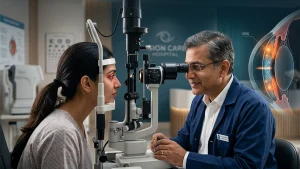
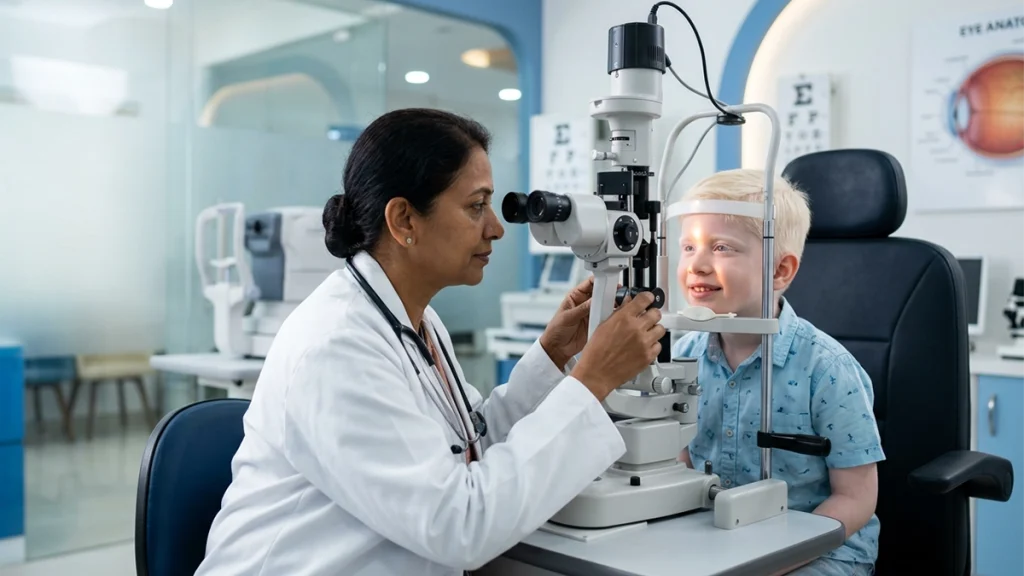
At ASG Eye Care we start albinism treatment with an in depth eye and visual function evaluation. We may do vision testing, refraction, retina exam, eye movement study, squint evaluation and we also discuss light sensitivity. For kids we look at how vision plays into school, reading, play and confidence. This in turn helps us create a care plan which is practical in the real world and not just on paper.
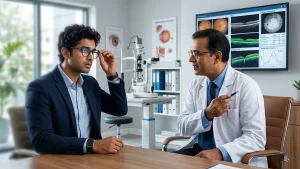
Our doctors go into detail on what albinism symptoms are in terms that any family can understand why the child may hold things at arm’s length, avoid very bright lights, and do poorly with distance vision. As for low vision support we put patients in touch with the best resources and which at home solutions will work best. In patients with ocular albinism we advocate for regular follow up which in turn helps us to identify changing needs and to adjust prescriptions or support equipment as the patient grows.
Long-Term Outlook
Most of us that have albinism have a lifetime of vision issues, but the disease itself doesn’t usually progress as do some eye diseases. Vision may be poor, which is a given, but with the right albinism treatment, many patients do very well in study, work, travel, and living very active lives. What is key is early diagnosis, realistic expectations, good vision care, and consistent follow up.
Families must address academic issues as they arise instead of when they are very serious. If albinism symptoms are at issue, early checkups can prevent delays which in turn cause problems. In terms of the adult population, new eyewear, measures for reducing glare, and assistive devices still improve daily life quality despite that some of these may have had this condition from a young age.
Key Takeaway
Albinism does not have a cure but it is very much managed. In terms of albinism treatment, what we do is improve what usable sight there is, reduce glare, correct refractive errors, support learning, and protect long term eye health. It doesn’t matter if it is oculocutaneous albinism or ocular albinism, what we see is that patients do best with structured vision care and timely low vision support. If we recognize the signs early we are able to get the right help out to the family at the right time.
Frequently Asked Questions
1. Can albinism be treated?
Yes we have methods to manage albinism which we have at present but we do not have a cure for it. Treatment is directed at improving what vision is usable with the use of glasses, glare control, assistive vision devices, eye alignment care and regular follow up. The genetic cause we do not have a way to reverse that at present but what we can do is greatly improve quality of life with the right support
2. What signs should families look for?
Common signs of albinism symptoms include impaired sharpness of vision, light sensitivity, involuntary eye movements, squint, poor depth perception, and pale skin, hair, or eye color. In ocular albinism the eye issues may present more greatly than skin or hair changes.
3. Is eye-only albinism different from other types of albinism?
Yes. Ocular albinism is a disease that affects the eyes while oculocutaneous albinism affects the eyes, the skin, and the hair, which is a greater range of what is affected. Also, in both cases vision is reduced and care may be a long term requirement.
4. Can reduced vision from albinism improve?
Low vision from albinism typically is not made fully normal but we see that it may be managed better in many cases. We have glasses, magnifiers, electronic tools, colored lenses, and changes at the school and work place which help patients to use what vision they do have more efficiently.
5. Does every child with albinism need special education?
Sometimes not. Many children with albinism do study in regular schools when they have access to proper vision care, classroom support, seating changes, large print material, and functional support devices if required.
6. When should someone visit an eye doctor for albinism?
An ophthalmologist should be reported to at the first sign of albinism symptoms which include nystagmus, light sensitivity, poor visual attention, or reduced vision. Early intervention in albinism treatment is key for families to better prepare for learning and daily life.