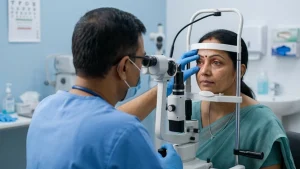

Many of my patients report to be confused when they have blurry vision with glasses which they have just received. It is expected that glasses will improve vision and so persistent blurriness leaves them to wonder if the prescription is incorrect or if there is some serious internal issue with the eye. In many cases, blurry vision with glasses is caused by a power discrepancy, an issue with the way the lens is set or the eye taking time to adjust. Also it may be related to dry eye, early cataract, diabetic changes or some other condition.
At ASG Eye Care we see that many of our patients had success with their previous pair of glasses but are now having trouble with tasks like reading, driving, and computer work. Blurry vision with glasses that doesn’t improve or in fact gets worse should not be brought in.
Why Can Vision Stay Blurry Even After Wearing Glasses?
Glasses are used for correction of myopia, hyperopia, astigmatism, and presbyopia. But if your current prescription is out, the frame does not fit right, or there has been change in your eye’s structure, blurry vision with glasses may still remain. At times the prescription may be accurate but the manufacturing of the glasses or how they are put together isn’t proper. Also even a little bit off in the cylindrical axis, pupillary distance, lens centering, frame tilt, or lens coating can cause blurry vision with glasses, headaches or eye strain.
| Possible Cause | How It Affects Vision | What May Help |
| Outdated prescription | Current power does not match the glasses | Repeat refraction |
| Incorrect lens fitting | Lens alignment is not correct | Optical adjustment |
| Astigmatism axis error | Vision appears stretched or distorted | Lens verification |
| Dry eye | Vision fluctuates and clears after blinking | Dry eye treatment |
| Cataract | Vision becomes hazy with glare | Cataract evaluation |
| Diabetes-related changes | Focusing may change with blood sugar | Retina and sugar control check |
Eye Power Change Is a Common Reason
An eye power change is a thing which may present in any age group. In children we see this as their eyes grow, in adults we note it due to aging, long term use of screens, diabetes, pregnancy, cataracts or certain medicines. When the blur is a slow process it may only mean that your present prescription is not right for your eyes.
However in a short time frame we see that prescriptions are changing which should be looked at closely. Changes in such a short amount of time may indicate unstable blood sugar, early cataracts, or corneal changes. This is the reason patients should not go in and out for new glasses without figuring out what is causing the continued blur.
New Glasses May Need Adjustment Time
Not at all is it true that every case of blurry vision with glasses is a disease. If you have recently transitioned to progressive lenses, gotten a greater cylindrical correction, changed frame size, or put on glasses after a long break, your eyes and brain may require a few days to adjust. During this time mild distortion or screen discomfort may present.
Still it is a gradual process. If you have persistent blurry vision with glasses beyond a couple of weeks, or the new pair is doing worse than the old, in for an eye exam. A full eye examination will determine if the issue is related to the lens/prescription or something else.
Dry Eyes Can Make Glasses Feel Ineffective
Dry eyes are a very neglected cause of blurry vision with glasses. We notice that the tear film is unstable in which case vision may clarify after a blink and then go back out of focus within a few seconds. This is a common issue with long screen time or air conditioned settings.
At times the glasses may be right but the eye surface is not smooth enough to produce clear vision. Treating dry eyes can often improve the blurry vision with glasses without the need to change the spectacle prescription.
When Blurry Vision May Indicate an Eye Condition
Some vision problems do not improve with the use of glasses. Cataract, glaucoma, diabetic retinopathy, macular disease, corneal problems, and optic nerve conditions may reduce clarity of vision even when the prescription is exact.
This is to say that persistent blurry vision with glasses should be looked at, not put off as a result of a lens issue. If the blurring is sudden, one sided, painful or related to redness, flashes, floaters, double vision, or side vision loss, seek care immediately.
| Symptom Pattern | Possible Reason | Suggested Next Step |
| Blur improves after blinking | Dry eye or tear film instability | Dry eye assessment |
| Blur is worse at night | Cataract or uncorrected astigmatism | Refraction and cataract check |
| Sudden blur in one eye | Retina, nerve, or blood vessel issue | Urgent consultation |
| Headache with new glasses | Lens error or adaptation issue | Optical review |
| Frequent power changes | Diabetes, cataract, or unstable refraction | Complete eye workup |
Why a Complete Eye Check Matters
In depth eye examination goes beyond just determining the prescription for glasses. It may include refraction, slit lamp evaluation, dry eye test, eye pressure measurement, retina exam, corneal study, and cataract screening. Also it helps the doctor to see if blurry vision with glasses is due to the prescription, lens quality, eye surface issue or a more serious problem.
In those with diabetes, high blood pressure, family history of glaucoma, prior eye surgery, or at age 40 and over regular eye check up is very important. In these patients blurry vision with glasses may be an early indicator of disease.
Blurry Vision With Glasses in Children
In children we see that they bring books very near, avoid reading, report headaches, or rub their eyes. In terms of fuzzy blurry vision with glasses we note that it may be due to the improper power of the lens, poor fit, amblyopia, squint, or progressive myopia.
Eye Care at ASG Eye Care
At ASG Eye Care, we take a full approach to care for patients that present with blurry vision with glasses. We don’t just look at the power of the prescription but also the health of the eye surface, clarity of the lens, the retina condition, and eye pressure. As each eye issue may require a different solution, a thorough diagnosis is the first step.
For certain patients what we may do is issue a corrected prescription or adjust their frames. For the rest it may be dry eye treatment, cataract assessment, diabetic eye exam, or management of the cornea and retina. If blurry vision with glasses is affecting daily routine, an early consultation can help restore clarity.
Key Takeaway
This issue may be due to a simple issue of prescription but also may be a sign of dry eye, cataract, diabetes, retina disease or some other eye issue. Instead of constantly switching out glasses it is better to determine the root cause. If the issue persists visit ASG Eye Care for a detailed evaluation and the right treatment plan.
Frequently Asked Questions
1 Why do I still have blurry vision with glasses?
You may still have blurry vision with glasses because of an out of date prescription, improper lens fit, dry eye, cataract, diabetes related focusing changes, or retinal disease. A full eye examination is the way to determine the cause.
2 Can eye power change suddenly?
Yes an eye power change is a thing which may happen with diabetes, cataract, pregnancy, certain drugs, or as a natural growth in children. Sudden or repeated changes should be evaluated by an eye specialist.
3 Are all vision problems corrected with glasses?
No. Some vision problems are a result of eye diseases which glasses do not fully correct. Cataracts, glaucoma, diabetic retinopathy, macular issues, and corneal disease may require medical or surgical treatment.
4 When should I see an eye doctor?
You should visit the eye doctor if your blurry vision with glasses persists, gets better or is a new onset, also if it is worse in one eye or is accompanied by pain, redness, flashes, floaters, a headache, or sudden vision loss.