A drop of the upper eyelid is not a sure thing to require an operation. Mild droop may not affect vision at all, while in more advanced cases the lid may cover the pupil, reduce the upper visual field, or cause raised eyebrows and head tilt. The need for Ptosis treatment is based on the cause, the degree of the condition, age, muscle strength, and it’s effect on vision.
An ophthalmologist will first do an eye exam. Some patients require observation or treatment of an issue which is at the root of their condition. We go to surgery when the ptosis causes a functional issue or when it is affecting a child’s visual development. Ptosis treatment is a very individualised, keeping Ptosis Treatment focused on vision, comfort, and safety.
What Is Ptosis?
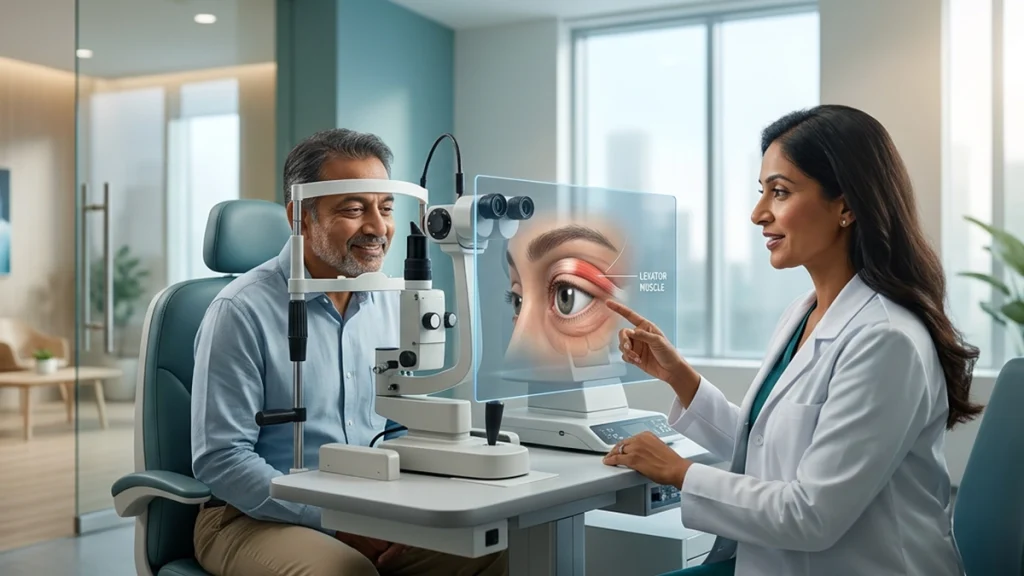
Ptosis is the term used for the upper eyelid which has descended below its normal position. It may affect one eye or both and may be present at birth or develop later. The droop may stay the same, grow worse over time, or fluctuate during the day. MedlinePlus reports that eyelid drooping may be constant, may progress, or may improve and that outcome depends on the cause. is raised mainly by the levator muscle and its supporting structure. With age this structure may weaken which leads to ptosis, in congenital ptosis we see poor muscle development. Nerve disorders, trauma, swelling, an eyelid growth, or prior eye surgery may also cause drooping. As causes differ, Ptosis Treatment must begin with an accurate diagnosis.
Understanding Ptosis Symptoms
Besides a low upper eyelid, Ptosis Symptoms may include heaviness, reduced vision above eye level, forehead strain, eyebrow lifting, or a backward chin tilt. Some people first notice that one eye looks smaller or that reading feels more tiring.
In children, Ptosis Symptoms can include an unusual head posture, frequent brow raising, strabismus, reduced attention to one eye, or unequal visual acuity. Severe childhood ptosis may interfere with normal visual development and cause what is known as lazy eye. MedlinePlus reports that in serious cases surgery may be required urgently to protect vision, if not it may be pushed back when vision is not affected. seek Prompt medical attention for Ptosis which may be associated with double vision, different size pupils, acute headache, facial weakness, eye pain or inability to move the eye. In Northern Ireland\’s health care system they advise that assessment of the child be done as soon as ptosis changes quickly over days or weeks. do I need treatment?
No. A very mild, stable ptosis that does not affect the pupil, narrow the field of vision, or produce discomfort may not require Ptosis treatment. The ophthalmologist may suggest watchful waiting and regular follow up, especially when the issue has been present for some time and a serious cause is ruled out.
Observation includes tracking of lid position, vision, eye movement, and muscle strength. In children we do see variable visual development even when the lid appears stable which is why they require very close follow up. That which once was determined to be a Droopy Eyelid Treatment may in fact require treatment at a later date.
Sometimes a person appears to have ptosis when the actual issue is excess upper-lid skin, eyebrow descent, swelling, or a difference in eye position. Accurate diagnosis keeps Droopy Eyelid Treatment appropriate. A complete examination helps prevent unnecessary Droopy Eyelid Treatment and ensures that the real condition is addressed.
When Is Ptosis Treatment Recommended?
Ptosis Treatment is commonly advised when the eyelid drops over the pupil, limits the upper visual field, or causes issues with daily tasks like reading, driving, using a computer, or safe walking. Also we may see recommendations for it when a person is in a constant state of raising the brow or tilting the head which in turn causes fatigue in the forehead or neck.
In a child, Ptosis Treatment may present at an earlier age if the lid is impairing the visual axis, causing astigmatism, producing unequal focus, or at risk of amblyopia. We are not just to even out the appearance of the eyelids. That is to protect vision during the years which the brain is developing its use of visual info. Moorfields NHS reports that congenitally present ptosis may prevent normal visual development which is a reason for corrective action in selected cases. also to be a factor when a stable droop brings about great personal issue. Before we perform Droopy Eyelid Treatment we go over what the results will be, that there may be some asymmetry and what safe eyelid closure looks like.
| Clinical situation | Is immediate surgery always required? | Likely approach |
| Mild, stable droop with clear vision | No | Observation and periodic eye checks |
| Eyelid affecting the visual field | Not automatically, but often considered | Functional testing and correction when appropriate |
| Sudden droop with double vision or pupil change | No surgery before diagnosis | Urgent medical or neurological evaluation |
| Childhood ptosis threatening vision | Early intervention may be necessary | Vision care and surgical planning |
| Droop caused by swelling or disease | Not usually at first | Treat or investigate the cause |
How Is Ptosis Diagnosed?
The ophthalmologist asks when the droop began, whether it changes, and whether there is double vision, injury, illness, or previous surgery. Old photographs may show whether it is new or longstanding.
The exam looks at lid position and levator function and also assesses vision, pupils, eye movements, the cornea, and tear film. Visual field testing may determine if the lid is impairing sight. Also we look at refractive error, strabismus and amblyopia in children. When Ptosis symptoms point to a nerve or muscle issue, further tests or referral to a specialist may be required.
These results present what is to be done in terms of ptosis treatment which should target the eyelid directly or some other health issue. Also they aid the surgeon in choosing a procedure that is best for the patient’s muscle strength and eye health.
Can Ptosis Be Treated Without Surgery?
These results present what is to be done in terms of ptosis treatment which should target the eyelid directly or some other health issue. Also they aid the surgeon in choosing a procedure that is best for the patient’s muscle strength and eye health.
Prescription eye drops may temporarily raise the eyelid in certain types of acquired ptosis, but they are not suitable for everyone and should only be used after an eye examination. Mild cases with normal vision may simply be monitored. This means that Ptosis Treatment does not always involve an operation.
A non surgical approach to Droopy Eyelid Treatment may include watchful waiting, treatment of surface symptoms, and management of the base illness or use of temporary supports. While exercises, massage, and over the counter cosmetic products may be used they do not in fact repair a damaged muscle or stretched tendon and therefore do not take the place of a medical evaluation.
When Is Surgery Recommended?
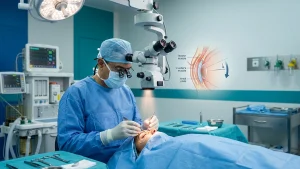
Surgery is done for structural droop which causes function loss, which threatens visual development, or is a result of a condition which does not improve with treatment. In Ptosis surgery the aim is to raise the lid while at the same time preserving blinking, eyelid closure, corneal protection, and a natural contour.
The character of Ptosis Surgery is based mostly on levator strength. A working muscle may be which we may tighten or reattach. For very poor muscle function, a frontalis sling that uses forehead movement to lift the lid may be used. At Alder Hey NHS it is reported that choice of procedure depends on the age at onset and present eyelid movement. Ptosis Surgery is also done as a day care procedure with local anaesthesia. In the case of Cambridge University Hospitals they note that local anaesthesia allows for the careful adjustment of eyelid height during surgery. some may require general anaesthesia.
| Procedure | When it may be considered | Main purpose |
| Levator advancement or repair | Good or moderate muscle function | Tightens or repositions the lifting structure |
| Levator resection | Usable muscle function | Shortens the muscle to improve elevation |
| Frontalis sling | Severe ptosis with weak muscle function | Uses forehead movement to raise the lid |
| Internal eyelid procedure | Selected mild or moderate cases | Raises the lid through an internal incision |
Recovery and Possible Risks
After Ptosis surgery you may see some swelling, bruising, tightness, watering, or blurred vision from ointment. We give out info to patients on wound care, medicines, activity, and follow up. Also may have temporary difficulty closing the eye which will require lubrication. Less commonly what is seen is the lid which remains too low or high, develops an uneven shape, or requires more work.
Before Ptosis Surgery, the doctor explains risks such as bleeding, infection, dry eye, recurrence, and possible revision so expectations remain realistic.
How Doctors Choose Between Observation and Surgery
The issue of Ptosis treatment is based on benefit and risk. A mild droop with normal vision may be seen, while a severe droop which covers the pupil may require correction. Age, cause, muscle function, health of the cornea, dry eye risk, and other eye conditions also play a role in that decision.
For adults we find that loss of vision and issue of carrying out daily tasks are what doctors report. In children what we see is if vision growth is at risk which is the issue. That the same degree of droop may be present but the treatment advice can be very different between patients. This is why Ptosis Treatment does not fit a one size fits all approach.Appropriate Droopy Eyelid Treatment is always personalised.
Refractive error, amblyopia, eye misalignment, or surface disease may also need care. Ptosis Treatment is therefore part of a complete vision plan.
When Should You Seek Urgent Care?
A slowly developing droop should be examined, but a sudden change needs prompt attention. Seek urgent medical care when new Ptosis Symptoms occur with double vision, unequal pupils, severe headache, facial or limb weakness, trouble speaking, eye pain, recent trauma, or restricted eye movement.
A drop in which you notice an improvement and then a return of the symptom during the day should also be looked at as some muscle and nerve disorders present with variable Ptosis Symptoms. Reoccurring or variable Ptosis Symptoms should not be ignored. Do not start random eye drops or cover it up with make up before you see a doctor.
Why Specialist Evaluation Matters
The most safe approach to Droopy Eyelid Treatment is to identify the cause. A specialist is able to tell apart ptosis from excess skin, brow droop, swelling, or eye position differences and to determine whether watchful waiting, medical intervention, or surgery is appropriate.
At ASG Eye Care, patients with a suspected drooping eyelid can receive a structured assessment. When Ptosis Surgery is advised, the procedure is selected according to muscle function, age, visual needs, and overall eye health. The goal of Ptosis Treatment is better function with safe closure and a balanced appearance. Asked Questions
Frequently Asked Questions
1. Can mild ptosis improve without surgery?
It may improve when temporary swelling, medication, or a treatable illness is responsible. Congenital and age-related structural ptosis are less likely to disappear by themselves. Mild cases with clear vision may only need monitoring, so Droopy Eyelid Treatment does not always mean an operation.
2. How can I tell whether ptosis is affecting my sight?
Difficulty seeing above eye level, frequent eyebrow lifting, forehead strain, or chin elevation can be clues. Eyelid measurements and visual-field testing help determine whether Ptosis Treatment is medically recommended.
3. Is surgery for ptosis only cosmetic?
No. Ptosis Surgery may be functional when the eyelid blocks sight, causes an abnormal head posture, or threatens visual development in a child. Appearance may improve too, but better eyelid function is often the main aim.
4. Is treatment different for children?
Yes. Childhood care focuses on preventing amblyopia and supporting normal visual development. Depending on the severity, Droopy Eyelid Treatment may include glasses, amblyopia therapy, monitoring, or an operation.
5. Can ptosis return after an operation?
Yes, recurrence is possible because eyelid tissues may stretch or the original condition may progress. A small number of patients require adjustment or repeat Ptosis Surgery. Follow-up remains important after Ptosis Surgery.
6. Are eye drops a permanent cure?
Eye drops which may in some cases improve lid function do not in fact treat all causes of ptosis. For best results from a Ptosis Treatment a consultation is necessary.
7. What happens if childhood ptosis is not treated?
When the lid is over the eye, in some children who are left alone, we see amblyopia, strabismus, or poor head posture as a result. Immediate surgical action is not required for every case but in those with progressive Ptosis symptoms you will need to come back in for a reevaluation.
8. Which doctor should assess ptosis?
An ophthalmologist, preferably one experienced in oculoplasty or eyelid disorders, can evaluate the cause and discuss Droopy Eyelid Treatment. Early assessment is especially important for children and for adults with sudden Ptosis Symptoms.