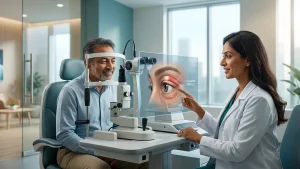
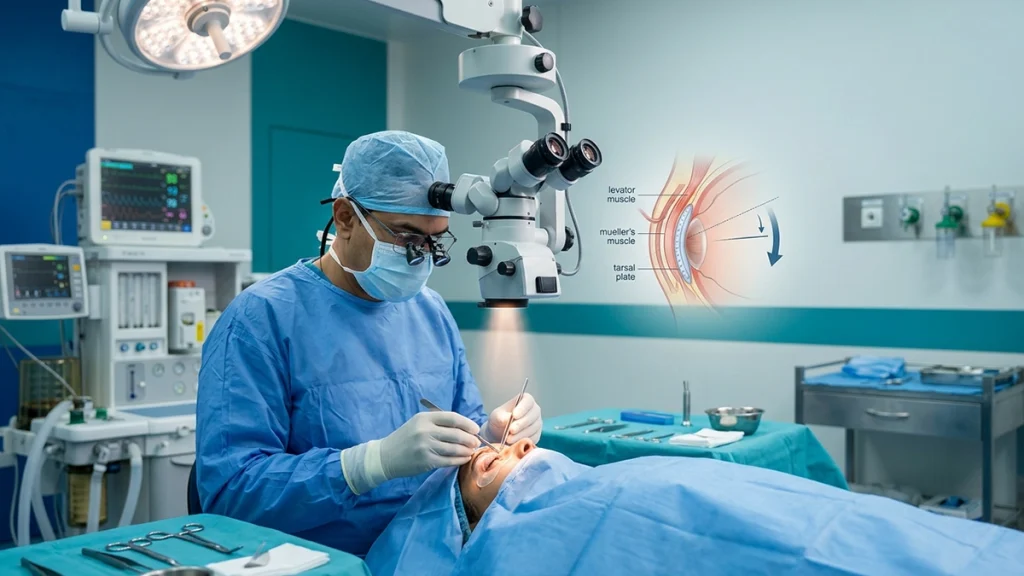
A droopy upper eyelid may present as a small cosmetic issue but also has the ability to block out part of what you see, cause strain in the forehead or make the eyes feel very tired. For Ptosis Surgery which is the correction of that which is dropped we raise the lid which is abnormally low and reposition it in relation to the pupil. Also based on what is causing it and the degree of the issue, treatment may include options which will improve clarity of vision, better lid balance and a more natural looking face.
People use Droopy Eyelid Surgery as a catch all term for eyelid correction. But what we do in true ptosis repair is we focus on the muscle, tendon or supportive structure that lifts the upper lid. It is not to say that it is the same as blepharoplasty which mostly does away with excess skin or fat. This guide goes through the what to expect in terms of assessment, procedure, Ptosis Recovery, what you can expect out of it and the main Ptosis Surgery Benefits in simple easy to understand language.
What Is Ptosis?
Ptosis, also called blepharoptosis, means that one or both upper eyelids sit lower than normal. It may be present from birth or develop later in life. Severe ptosis can cover the pupil and affect vision.
The levator muscle and its tendon-like extension lifts most of the upper eyelid. Also we have the small structure of Muller’s muscle which also plays a role. With age we see stretching of the tissue, weak muscle growth, nerve issues, injury, prior eye surgery or weight in the lid which can disrupt this system. As the causes vary, Ptosis Surgery must be planned for the individual instead of a one size fits all approach.
When Is Surgery Considered?
An ophthalmologist may put forth that Ptosis Surgery be done when the eyelid interferes with sight, causes a chin up posture, brings about brow fatigue or results in a large difference between the eyes. In children treatment may be required when the lid blocks the visual axis and puts at risk normal visual development. In adults age related stretching of the elevator attachment is a common issue which may present, but first into play must go the issues of neurological, muscular, traumatic and mechanical causes.
Not all cases of drooping lids require Droopy Eyelid Surgery. We see a sudden drop in eye function that goes along with double vision, unequal pupils, weakness or severe headache as a reason to seek emergency medical care. Surgery does which is to change the position of the eyelid; it does not include in its scope diagnosis or treatment of a base nerve or muscle issue.
Examination and Planning
Before the operation, the doctor asks when the drooping began, whether it changes during the day and whether there has been trauma, contact lens use or previous eye treatment. The examination may include vision, pupil response, eye movements, tear-film health, eyelid closure, lid height and the strength of the levator muscle.
These measurements which we take out are for the surgeon to determine what technique to use and how high the lid can go safely. Photographs or visual-field testing may also be advised. Safe Droopy Eyelid Surgery should improve opening without preventing protective closure.
Types of Ptosis Surgery
There is no single procedure for every patient. The approach depends on elevator strength, severity, age, cause and eyelid anatomy.
| Technique | What the Surgeon Does | When It May Be Considered | Key Point |
| Levator advancement or resection | Tightens, advances or shortens the main lifting structure | Often used when levator function is fair or good | Eyelid height can be adjusted carefully |
| Müller’s muscle–conjunctival procedure | Shortens tissue from the inner side of the eyelid | Selected mild cases with a favourable clinical response | Usually avoids an external skin incision |
| Frontalis sling | Connects the eyelid to the forehead muscle with sling material | Poor levator function, including some congenital cases | The forehead helps lift the eyelid |
| Combined repair and blepharoplasty | Corrects true ptosis and removes selected excess skin | When both problems are present | Each problem must be measured separately |
Levator advancement is frequently used for age-related ptosis. Through an incision hidden in the eyelid crease, the surgeon identifies and advances the elevator attachment. Selected patients may have correction from the inner surface of the eyelid. When the elevator is very weak, a frontalis sling allows forehead movement to assist eyelid opening. AIIMS also lists conjunctival-route ptosis correction among the oculoplastic techniques used by its specialist service.
What Happens During the Procedure?
In adults the procedure is a day care under local anesthetic which at times includes sedation. Being awake allows the surgeon to ask the patient to look up, open or close the eyes which in turn allows assessment of lid height and contour. In children general anesthetic is the usual requirement.
After prepping and marking the eyelid we’ll go to the designated correction area which we then adjust and check the lid position. A small incision is done within the natural fold of the eye and is closed up with very fine sutures. Droopy eyelid surgery can also take more time for when both eyes are treated at once, if another procedure is added in, or due to pre-existing scar tissue which makes the anatomy more complex. Also many patients go home the same day but we ask that they make alternate transportation arrangements in advance and follow up on all of our post op instructions.
Ptosis Recovery Timeline
Early Ptosis Recovery commonly includes swelling, bruising, mild pain, tearing and temporary blurred vision from the anesthetic. Swelling may in fact increase in the first few days which is normal before it begins to go down. Bruising usually subsides within one to three weeks but at the same time lid height and shape may still be changing for several weeks.
| Recovery Stage | What May Be Noticed | Main Care Focus |
| First 24–72 hours | Swelling, bruising, watering and mild discomfort | Use prescribed medicine, protect the wound and keep the head elevated |
| First 1–2 weeks | Bruising starts fading; sutures may be reviewed or removed | Attend follow-up visits and avoid rubbing, heavy lifting and dusty areas |
| Weeks 3–6 | Eyelid position becomes easier to assess as swelling reduces | Resume activities gradually and continue lubrication if advised |
| Following months | The scar, crease and contour continue to soften | The final result is reviewed after healing stabilises |
During Ptosis recovery cold compresses and elevation of the head may be recommended. Do not rub the eye, swim, wear eye make up or perform strenuous activity until the surgeon says it is ok.
Some people may notice the first eye to not fully close at times which is more apparent during sleep. We may also prescribe lubricating drops or ointments for protection of the eye. In case of severe or increasing pain, sudden loss of vision, rapid increase in swelling, active bleed, pus discharge or increasing redness please get back in touch with your surgical team. NHS also reports that bruising and swelling is very common and there is a very rare case of deep bleeds that may affect vision.
Expected Results
The aim of treatment is to bring the upper lid to a better, more useful position while at the same time we work on the natural curve and at protecting the eye. We see that many of the patients report improved upper vision once the swelling has gone down. Also the eyes may look more balanced which is great, although we can not guarantee perfect symmetry.
During Ptosis Recovery,the eyelid may appear at times to be very high, very low or uneven. At early stages this may be a misrepresentation. The surgeon will evaluate progress at the follow up visits and typically will wait for the swelling and the tissues to settle before determining the final result.
The main Ptosis Surgery Benefits may include improved upper field vision, reduced need to raise the eyebrows, less forehead strain and better eyelid balance. In a child with severe congenital ptosis in which timing is of the essence for visual development the timely correction may also help keep the pupil clear. The outcome is a function of the cause, muscle health, state of the cornea, history of prior procedures and the degree of drooping.
Functional and Appearance-Related Benefits
For a person with ptosis which is due to the lid covering the pupil at least partially we see that one great Ptosis Surgery Benefits is improved access to the upper field of vision. Reading signs, walking under overhead structures or looking up may report that it is more comfortable. Also a patient who is a chronic browburger which is someone that repeatedly contracts the brow muscles to lift the lids may see a reduction in brow pain post treatment.
Other Ptosis Surgery Benefits may include a more open and balanced look of the eyes. This is also to reduce the look of tiredness which a low lid may cause. At the same time the surgeon has to preserve normal eye closure. It is a risk to raise the eyelid too far which in turn may expose the cornea, so a safe outcome may not always produce exactly even results.
Possible Risks and Limitations
Possible surgical risks include bruising, swelling, infection, bleeding, dryness, a gritty feeling, visible scarring, temporary difficulty closing the eye and an irregular eyelid contour. The eyelid may remain too low, sit too high or droop again later. Revision surgery is sometimes required.
A full pre op discussion for Droopy Eyelid Surgery we will go over under-correction, over-correction, asymmetry and the rare chance of vision threatening bleeding. Also results may be affected by poor tear production, facial nerve weakness, thyroid eye disease, muscle disorders and past scarring.
These factors can change both the surgical plan and Ptosis Recovery. MedlinePlus and NHS patient information also list dryness, incomplete eyelid closure, uneven eyelids, infection and rare visual complications among the possible risks.
Ptosis Treatment in Children and Adults
Congenital ptosis does in fact require special care as a low lid may cause amblyopia, astigmatism or abnormal head posture. In a child Ptosis Surgery timing is based out whether sight is at risk, the degree of drooping and the function of the levator muscle. Some kids require early intervention while for others we may choose to do a close follow up with pediatrics ophthalmology and oculoplasty specialists.
Adults usually see ptosis related to aging when the levator’s attachment weakens or breaks. Also at play may be past eye issues, daily contact lens wear, injury and neuromuscular diseases. In all age groups Droopy Eyelid Surgery should be a result of an in depth evaluation of a cause rather than a cosmetic choice.
Why Specialist Care Matters
The eyelid must open sufficiently for useful vision but close enough to protect the eye. For success in treatment we see that there is an accurate diagnosis, precise measurement and choice of proper technique. An oculoplasty trained ophthalmologist looks at eyelid position as well as the tear film, cornea, visual function and also any neurological or muscle related issues.
At ASG Eye Hospital we see patients with droopy eyelids in which we evaluate to determine if their condition is best treated by watchful waiting, medical management of an underlying issue or by Droopy Eyelid Surgery. Suitability for Droopy Eyelid Surgery depends on the diagnosis, eyelid measurements and eye-surface health. The consultation is also the right time to discuss realistic Ptosis Surgery Benefits, likely scarring, anaesthesia, aftercare and the possibility of further adjustment.
Frequently Asked Questions
1. Is ptosis surgery painful?
During the course of the procedure anesthesia is used to minimize pain. Post procedure there may be mild tenderness, tightness or irritation which is usually treated with the medications that the surgeon has prescribed. If you are experiencing severe or increasing pain you should report it right away.
2. How long does ptosis recovery take?
Visible swelling and bruising usually improves in the first 1 to 3 weeks, but Ptosis recovery goes beyond that. Eyelid contour, crease and final height may take weeks or months to stabilize.
3. Will both eyelids look exactly equal?
The purpose of Droopy Eyelid Surgery is to achieve a healthy, safe and natural eyelid position. Symmetry is improved in many cases, although we cannot promise exact equality which is due to pre-existing differences, swelling, muscle function and healing which play a role in the result.
4. Can ptosis return after surgery?
Yes. The eyelid may also slowly drop due to age, tissue stretch, scarring or progress of the original condition. Results of Ptosis Surgery Benefits may last for years but are not a life time fix for all patients.
5. Is ptosis correction the same as blepharoplasty?
No. Ptosis surgery works on the eyelid lifting mechanism, at the same time blepharoplasty is to remove or reposition excess skin and fat. Some patients have both issues and may be put forward with a combined procedure.
6. When can I return to work?
This is individual by individual. Many people wait until bruising and swelling has gone down a bit, also in very dusty or physical jobs a longer break is required. Advice is personal to Ptosis Recovery, vision and work duties.
7. What improvements can treatment provide?
The possible Ptosis Surgery Benefits include a clearer upper visual field, reduced brow strain, a more natural eyelid height and better balance between the eyes. These Ptosis Surgery Benefits should always be discussed in relation to the diagnosis.
8. When does a drooping eyelid need urgent attention?
A sudden drooping eyelid accompanied by double vision, unequal pupils, a severe headache, facial weakness or limb weakness requires urgent medical assessment. In that situation, finding the underlying cause comes before planning Droopy Eyelid Surgery.